
Revenue growth vs profit growth explores the difference between scaling sales and building financial strength, and how each shapes business decisions over time. The article breaks down what both metrics mean and how they differ. It also explains how modern businesses are shifting toward balancing both, focusing on sustainable growth rather than expansion at any cost.
Fast growth can be addictive. Bigger numbers signal momentum, attract attention, and create the sense that everything is moving in the right direction. But not all growth strengthens a business. Sometimes it stretches it.
Some companies win customers and dominate conversations. Yet, they struggle to hold onto them. Others move more quietly, but build something far more durable beneath the surface. The difference is in how growth is being driven and what it is actually leaving behind.
Looking at revenue growth vs profit growth forces that difference into the open. It shifts the focus from how much is coming in to what is truly being built, and whether that growth is creating stability or just speed.
Revenue growth vs Profit growth: understanding both
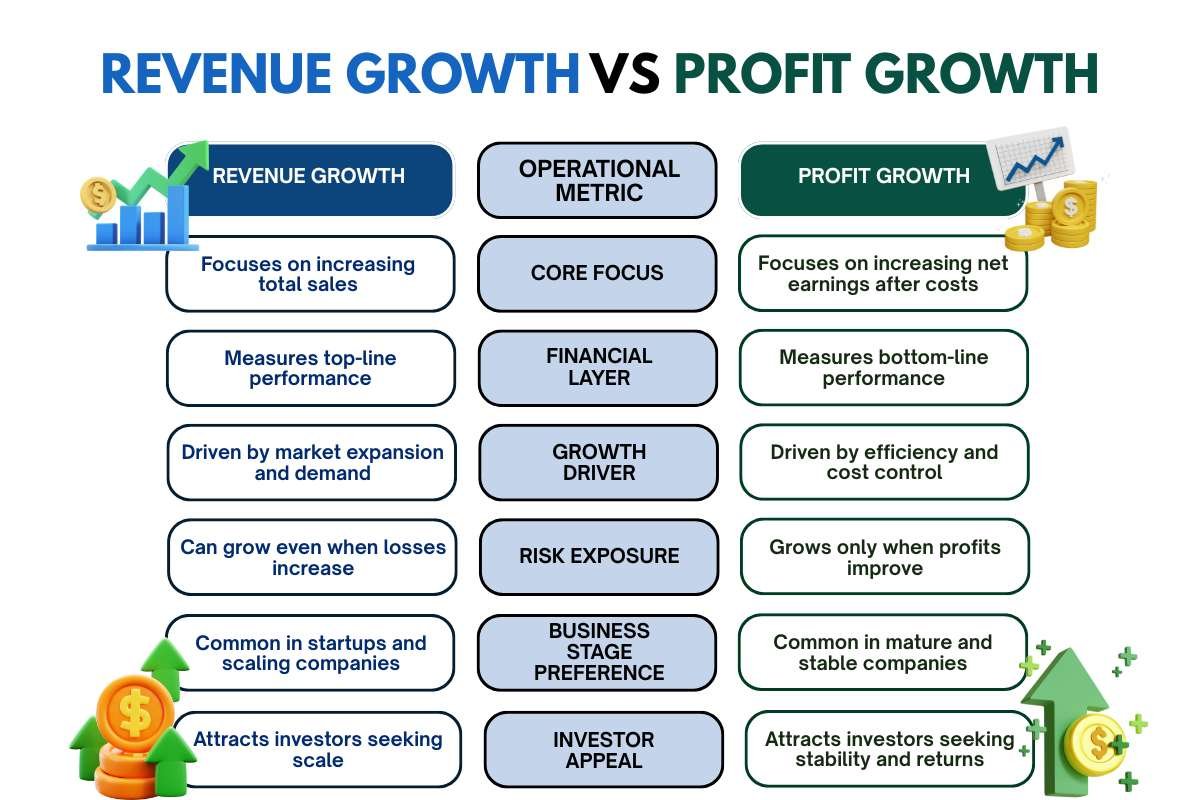
Businesses often track growth, but not all growth means the same thing. Some focus on how fast sales increase. Others focus on how much money remains after costs. These two views shape how companies make decisions and measure success. To understand this clearly, we need to break them down one by one.
What is revenue growth?
Revenue growth shows how fast a company increases its total sales. It tracks the top line, not what the company keeps. A business can grow revenue by selling more units, raising prices, or entering new markets.
This metric focuses on expansion. It reflects demand, reach, and market traction. Startups and scaling companies often push revenue growth to capture market share quickly.
Revenue growth does not account for costs. A company can report high revenue growth and still lose money if expenses rise faster than sales. This is why revenue alone cannot show financial health.
Revenue growth is the percentage increase in total sales of a company over a specific period.
What is profit growth?
Profit growth shows how much a company increases its earnings after all costs. It tracks what the business keeps after paying for operations, salaries, and other expenses.
This metric focuses on efficiency. It reflects how well a company controls costs and maintains margins. Mature companies often prioritize profit growth to strengthen financial stability.
Profit growth does not always mean expansion. A company can grow profit without increasing sales by cutting costs or improving processes. This can improve margins but may limit long-term scale.
Profit growth is the percentage increase in a company’s net earnings over a specific period.
What are the key differences between revenue growth vs profit growth?
Revenue growth and profit growth may look similar at first glance, but they guide very different decisions. One pushes expansion. The other demands discipline. Understanding where they differ helps leaders avoid costly trade-offs.
| Revenue Growth | Difference | Profit Growth |
| Focuses on increasing total sales | Core Focus | Focuses on increasing net earnings after costs |
| Measures top-line performance | Financial Layer | Measures bottom-line performance |
| Driven by market expansion and demand | Growth Driver | Driven by efficiency and cost control |
| Can grow even when losses increase | Risk Exposure | Grows only when profits improve |
| Common in startups and scaling companies | Business Stage Preference | Common in mature and stable companies |
| Attracts investors seeking scale | Investor Appeal | Attracts investors seeking stability and returns |
1. Core focus
Revenue growth centers on expansion. Companies aim to sell more, reach new customers, and increase market share. This often leads to aggressive strategies such as heavy marketing spend or price cuts.
Profit growth centers on earnings. Companies aim to keep more money from each sale. This leads to tighter cost control, better pricing discipline, and careful resource use. The difference influences how companies operate. One pushes outward. The other pulls inward to improve efficiency.
2. Financial layer
Revenue growth sits at the top line. It shows total income before expenses. This makes it a strong signal of demand but a weak signal of financial health.
Profit growth sits at the bottom line. It shows what remains after all costs. This makes it a direct measure of sustainability and financial strength. A company can show strong revenue growth while hiding weak profitability. Profit growth exposes this gap clearly.
3. Growth driver
Revenue growth depends on external factors. Market demand, customer acquisition, and pricing power drive it. Companies often invest heavily to push these drivers.
Profit growth depends on internal control. Cost management, process efficiency, and margin improvement drive it. Companies focus on optimizing operations rather than expanding rapidly. This difference affects how resources are allocated. One spends to grow. The other refines to earn.
4. Risk exposure
Revenue growth can hide risk. A company may scale fast but burn cash at the same time. Rising costs, discounts, or inefficient operations can reduce profits even when sales increase. Profit growth reduces risk. It requires that earnings improve after costs. This forces companies to maintain discipline and avoid waste.
A business that ignores profit may face cash flow problems even with strong revenue numbers.
5. Business stage preference
Early-stage companies often prioritize revenue growth. They aim to capture market share quickly and build a customer base before competitors.
Mature companies shift focus to profit growth. They aim to stabilize operations and generate consistent returns. The stage of the business often decides which metric takes priority.
6. Investor appeal
Revenue growth attracts investors who seek scale. They look for companies that can dominate markets and grow quickly.
Profit growth attracts investors who seek returns. They value consistent earnings and financial stability. Different investor types favor different growth signals. They guide how companies present their performance.
Revenue growth vs Profit growth: which should companies focus on?

There is no single right answer. The focus depends on the stage of the business, the market, and the goal the company wants to achieve. Revenue growth and profit growth are not rivals. They work best when used at the right time.
Early-stage companies often lean toward revenue growth. They need visibility, customers, and market share. At this stage, speed matters more than efficiency. Founders may spend heavily on marketing, hiring, and product expansion. This can reduce short-term profit, but it helps the business build a strong position.
Growth stage companies start balancing both. Revenue still matters, but costs begin to come under closer control. Leaders look at unit economics, customer acquisition cost, and lifetime value. They aim to grow without losing too much money. This stage tests whether the business model can scale.
Mature companies shift focus toward profit growth. They already have customers and brand presence. Now they aim to improve margins and generate stable returns. They cut waste, refine pricing, and improve operations. Profit becomes a key signal of long-term strength.
A strong company does not choose one forever. It moves between the two based on need. It may push revenue during expansion and switch to profit during consolidation. This balance helps the business grow while staying financially stable.
In the end, the focus should match the goal. If the aim is scale, revenue growth leads. If the aim is sustainability, profit growth takes priority. The best companies know when to shift from one to the other.
Revenue growth vs Profit growth: what is trending in 2026

Companies in 2026 are changing how they approach revenue growth vs profit growth. Many are moving away from pure revenue focus and paying closer attention to profit. Global GDP growth is projected to ease to 2.9% in 2026 before edging up to 3.0% in 2027. Rising costs, tighter funding, and market uncertainty are forcing this shift. Businesses now look beyond sales numbers and focus more on margins and cash flow.
At the same time, revenue growth has not lost importance. Companies still need demand and market presence. But they are no longer chasing growth at any cost. Leaders now question how much it costs to acquire customers and how long it takes to recover that cost. This shift shows a stronger focus on unit economics and sustainable scaling.
The trend is clear. Companies want both growth and control. They push revenue to expand, but they protect profit to survive. This balanced approach is shaping how modern businesses plan, invest, and grow.
Conclusion:
Growth can tell two very different stories at the same time. One shows momentum, noise, and outward success. The other reveals control, discipline, and how well the business actually holds together when pressure builds. Ignoring that difference is where strong-looking companies start to crack.
Revenue growth vs profit growth is a reality check. It forces you to ask whether the business is expanding with intent or simply expanding because it can. The real edge comes from knowing when to chase volume and when to protect margins, without letting one quietly weaken the other over time.
People also ask
1. Why do investors sometimes prefer revenue growth over profit?
In early stages, revenue signals demand and market fit. Investors often back growth first, expecting profits to follow once scale is achieved.
2. Can focusing too much on profit slow down a business?
Yes, it can limit expansion. Cutting costs too early may reduce innovation, hiring, or market reach, thereby slowing long-term growth.
3. How can a business balance revenue growth vs profit growth?
It comes down to control, not compromise. A business needs to grow revenue with intent, not just speed, while keeping a close watch on costs that scale alongside it.