
Tax planning for retirement is essential for protecting long-term savings and reducing unnecessary tax burdens. This guide explains how retirement income is taxed, highlights hidden tax traps, and explores smart withdrawal strategies, Roth conversions, and annual tax review practices. Readers will also learn common retirement tax mistakes to avoid and practical ways to preserve wealth, improve financial flexibility, and make retirement income last longer.
Retirement is supposed to be the phase where decades of hard work finally pay off. But for many retirees, taxes quietly become one of the biggest threats to their savings. A large retirement corpus does not automatically guarantee financial security because what truly matters is how much money remains after taxes.
Many people are surprised to learn that retirement income from 401(k)s, pensions, Social Security benefits, investments, and even withdrawals can all trigger different tax consequences. One poorly timed withdrawal can push retirees into a higher tax bracket, increase Medicare premiums, or create unnecessary tax liabilities that compound over time.
That is why smart tax planning for retirement is no longer optional; it is essential. A strategic retirement tax plan can help reduce lifetime taxes, preserve wealth, and make retirement income last longer. From understanding how retirement income is taxed to creating the right withdrawal strategy, even small decisions can have a major long-term financial impact.
In this guide, readers will discover the key phases of retirement tax planning, hidden tax traps most people miss, tax-efficient withdrawal strategies, common mistakes to avoid, and practical yearly review tips that can help build a more financially secure retirement.
Understanding taxation on retirement income
Retirement taxes are often more complicated than people expect. Unlike a regular salary, retirement income usually comes from multiple sources, and each one is taxed differently. Without proper planning, retirees can unknowingly move into higher tax brackets and reduce their long-term savings faster.
- Traditional Retirement Accounts: Withdrawals from traditional 401(k)s and IRAs are generally taxed as ordinary income. Large withdrawals can increase annual tax liability and even raise Medicare premiums.
- Roth Accounts: Qualified withdrawals from Roth IRAs and Roth 401(k)s are usually tax-free, making them valuable for reducing taxable income during retirement.
- Social Security Benefits: Many retirees are surprised to learn that Social Security benefits can become taxable depending on total annual income. In some cases, up to 85% of benefits may be taxed.
- Investment Income: Capital gains and dividend income often receive lower tax rates than ordinary income, but poorly timed asset sales can still increase overall taxes.
Why Tax Diversification Matters
A mix of taxable, tax-deferred, and tax-free accounts gives retirees greater flexibility to manage withdrawals efficiently and reduce lifetime taxes.
Understanding how retirement income is taxed is the first step toward building a smarter and more tax-efficient retirement strategy.
The 4 phases of tax planning for retirement
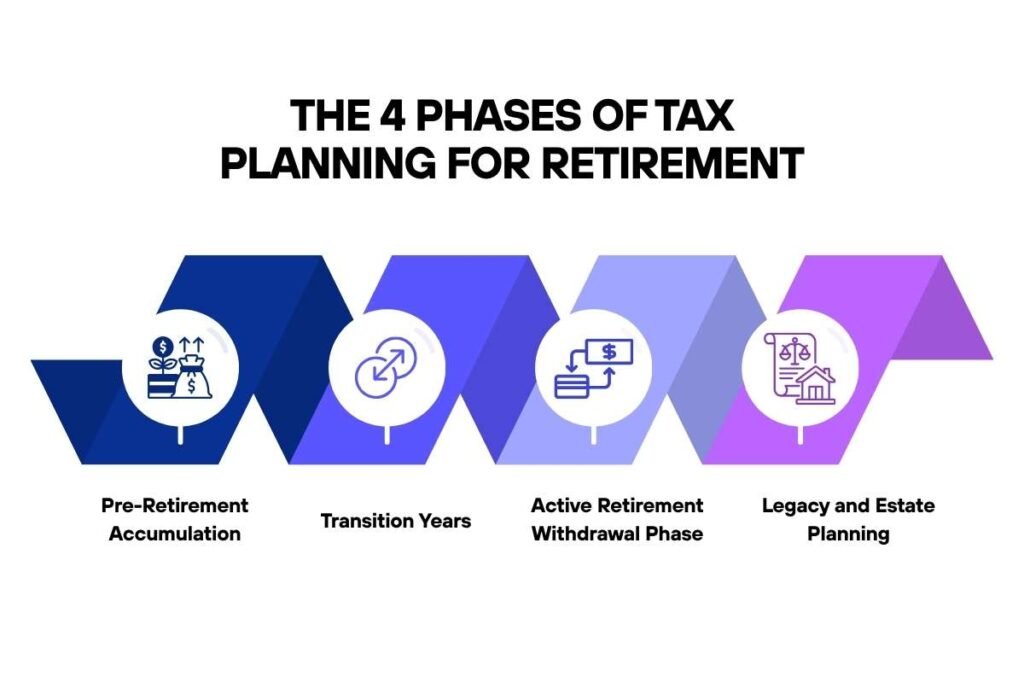
Effective tax planning for retirement is not a one-time task. It is a long-term strategy that changes across different stages of life. Each phase creates new opportunities to reduce taxes, protect savings, and improve retirement income efficiency.
According to financial planning studies, retirees who actively manage withdrawals, Roth conversions, and tax brackets can potentially save thousands of dollars in lifetime taxes compared to passive withdrawal strategies.
Phase 1: Pre-retirement accumulation
| Primary Goal | Build retirement wealth |
| Key Tax Strategy | Maximize 401(k), IRA, and HSA contributions |
| Potential Benefit | Lower taxable income during earning years |
This stage focuses on maximizing tax-advantaged savings accounts and reducing taxable income during peak earning years. Higher contributions to retirement accounts can also increase long-term compounding potential.
Phase 2: Transition years
| Primary Goal | Prepare for retirement income |
| Key Tax Strategy | Roth conversions and strategic withdrawals |
| Potential Benefit | Reduce future RMD tax burden |
The years just before retirement are often considered one of the best windows for proactive tax planning. Many retirees use this phase for Roth conversions and controlled withdrawals before Required Minimum Distributions (RMDs) begin.
Phase 3: Active retirement withdrawal phase
| Primary Goal | Manage retirement cash flow |
| Key Tax Strategy | Tax-efficient withdrawal sequencing |
| Potential Benefit | Minimize lifetime taxes |
Once retirement begins, the withdrawal strategy becomes critical. Poorly planned withdrawals can increase taxes, Medicare premiums, and taxation on Social Security benefits.
Phase 4: legacy and estate planning
| Primary Goal | Preserve wealth for heirs |
| Key Tax Strategy | Beneficiary and estate tax planning |
| Potential Benefit | Improve wealth transfer efficiency |
This phase focuses on transferring wealth efficiently. Proper beneficiary structures and estate planning strategies can help reduce future tax burdens on heirs.
A structured approach across all four phases can significantly improve long-term retirement efficiency and help retirees keep more of their savings over time.
Retirement withdrawal strategies that can reduce lifetime taxes
How retirees withdraw money can be just as important as how they saved it. A poorly planned withdrawal strategy can push retirees into higher tax brackets, increase Medicare costs, and trigger additional taxes on Social Security benefits.
Studies from retirement planning firms have shown that tax-efficient withdrawal sequencing can potentially extend portfolio longevity and reduce lifetime tax liability significantly. This highlights the importance of tax planning for retirement in managing long-term income efficiently.
The Common Withdrawal Order
Many financial planners follow a structured withdrawal sequence to improve tax efficiency:
| Withdrawal Source | Typical Tax Impact | Why It Is Used |
| Taxable Accounts | Lower capital gains tax rates | Allows tax-deferred accounts to keep growing |
| Traditional 401(k)/IRA | Taxed as ordinary income | Managed gradually to avoid higher tax brackets |
| Roth Accounts | Generally tax-free withdrawals | Preserved for later years or emergencies |
Why Withdrawal Timing Matters
Large withdrawals in a single year can create multiple financial consequences, including:
- Higher income tax rates
- Increased Medicare IRMAA surcharges
- Higher taxation on Social Security benefits
- Faster depletion of retirement savings
Roth Conversion Strategy
Many retirees strategically convert portions of traditional retirement accounts into Roth accounts during lower-income years. While taxes are paid upfront on the converted amount, future qualified withdrawals may become tax-free.
Coordinating Income Sources
Smart retirement tax planning often involves balancing:
- Retirement account withdrawals
- Investment income
- Social Security timing
- Healthcare-related tax thresholds
The goal is not simply to reduce taxes in one year, but to minimize total lifetime taxes while preserving long-term retirement income.
Hidden retirement tax traps most people miss

Many retirees focus on saving for retirement but overlook the hidden tax traps that can quietly reduce their wealth over time. Even a single financial decision can create unexpected tax consequences that affect future retirement income.
1. Required minimum distribution (RMD) penalties
Once retirees reach the required age for RMDs, they must begin withdrawing money from certain retirement accounts. Missing an RMD or withdrawing less than required can result in significant penalties and additional taxes.
2. Social security tax surprises
A growing number of retirees are discovering that Social Security benefits are not always tax-free. Higher combined income from investments, pensions, or retirement withdrawals can increase the taxable portion of benefits.
3. Medicare IRMAA surcharges
Higher retirement income can also increase Medicare premiums through Income-Related Monthly Adjustment Amounts (IRMAA). Large withdrawals or capital gains in a single year may trigger these additional healthcare costs.
| Common Tax Trap | Potential Impact |
| Large retirement withdrawals | Higher tax bracket |
| Missed RMDs | Penalties and extra taxes |
| High combined income | Taxable Social Security |
| Large capital gains | Increased Medicare premiums |
4. Poor beneficiary planning
Outdated beneficiary designations on retirement accounts can create unnecessary tax complications for heirs and reduce wealth transfer efficiency.
5. Ignoring tax diversification
Relying too heavily on tax-deferred accounts may increase taxable income later in retirement. A balanced mix of taxable, tax-free, and tax-deferred accounts provides greater flexibility.
Identifying these hidden retirement tax traps early can help retirees avoid costly mistakes and protect more of their long-term savings.
Common tax planning mistakes in retirement
Even financially prepared retirees can make tax mistakes that slowly reduce their savings over time. In many cases, small planning errors lead to higher taxes, larger healthcare costs, and lower long-term retirement income. Proper tax planning for retirement can help reduce these risks and improve financial stability.
1. Delaying tax planning until retirement
Many people spend decades building retirement savings but start planning for taxes only after retirement begins. According to retirement advisors, this often results in missed Roth conversion opportunities and higher Required Minimum Distributions (RMDs) later in life.
2. Overusing tax-deferred accounts
Relying too heavily on traditional 401(k)s and IRAs can create large taxable withdrawals during retirement. For example, retirees with high RMDs may unexpectedly move into higher tax brackets while also increasing Medicare premiums.
3. Ignoring social security tax rules
Many retirees assume Social Security income is completely tax-free. However, the IRS states that up to 85% of Social Security benefits can become taxable depending on combined income levels.
For instance:
- Single filers with combined income above $34,000 may face taxation on up to 85% of benefits.
- Married couples filing jointly above $44,000 may also trigger higher taxation.
4. Poor withdrawal sequencing
Large withdrawals in a single year can trigger multiple financial consequences at once:
- Higher tax brackets
- Increased Medicare IRMAA surcharges
- More taxable Social Security income
Financial studies on retirement decumulation strategies show that structured withdrawal planning can significantly improve retirement efficiency compared to fixed withdrawal methods.
| Common Mistake | Real-World Impact |
| Delayed tax planning | Higher future RMD taxes |
| Large IRA withdrawals | Increased Medicare premiums |
| Ignoring Social Security taxation | Unexpected tax bills |
| No annual tax review | Missed Roth conversion opportunities |
Not Reviewing Plans Annually
Tax laws, healthcare costs, and retirement income change regularly. Advisors increasingly recommend yearly retirement tax reviews because even small adjustments can reduce long-term tax liability.
Avoiding these common mistakes can help retirees preserve more wealth and create a more stable, tax-efficient retirement plan.
A year-by-year retirement tax review checklist

Retirement tax planning is not a one-time activity. Tax laws, retirement income, healthcare costs, and investment returns change regularly, which is why annual reviews are essential for protecting long-term wealth.
Even small adjustments, such as timing a withdrawal differently or planning a Roth conversion, can potentially save thousands of dollars over retirement.
Here are some of the most important areas retirees should review every year as part of effective tax planning for retirement:
- Review projected taxable income: Estimate total annual income to avoid moving into a higher tax bracket unnecessarily.
- Monitor Social Security taxation thresholds: Higher combined income can make up to 85% of Social Security benefits taxable.
- Check Required Minimum Distribution (RMD) obligations: Missing RMD deadlines can lead to penalties and additional tax complications.
- Evaluate Roth conversion opportunities: Lower-income years may provide ideal opportunities to shift funds into tax-free Roth accounts.
- Review investment-related taxes: Large capital gains from investments can increase overall taxable income and Medicare costs.
- Track Medicare IRMAA limits: Higher retirement income may increase Medicare Part B and Part D premiums.
- Rebalance portfolios tax-efficiently: Strategic portfolio adjustments can help reduce unnecessary capital gains taxes.
- Update estate and beneficiary plans: Outdated beneficiary information can create tax and inheritance complications for heirs.
- Review withdrawal sequencing: Coordinating withdrawals from taxable, tax-deferred, and Roth accounts can improve tax efficiency.
- Stay updated on tax law changes: Retirement tax rules and income thresholds often change, affecting future planning strategies.
Retirees who review these areas consistently are often better positioned to reduce lifetime taxes, preserve retirement savings, and maintain greater financial flexibility throughout retirement.
Real retirement tax scenarios
Retirement tax planning becomes easier to understand when viewed through real-world situations. The following examples show how different financial decisions can directly affect taxes, healthcare costs, and long-term retirement savings.
Scenario 1: The high 401(k) retiree
A retiree who spent decades maximizing a traditional 401(k) accumulated a large retirement balance. However, once Required Minimum Distributions (RMDs) began, the mandatory withdrawals significantly increased taxable income.
As a result:
- The retiree moved into a higher tax bracket
- A larger portion of Social Security became taxable
- Medicare premiums increased due to IRMAA surcharges
This situation is common among retirees who focus heavily on tax-deferred accounts without building tax diversification.
Scenario 2: The early roth conversion strategy
Another retiree retired at age 60 but delayed Social Security benefits until later years. During this lower-income window, they strategically converted portions of a traditional IRA into a Roth IRA over several years.
This helped:
- Reduce future RMD amounts
- Lower long-term taxable income
- Create tax-free withdrawal flexibility later in retirement
Financial planners often consider these transition years to be one of the best opportunities for proactive retirement tax planning.
Scenario 3: The large one-time withdrawal mistake
A retiree withdrew a large amount from a retirement account in a single year to purchase property. While the withdrawal solved a short-term financial need, it also created major tax consequences.
The large withdrawal triggered:
- Higher federal taxes
- Increased Medicare premiums
- Additional taxation on Social Security benefits
This highlights why withdrawal timing is one of the most important parts of retirement tax planning.
Scenario 4: The tax-diversified retiree
A couple maintained savings across taxable accounts, Roth accounts, and traditional retirement accounts. Instead of depending on a single income source, they adjusted withdrawals yearly based on tax brackets and healthcare thresholds.
This strategy provided:
- Better control over taxable income
- Greater flexibility during market downturns
- Lower overall lifetime tax exposure
These scenarios show that retirement taxes are not only about how much money retirees save but also about how strategically they manage withdrawals, income timing, and tax diversification throughout retirement.
Conclusion:
Retirement planning is no longer just about saving enough money; it is about keeping more of it after taxes. Without a proper strategy, taxes can quietly reduce retirement income through higher tax brackets, taxable Social Security benefits, Medicare surcharges, and inefficient withdrawals.
This is why effective Tax Planning for Retirement plays such a critical role in long-term financial security. From understanding how retirement income is taxed to managing withdrawals strategically and avoiding hidden tax traps, every financial decision in retirement can have lasting consequences.
The good news is that proactive planning can make a significant difference. Annual tax reviews, diversified retirement accounts, smart withdrawal sequencing, and timely Roth conversions can all help retirees reduce lifetime taxes and improve financial flexibility.
Retirement should provide peace of mind, not unexpected tax surprises. The earlier retirees begin planning for taxes, the better positioned they are to protect their wealth, preserve income, and build a more financially stable future.
FAQs on tax planning for retirement
1. Why is tax planning important in retirement?
Tax planning helps retirees reduce unnecessary taxes on withdrawals, Social Security benefits, investments, and healthcare-related costs. A proper strategy can preserve retirement savings and improve long-term financial stability.
2. Are Social Security benefits taxable after retirement?
Yes, Social Security benefits can become taxable depending on total annual income. In some cases, up to 85% of benefits may be subject to taxes if retirement income crosses certain thresholds.
3. What is the most tax-efficient retirement withdrawal strategy?
Many financial planners recommend withdrawing from taxable accounts first, followed by tax-deferred accounts like traditional IRAs and 401(k)s, while preserving Roth accounts for later years due to their tax-free withdrawal benefits.
4. What are required minimum distributions (RMDs)?
RMDs are mandatory withdrawals that retirees must take from certain retirement accounts after reaching a specific age. Failing to take RMDs can result in penalties and additional tax liabilities.
5. How often should retirement tax plans be reviewed?
Retirement tax plans should ideally be reviewed every year. Annual reviews help retirees adjust withdrawals, monitor tax brackets, evaluate Roth conversion opportunities, and stay updated with changing tax laws.