The Internet of Things is no longer a future-facing concept; it is the invisible infrastructure shaping how industries operate, cities breathe, and consumers interact with technology. From factories that predict failures before they occur to buildings that respond intelligently to human presence, IoT has become a foundational layer of modern digital transformation. In the United States, a new generation of startups is pushing the boundaries of what connected devices can achieve, combining sensors, software, analytics, and artificial intelligence to deliver real-world impact at scale.
This article explores some of the most compelling U.S.-based IoT startups to watch, not just for their technology but for how they are redefining efficiency, security, sustainability, and intelligence across industries.
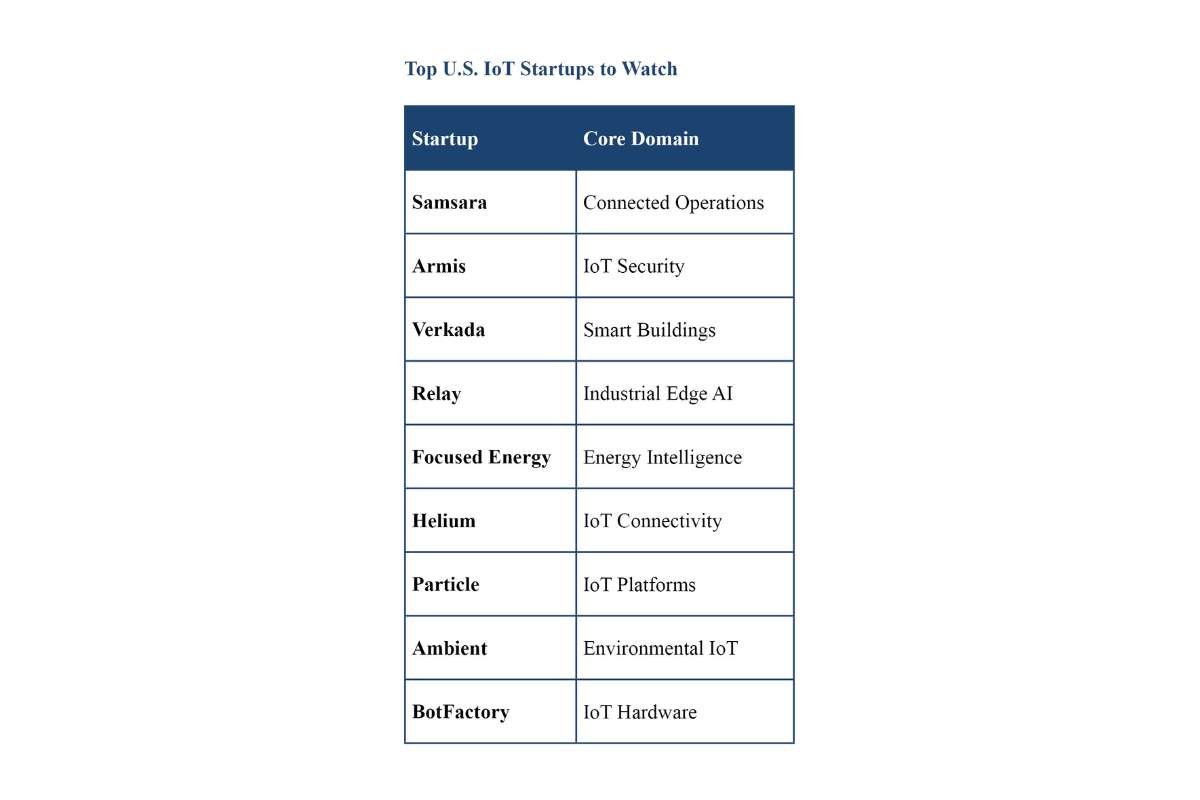
| Top U.S. IoT Startups to Watch | |
|---|---|
| Startup | Core Domain |
| Samsara | Connected Operations |
| Armis | IoT Security |
| Verkada | Smart Buildings |
| Relay | Industrial Edge AI |
| Focused Energy | Energy Intelligence |
| Helium | IoT Connectivity |
| Particle | IoT Platforms |
| Ambient | Environmental IoT |
| BotFactory | IoT Hardware |
Securing the Unseen World of Connected Devices
As enterprises deploy thousands of connected devices, a critical problem emerges: many of these endpoints are invisible to traditional IT security tools. Armis addresses this challenge by focusing on discovery first. Its agentless platform identifies every device connected to a network managed or unmanaged and continuously monitors its behavior.
What makes Armis essential in the IoT era is its ability to contextualize risk. Medical devices in hospitals, industrial sensors in factories, and smart systems in offices all have unique threat profiles. Armis provides security teams with the visibility and intelligence required to protect these environments without disrupting operations. As IoT adoption accelerates, the company is becoming a cornerstone of enterprise cyber resilience.
Rethinking Smart Building Security
Verkada operates at the intersection of physical security and cloud intelligence. Instead of fragmented systems for cameras, access control, and environmental monitoring, Verkada offers a unified, cloud-managed platform designed for modern buildings.
Its approach reflects a broader shift in IoT from passive monitoring to proactive intelligence. Security cameras do more than record; they analyze patterns. Access systems integrate seamlessly with building data. Environmental sensors track air quality and occupancy. The result is a living, responsive building ecosystem that adapts to how people move and work within spaces.
As organizations rethink offices, campuses, and public spaces, Verkada’s model of integrated, intelligent infrastructure is gaining strong momentum.
Bringing Intelligence to the Edge of Industry
Industrial IoT often faces a fundamental constraint: latency. Sending every data point to the cloud is neither practical nor efficient in environments that demand real-time responses. As a leading U.S. IoT startup, Relay addresses this challenge by enabling intelligence at the edge.
Its platform connects industrial equipment and allows machine learning models to run close to where data is generated on factory floors, in energy systems, and across logistics networks. This reduces dependency on centralized cloud processing and enables faster, more reliable insights.
Relay’s significance lies in its role as a bridge between legacy industrial systems and modern AI-driven workflows, helping enterprises transition toward Industry 4.0 without massive infrastructure overhauls.
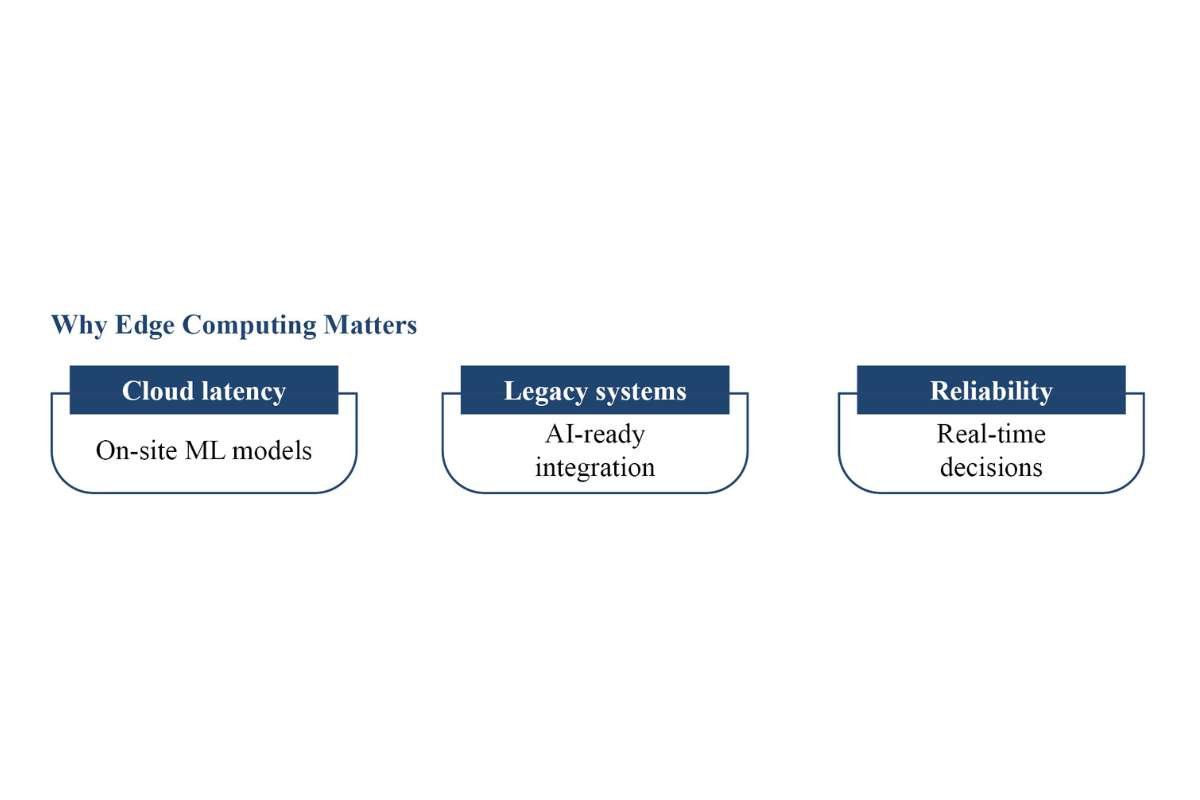
| Why Edge Computing Matters | |
|---|---|
| Challenge | Relay Solution |
| Cloud latency | On-site ML models |
| Legacy systems | AI-ready integration |
| Reliability | Real-time decisions |
When Buildings Learn from Human Behavior
Buildings have traditionally been static structures with rigid systems. Focused Energy challenges this paradigm by making buildings responsive to how spaces are actually used. Using IoT sensors and machine learning, the company analyzes occupancy patterns and dynamically adjusts systems such as HVAC and lighting.
The impact is twofold. Organizations reduce energy consumption and operational costs, while occupants benefit from more comfortable and healthier environments. In an era where sustainability and efficiency are strategic priorities, Focused Energy demonstrates how IoT can align economic and environmental goals through intelligence rather than excess infrastructure.

Helium: Redefining IoT Connectivity Through Decentralization
Connectivity is the backbone of IoT, yet traditional networks are often expensive and inefficient for low-power devices. Helium introduces a radically different model: a decentralized wireless network built and maintained by its community.
By incentivizing individuals and businesses to deploy hotspots, Helium creates a distributed infrastructure suitable for sensors that transmit small amounts of data over long distances. This model dramatically lowers connectivity costs and enables large-scale IoT deployments in sectors such as agriculture, asset tracking, and smart cities.
Helium’s approach challenges conventional telecom assumptions and highlights how network architecture itself can be reimagined for the IoT age.
Lowering the Barrier to IoT Innovation

For many innovators, the challenge is not the idea, but execution. Particle addresses this by providing an end-to-end IoT development platform that combines hardware, connectivity, and cloud software.
Engineers can prototype quickly, manage devices at scale, and deploy products without stitching together multiple vendors. Particle’s value lies in its abstraction of complexity, allowing product teams to focus on functionality and user experience rather than infrastructure.
As IoT continues to expand into new verticals, platforms like Particle play a critical role in democratizing innovation and accelerating time-to-market.
Sensing the World for Health and Safety
Ambient represents a growing category of environmental intelligence, operating as a specialized U.S. IoT startup focused on advanced monitoring. Its sensors monitor parameters such as air quality, noise, vibration, and temperature factors that directly impact health, safety, and productivity.
What distinguishes Ambient is its emphasis on actionable insights. Real-time alerts allow organizations to respond to environmental risks before they escalate. From workplaces and laboratories to urban infrastructure, Ambient’s technology reflects the increasing demand for data-driven environmental awareness in both public and private spaces.
BotFactory: Accelerating the Hardware Backbone of IoT
While much of the IoT conversation centers on software and connectivity, hardware remains fundamental. BotFactory focuses on one of the most critical components of connected devices: printed circuit boards.
By automating PCB production in compact, high-speed machines, BotFactory enables rapid prototyping and iteration. This capability shortens development cycles and reduces costs for startups and engineers building custom IoT hardware. In doing so, BotFactory indirectly fuels innovation across the entire IoT ecosystem by removing friction at the hardware level.

The Bigger Picture: Trends Defining the IoT Startup Ecosystem
Several macro trends connect the evolution of the modern U.S. IoT startup into a coherent narrative. First is the convergence of IoT and artificial intelligence, where data is no longer just collected but interpreted in real time. Second is the shift toward edge computing, driven by the need for speed and reliability. Third is the growing importance of security and sustainability as non-negotiable design principles.
Equally important is the move toward simplification, whether through unified platforms, decentralized networks, or developer-friendly tools. The most successful IoT startups are not those adding more devices, but those making complex systems easier to deploy, manage, and trust.
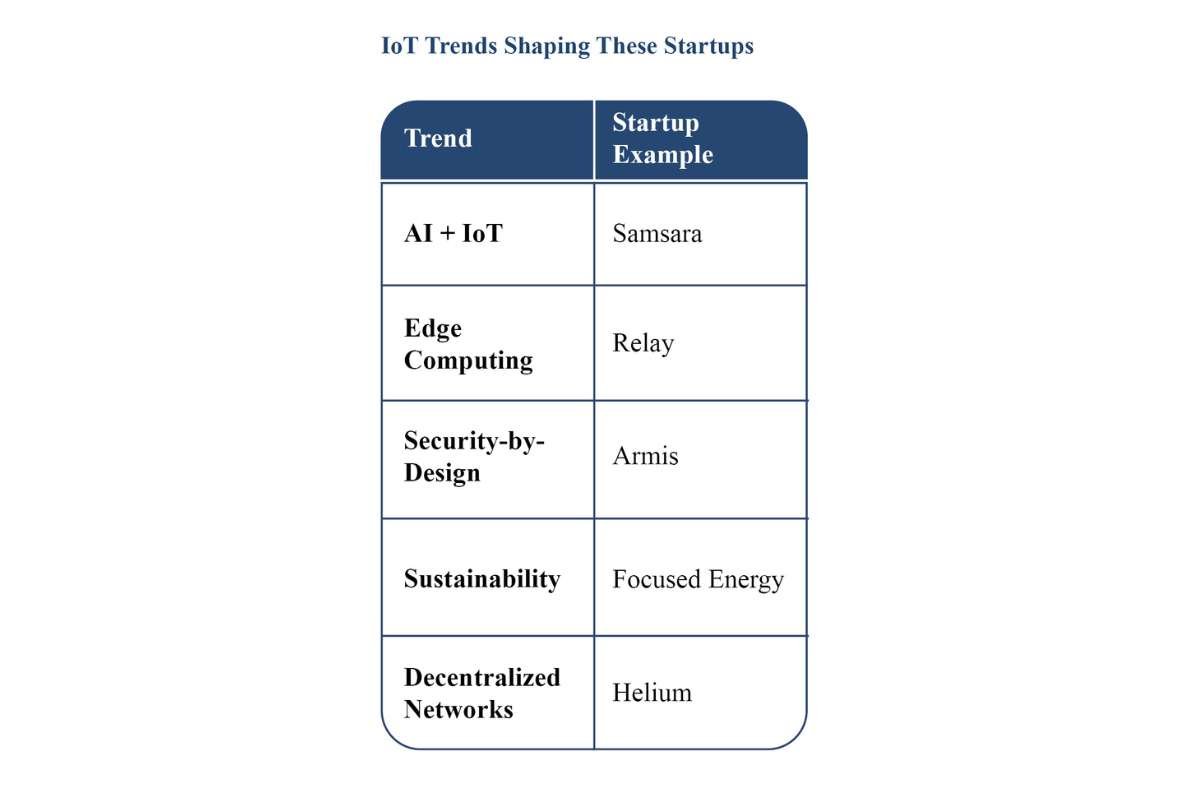
| IoT Trends Shaping These Startups | |
|---|---|
| Trend | Startup Example |
| AI + IoT | Samsara |
| Edge Computing | Relay |
| Security-by-Design | Armis |
| Sustainability | Focused Energy |
| Decentralized Networks | Helium |
Watching the Architects of a Connected Future
The U.S. IoT startup landscape is defined by depth rather than novelty. These companies are not merely experimenting with connectivity; they are building the operational, security, and intelligence layers that modern industries depend on. From factories and buildings to networks and environmental systems, IoT is becoming the silent engine of progress.
For investors, these startups represent long-term infrastructure plays. For enterprises, they offer pathways to efficiency, resilience, and sustainability. And for the broader technology ecosystem, they signal a future where intelligence is embedded seamlessly into the physical world quietly, persistently, and at scale.