
A good business strategy can look impressive on paper and still fail in practice. The difference often comes down to the people responsible for turning that strategy into action.
Leaders and managers need to understand where the business stands, where it wants to go, what could prevent progress, and how resources should be used. That requires more than technical knowledge. It requires strategic management skills.
These skills help managers connect business goals with market realities, make informed decisions, manage people, identify risks, and keep teams focused on priorities. They are particularly important when businesses face changing customer expectations, new technologies, stronger competition, economic uncertainty, or rapid industry shifts.
For businesses building a broader approach to strategy, management skills should be viewed alongside the wider principles, processes, levels, and frameworks of strategic management.
What are strategic management skills? Why do they matter?
Strategic management skills are the abilities managers use to understand business conditions, make better decisions, manage resources, lead teams, handle risks, and put business strategies into action.
In simple terms, these skills help managers decide where the business is now, where it should go, what challenges may arise, what resources are needed, and whether the strategy is working.
These skills connect planning with action. They help managers turn business goals into clear tasks, assign responsibilities, track results, and make changes when needed.
These skills connect planning with action and are closely related to the strategic management process, which helps organizations move from analysis and planning to implementation and evaluation.
Strong strategic skills help reduce the gap between business goals and daily operations. They support better decision-making, stronger leadership, efficient resource use, and faster responses to market changes.
How do strategic management skills work in real businesses?
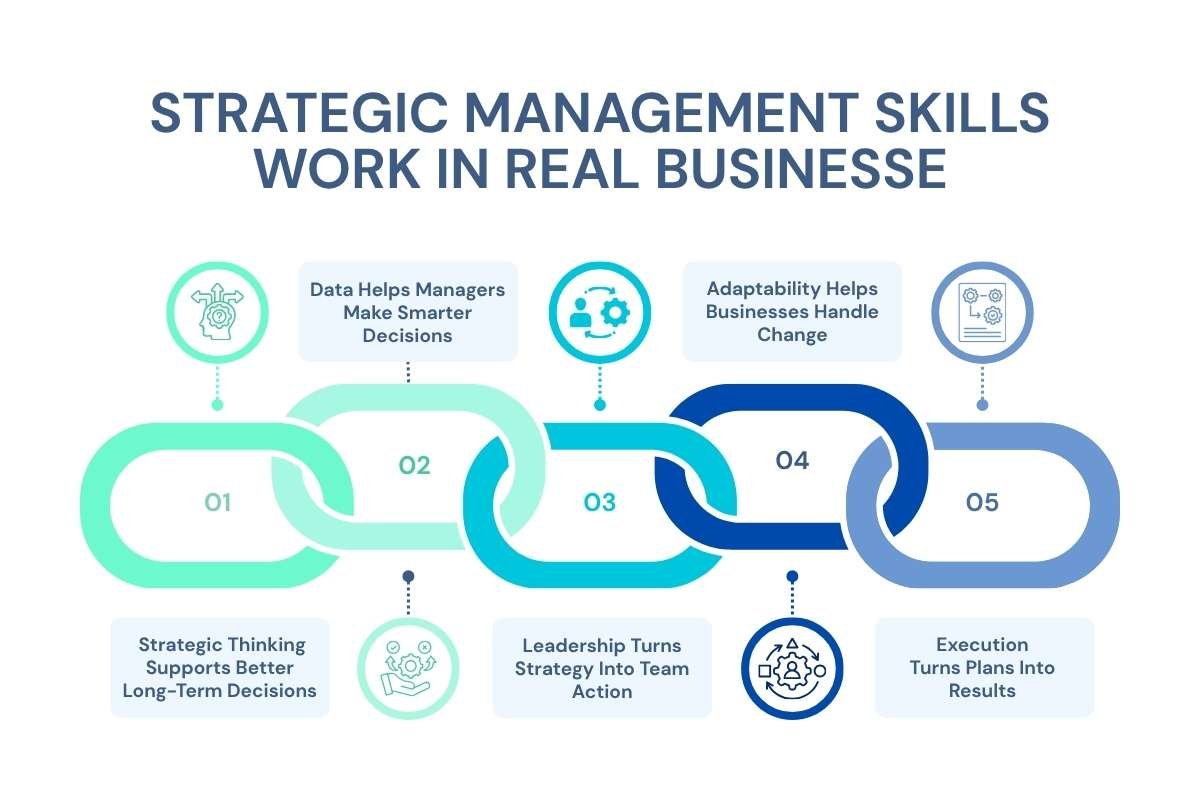
Strategic management skills help businesses make better decisions, respond to change, lead teams, and turn plans into results. Companies use these skills in different ways:
1. Strategic thinking supports better long-term decisions
Strategic thinking helps managers look beyond immediate problems. They consider customers, competitors, technology, costs, and future opportunities before making decisions.
Tools such as SWOT analysis, PESTLE analysis, and competitive analysis can support these decisions.
2. Data helps managers make smarter decisions
Managers use business data to understand what is working and where changes are needed. They may review sales, customer behavior, costs, market share, and competitor activity.
For example, before entering a new market, a company can study customer demand, competition, costs, and regulations. This helps managers balance data with business judgment.
3. Leadership turns strategy into team action
A strategy works only when employees understand their roles. Strategic leaders set clear priorities, assign responsibility, solve problems, and keep teams focused on business goals.
Toyota is a strong example. Its management approach focuses on continuous improvement (Kaizen), respect for people, teamwork, and solving problems at their source. This shows how strategic ideas can become part of everyday work.
4. Adaptability helps businesses handle change
Markets, technology, customer needs, and competition can change quickly. Strategic managers must know when to stay with a plan and when to adjust it.
Example: If customers increasingly prefer cloud-based software, a software company may assess the market, review its capabilities, estimate investment needs, and decide whether to shift toward cloud services.
5. Execution turns plans into results
Strategic management is not only about creating plans. Managers must also put those plans into action.
They can do this by:
- Setting clear goals.
- Assigning responsibility.
- Setting deadlines.
- Providing resources.
- Tracking key results.
- Reviewing progress.
- Fixing problems quickly.
This is where strategic management skills directly affect business performance.
Real-world example: Microsoft and strategic adaptation
Microsoft’s business strategy shows the importance of adapting to major technology shifts, particularly cloud computing and AI. Its investor materials highlight these areas as important parts of its business.
The key lesson is simple: businesses need to monitor market changes and align their investments, people, technology, and resources with future opportunities.
In short, strategic management skills help businesses think ahead, use evidence, lead people, adapt to change, and turn strategy into measurable results.
Core competencies every strategic manager needs

Successful managers rarely depend on one skill. They combine several competencies to make balanced decisions.
- Strategic Thinking: Strategic thinking allows managers to connect individual decisions with broader business objectives. It encourages long-term thinking without ignoring immediate operational realities.
- Analytical Thinking: Managers need to examine evidence, identify patterns, compare alternatives, and understand cause and effect. Analytical thinking helps reduce decisions based purely on assumptions.
- Decision-Making: Strategic decisions often involve uncertainty. Strong managers define the problem, evaluate alternatives, consider risks, make a decision, and remain prepared to adjust when new evidence appears.
- Leadership: Leadership helps managers translate strategy into coordinated action. It includes delegation, accountability, motivation, conflict management, and team development.
- Communication: A strategy that employees cannot understand is difficult to execute. Strategic managers need to explain priorities in clear language and adapt communication for executives, employees, customers, and other stakeholders.
- Problem-Solving: Complex business problems rarely have one obvious answer. Strategic managers break large problems into manageable parts, identify root causes, compare solutions, and test practical responses.
- Financial Understanding: Managers do not need to be accountants, but they should understand revenue, costs, profitability, cash flow, investment requirements, and return on investment. Financial awareness helps ensure that strategic ambitions remain commercially realistic.
- Risk Management: Every strategic decision carries some level of risk. Managers should identify potential threats, estimate their impact, establish mitigation measures, and prepare contingency plans.
- Change Management: Strategy frequently requires organizations to change processes, technologies, structures, or employee responsibilities. Managers must help people understand why change is necessary and how it will affect their work.
- Negotiation and Collaboration: Strategic initiatives often involve competing priorities between departments and stakeholders. Managers need to negotiate resources, build agreement, and create solutions that support the organization’s larger objectives.
| Component | What It Helps Managers Do | Practical Application |
| Strategic Thinking | See the bigger picture | Evaluate long-term opportunities |
| Analysis | Understand internal and external conditions | Study customers and competitors |
| Decision-making | Choose between alternatives | Prioritize investments |
| Leadership | Align people with goals | Build accountable teams |
| Communication | Explain strategy clearly | Connect company goals to employee responsibilities |
| Execution | Convert plans into action | Set owners, timelines, and KPIs |
| Risk management | Prepare for uncertainty | Develop contingency plans |
| Adaptability | Respond to meaningful changes | Adjust strategy when market conditions shift |
| Financial understanding | Assess commercial feasibility | Evaluate costs and returns |
| Continuous improvement | Strengthen performance over time | Review results and improve processes |
A useful way to apply them is to create a repeating management cycle:
Analyze → Decide → Align → Execute → Measure → Improve
This cycle prevents strategy from becoming a document that sits unused after the planning stage.
How can managers improve their strategic management skills?

Strategic management skills develop through practice, reflection, and exposure to real business problems.
Managers can strengthen them by:
- Studying business beyond one department. Understanding sales, finance, operations, marketing, technology, and human resources gives managers a more complete view of how decisions affect the organization.
- Use evidence before making major decisions. Ask what the data says, what assumptions are being made, and what information is still missing.
- Practice scenario planning. Consider what could happen if customer demand falls, a competitor enters the market, costs increase, or technology changes.
- Review outcomes honestly. A strategy should not be protected simply because senior leaders approved it. If results do not support the assumptions, managers should investigate and adjust.
- Develop communication skills. Strategic ideas become more valuable when teams can understand them and act on them.
- Learn from implementation. McKinsey’s implementation work highlights capability building, performance management, project management, and strategy rollout as practical parts of turning strategy into impact.
For businesses, these practices can also be integrated into leadership development, performance reviews, management training, and strategic planning meetings.
Conclusion
Strategic management skills help managers bridge the gap between business ambition and practical results. They work as part of the wider strategic management discipline, connecting strategy, leadership, decision-making, execution, and evaluation.
The strongest strategic managers also remain adaptable. They understand that a strategy should provide direction without becoming a rigid set of assumptions.
Companies such as Toyota demonstrate how strategic principles can become part of everyday organizational behavior, while companies such as Microsoft illustrate the importance of adapting investment priorities as technology and customer needs evolve.
For organizations seeking sustainable growth, developing these skills across management levels can create better decisions, stronger execution, and greater organizational resilience.
FAQs
1. What are strategic management skills?
Strategic management skills are abilities that help managers make decisions, solve problems, lead teams, and achieve long-term business goals.
2. Why are strategic management skills important?
They help businesses make better decisions, use resources wisely, manage risks, and respond effectively to market changes.
3. What are the most important strategic management skills?
Key skills include strategic thinking, decision-making, leadership, communication, problem-solving, risk management, adaptability, and execution.
4. How can managers develop strategic management skills?
Managers can build these skills through practical experience, business analysis, training, leadership responsibilities, and learning from past decisions.
5. What is the difference between strategic management skills and strategic planning?
Strategic planning defines business goals and actions, while strategic management skills help managers develop, execute, measure, and adjust those plans.
6. How do strategic management skills improve business performance?
They help managers make informed decisions, align teams, manage resources, reduce risks, and turn business strategies into measurable results.
7. Can strategic management skills be learned?
Yes. Managers can develop them through education, hands-on experience, mentoring, cross-functional work, and continuous practice.