
A startup can have a great product, talented founders, and strong funding and still struggle to grow. The problem is often not a lack of effort. It is a lack of direction.
Early-stage companies face difficult choices every day: Which customers should we target? What problem should we solve first? How much should we spend? Should we hire now or later? Should we enter a new market or strengthen the existing one?
Strategic management for startups helps answer these questions before they become expensive mistakes.
Unlike a traditional corporate strategy document that may cover several years, startup strategy needs to be practical and flexible. Founders need a clear direction while staying ready to change when customer feedback, competition, technology, or market conditions shift.
A useful strategy therefore connects four things: where the startup is today, where it wants to go, what it will prioritize, and how it will measure progress.
What is strategic management for startups?
Strategic management for startups is the continuous process of setting business direction, understanding the market, choosing priorities, allocating limited resources, measuring results, and adjusting decisions as the startup learns.
In simple terms, it answers five important questions:
- What problem are we solving?
- Who has this problem?
- Why should customers choose us?
- Where should we focus our limited resources?
- What evidence tells us whether we should continue, change, or stop?
This is different from simply writing a business plan. A business plan describes how a company expects to operate, while strategic management creates an ongoing decision-making system.
Stripe’s startup strategy guidance similarly emphasizes value proposition, business model, market positioning, agile methods, objectives and key results, and sustainable scaling.
The 5 building blocks of startup strategy
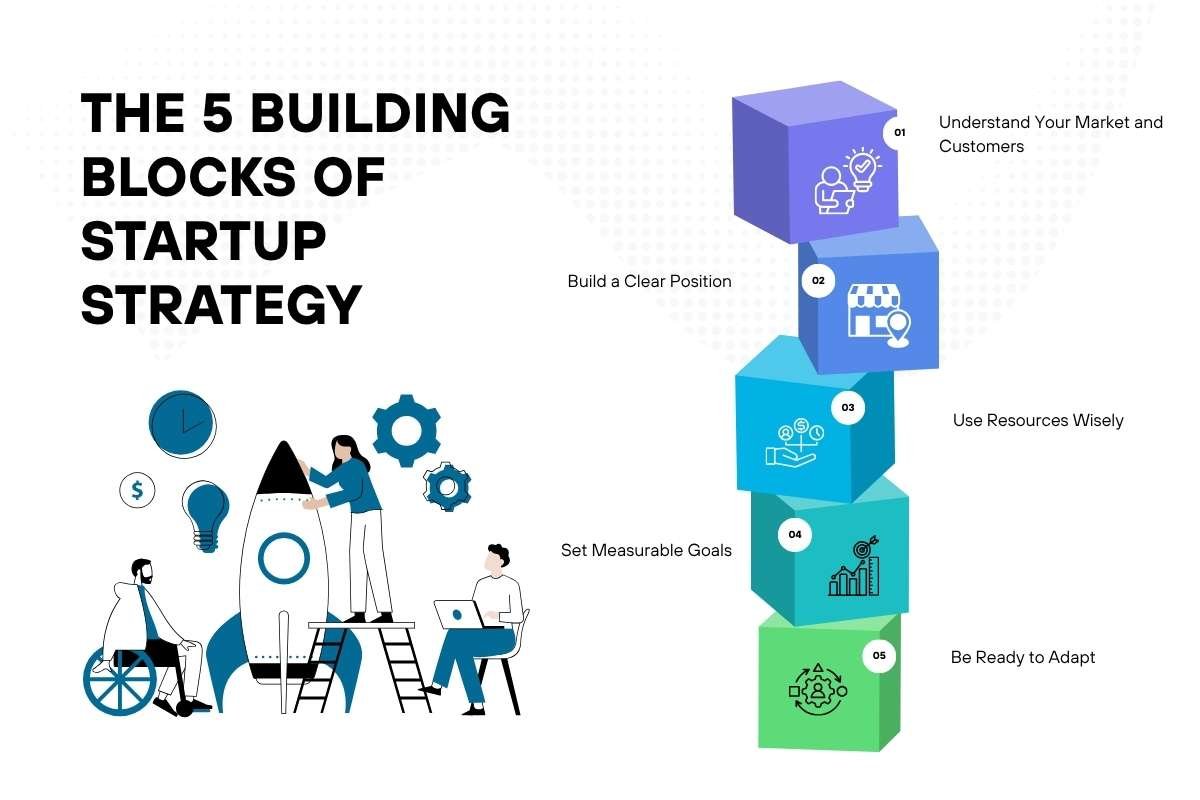
Strategic management for startups helps founders decide what to focus on, where to spend resources, and when to change direction.
1. Understand Your Market and Customers: Start by identifying who your customers are and what problem they need to solve. Use customer feedback, market research, and competitor analysis to test whether the problem is real.
Example: Shopify started by solving its founders’ own problem of selling products online. The idea later became a platform for other businesses.
2. Build a Clear Position: Be clear about what you offer, who you serve, and why customers should choose you. A focused position is better than trying to sell to everyone.
3. Use Resources Wisely: Startups have limited money, people, and time. A good strategy helps founders decide what needs investment now and what can wait.
4. Set Measurable Goals: Turn big plans into clear targets. These can include sales, active users, customer retention, conversion rates, or revenue.
5. Be Ready to Adapt: A startup’s first idea may not always work. Founders should use customer feedback and business results to improve the product or change direction when needed.
Example: Segment changed its product direction after learning from the market and eventually found stronger product-market fit.
Why early-stage companies need strategy before they scale
Growth sounds positive, but uncontrolled growth can make a weak business model more expensive to maintain.
Suppose a startup has unclear positioning, poor customer retention, and an inefficient acquisition channel. Increasing advertising spend may bring more customers, but it can also increase losses.
That is why strategic management for startups matters before aggressive scaling.
1. It prevents resource waste
A young company may have only a few employees and limited cash. Every major decision has an opportunity cost.
Hiring five people for a product feature that customers do not need is expensive. Entering three markets before understanding one is expensive. Spending heavily on advertising before validating the offer is expensive.
Strategy helps founders ask: What deserves attention now?
2. It keeps product development connected to customer needs
Founders often become attached to features they believe customers will love. Strategy introduces a healthier question: What evidence shows that this feature solves an important problem?
Stripe notes that product-market fit reflects how well a product meets the needs of a specific market, with customer acquisition and retention providing important signals.
This is also why MVPs, customer interviews, usage data, and early sales conversations are valuable. They turn assumptions into evidence.
3. It creates a smarter path to product-market fit
Product-market fit should not be treated as a box that founders simply tick.
The Y Combinator’s Michael Seibel warns that founders can mistakenly believe they have reached product-market fit and then start hiring and increasing their burn too early.
A strategic startup therefore tracks signals such as:
- Customer retention
- Repeat purchases
- Organic referrals
- Product usage
- Conversion rates
- Customer feedback
- Revenue growth
- Acquisition cost
- Gross margin
No single metric proves product-market fit. The combination of customer behavior and business performance provides a stronger picture.
4. It helps founders manage cash more carefully
A startup can run out of money even when the product has potential.
Strategic planning connects spending decisions with milestones. Instead of saying, “We need a bigger team,” founders can ask, “What business result should this hire help us achieve?”
The same logic applies to technology, marketing, office costs, partnerships, and expansion.
5. It creates focus when opportunities multiply
Startups often receive many opportunities: a new customer segment, partnership, product idea, geographic market, or funding opportunity.
Not every opportunity deserves a yes.
A simple strategic filter can ask: Does this opportunity strengthen our core customer proposition, improve economics, or move us closer to our primary goal?
If the answer is no, the opportunity may need to wait.
6. It prepares the company for responsible scaling
Scaling is not simply adding customers.
A startup must also strengthen its people, processes, technology, finances, customer support, and decision-making systems.
Canva provides a useful example of how strategy can support growth. Its official information currently says that more than a quarter of a billion people use Canva every month, showing how far the company has expanded from its early-stage roots.
The lesson is that strategy must evolve as a startup becomes more complex.
A practical strategic management framework for startups

Founders do not need a 50-page strategy document. A one-page strategic management framework can be enough to create clarity.
As Eric Ries, author of The Lean Startup, explains, “Entrepreneurship is management.” He argues that startups need a management approach built for uncertainty, where teams test ideas, measure results, and learn from customer feedback.
This makes a startup strategy more practical: set a direction, test your assumptions, measure what matters, and adjust when the evidence changes.
Step 1: Define the problem
Write down the specific customer problem and why it matters.
Step 2: Identify the ideal customer
Describe the customer segment most likely to experience the problem and pay for the solution.
Step 3: Define the value proposition
Explain what the startup offers and why customers should choose it over alternatives.
Step 4: Study the competitive landscape
Identify direct competitors, indirect alternatives, pricing models, market gaps, and potential barriers to entry.
Step 5: Choose three to five strategic priorities
Avoid creating 15 priorities. A small team cannot execute everything simultaneously.
Step 6: Attach measurable KPIs
Every priority should have a measurable indicator. For example, a customer-retention goal could be connected to monthly retention or repeat-purchase rates.
Step 7: Set review periods
Review the strategy monthly for operational signals and quarterly for broader direction. The exact frequency should depend on the startup’s speed and market volatility.
Step 8: Decide what not to do
This is one of the most overlooked parts of strategy. A clear “not now” list protects the team from distractions.
For a wider view of strategic planning tools such as SWOT, PESTEL, Porter’s Five Forces, Ansoff Matrix, and Balanced Scorecard, see the business strategy management tools guide.
What happens when startups scale without strategic clarity?

The risks are not theoretical.
CB Insights’ 2026 analysis examined 431 VC-backed companies that shut down since 2023. It found that running out of capital was cited in 70% of cases, while poor product-market fit appeared in 43%, bad timing in 29%, and unsustainable unit economics in 19%. The report notes that multiple reasons could apply to the same startup.
Scaling before validating the market can amplify existing problems:
- More customers can increase support problems.
- More employees can increase coordination costs.
- More marketing can increase acquisition losses.
- More features can make the product harder to use.
- More markets can spread the team too thin.
The answer is not to avoid growth. It is to make sure growth follows evidence. A startup should scale what works rather than simply scale what exists.
Conclusion
Strategic management for startups is not about perfectly predicting the next five years. It is about making better decisions with limited resources and incomplete information.
The strongest approach combines customer understanding, clear positioning, focused priorities, measurable goals, disciplined spending, and continuous learning.
Canva shows how mission and goals can keep a growing organization aligned. Shopify demonstrates how solving a real problem can lead to a broader opportunity. Segment shows why founders must remain willing to change direction when evidence challenges their original assumptions.
For an early-stage company, the best strategy management is rarely the most complicated one. It is the one that makes the next important decision clearer.
FAQs
1. What is strategic management for startups?
It is the process of setting goals, choosing priorities, using resources wisely, and adapting strategies to support startup growth.
2. Why is strategic management important for startups?
It helps startups focus their limited time, money, and people on the right opportunities while reducing costly mistakes.
3. What are the key elements of startup strategy?
The key elements include market research, customer needs, clear positioning, resource allocation, measurable goals, and continuous improvement.
4. How does strategic management help startups grow?
It helps founders identify what works, manage resources better, and make informed decisions before expanding products, teams, or markets.