
Businesses collect data from sales, marketing, finance, customer service, and daily operations. However, data alone cannot improve performance. Companies need a clear business intelligence strategy to turn information into useful insights, solve business problems, and support better decisions.
A strong strategy connects business goals with reliable data, suitable BI tools, and measurable performance targets. It also helps teams use insights in their daily work, track progress, and identify areas for improvement.
How to align BI initiatives with business goals and priorities
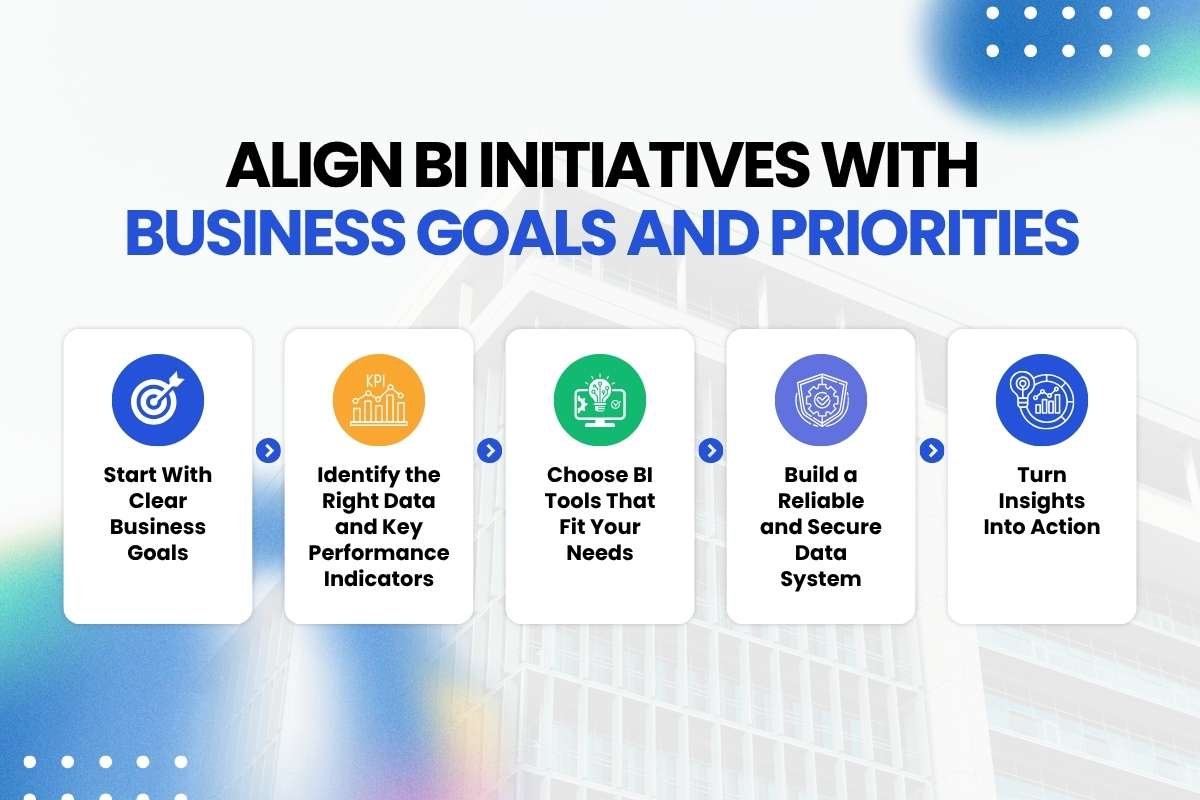
A successful business intelligence strategy starts with business needs, not software selection. Companies should identify their priorities, choose the right data, set measurable targets, and help teams act on the findings.
1. Start with clear business goals
Before choosing business intelligence tools, identify what the business wants to achieve. Common goals include increasing sales, reducing operating costs, improving customer retention, and making faster decisions.
Each BI initiative should support a specific goal.
For example:
- Sales: Identify products and regions that generate the most revenue.
- Marketing: Measure which campaigns bring valuable leads.
- Finance: Track spending and identify rising costs.
- Operations: Monitor stock levels and delivery delays.
- Customer service: Find common complaints and improve response times.
According to Microsoft’s customer case study, Walmart serves approximately 10,500 stores and clubs and has around 2.3 million associates worldwide, as reported in the 2022 case study.
Key takeaway: Businesses should connect BI projects with specific priorities, such as improving financial reporting or helping managers access reliable information faster.
2. Identify the right data and key performance indicators
Once the business goals are clear, identify the data needed to measure progress. Information should come from reliable sources, such as sales systems, customer relationship management platforms, financial software, and website analytics.
Next, choose key performance indicators (KPIs) that show whether the initiative is working.
| Business Priority | Useful BI Metrics |
|---|---|
| Increase revenue | Sales growth, average order value |
| Reduce costs | Operating expenses, cost per order |
| Improve marketing | Conversion rate, cost per lead |
| Retain customers | Repeat purchase rate, customer churn |
| Improve operations | Delivery time, inventory turnover |
Real-world example: Medtronic
Medtronic created INSIGHTS, a centralized analytics system using Microsoft Power BI, to improve data access across its global operations. By 2023, quarterly dashboard activity had grown from around 15,000 to 500,000 clicks, with 4,100 active users. The system also helped automate over 240,000 hours of work.
Key takeaway: Set clear KPIs and maintain reliable data to help teams make better business decisions.
3. Choose BI tools that fit your needs
The right software choices and modern business intelligence solutions depend on the company’s size, data sources, budget, technical skills, and reporting needs.
For example, Microsoft Power BI, Tableau, and Looker can help teams analyze information and create interactive business intelligence dashboards. However, a tool alone cannot fix unclear goals or poor data quality.
Before choosing a platform, consider:
- Integration: Can it connect with the systems your teams already use?
- Ease of use: Can employees understand reports without advanced technical skills?
- Security: Can access be controlled according to employee roles?
- Scalability: Can the platform handle growing data needs?
- Cost: Does the expected business value justify the expense?
Start with a small pilot project. Test whether the selected tool answers a real business question, gives employees reliable information, and supports faster decisions. Expand the project after reviewing the results.
4. Build a reliable and secure data system
A business intelligence strategy needs consistent, trustworthy data. When choosing tools, it is also important to understand the difference between business intelligence and business analytics to ensure you are focusing on historical reporting as well as forward-looking predictive insights. If sales, finance, and operations teams use different figures for the same metric, managers may struggle to agree on the right action.
Companies should define common data standards and assign responsibility for maintaining important datasets. They should also use suitable access controls, encryption, backups, and regular data quality checks.
Security is especially important when BI systems contain customer details, financial records, or healthcare information. Businesses must follow the privacy and data protection rules that apply to their operations.
A shared data system can also reduce repeated work. Instead of asking different departments to prepare separate reports, employees can use approved dashboards based on consistent information.
The result is a clearer view of business performance and less time spent checking conflicting reports.
5. Turn insights into action
Reports create value only when people use them to make decisions. A strong BI strategy explains who will review the findings, what action they can take, and how the results will be measured.
Consider a distributor whose dashboard shows frequent stock shortages. The operations manager can review demand patterns, compare supplier lead times, and adjust reorder levels. The team can then track whether stock availability improves.
To make this process work, companies should:
- Assign an owner to each important KPI.
- Review performance at regular intervals.
- Set clear targets and action points.
- Share findings with the teams responsible for decisions.
- Measure the results of each major change.
BI teams should also gather feedback from employees. If users find reports confusing or cannot access the information they need, the company should improve the dashboards and training.
This creates a continuous process of measuring, acting, and improving instead of treating BI as a one-time technology project.
How to measure the success of a BI strategy

A business intelligence strategy should include a way to measure its value. Companies can track both business performance and how effectively employees use AI in business intelligence systems.
Useful measures include:
- Revenue growth: Has the initiative supported higher sales?
- Cost savings: Have reporting or operating costs decreased?
- Decision speed: Can teams make important decisions faster?
- Data accuracy: Have reporting errors and conflicting figures decreased?
- User adoption: Are employees regularly using dashboards and reports?
- Goal completion: Is the project meeting its original targets?
Set a baseline before launching a BI initiative. For example, record how long a monthly report takes to prepare and how often it contains errors. After introducing a new system, measure the same indicators again.
This makes it easier to understand whether the project is delivering value. It also helps leaders decide whether to expand, improve, or stop an initiative.
Conclusion
A business intelligence strategy works best when it becomes part of everyday decision-making rather than a separate technology initiative. Companies should regularly review whether their business intelligence projects address actual business needs and deliver measurable results.
Start with a clear priority, involve the teams responsible for acting on the data, and refine the approach based on performance. As business needs change, the strategy should evolve to keep data useful, relevant, and aligned with long-term growth.
FAQs on business intelligence strategy
1. Who is responsible for developing a business intelligence strategy?
Business leaders, BI teams, data analysts, IT departments, and relevant business users should work together to develop the strategy.
2. How do you create a business intelligence strategy?
Define business goals, identify the required data, select KPIs, choose suitable BI tools, establish data security practices, and measure results.
3. What is the difference between a BI strategy and a BI tool?
A BI strategy defines business goals and how data will support them, while a BI tool helps collect, analyze, visualize, and report information.
4. How can small businesses implement a BI strategy?
Small businesses can start by tracking a few important metrics, connecting existing data sources, and using an affordable BI tool to address one specific business problem.
5. How often should a business intelligence strategy be reviewed?
Companies should review BI performance regularly, such as monthly or quarterly, and update the strategy when business goals, data needs, or performance targets change.