A company can have a brilliant strategy and still struggle if its daily operations cannot support it. Likewise, a business can run its operations efficiently but lose its competitive position if leaders fail to prepare for long-term change.
That is why understanding Strategic management vs operational management matters.
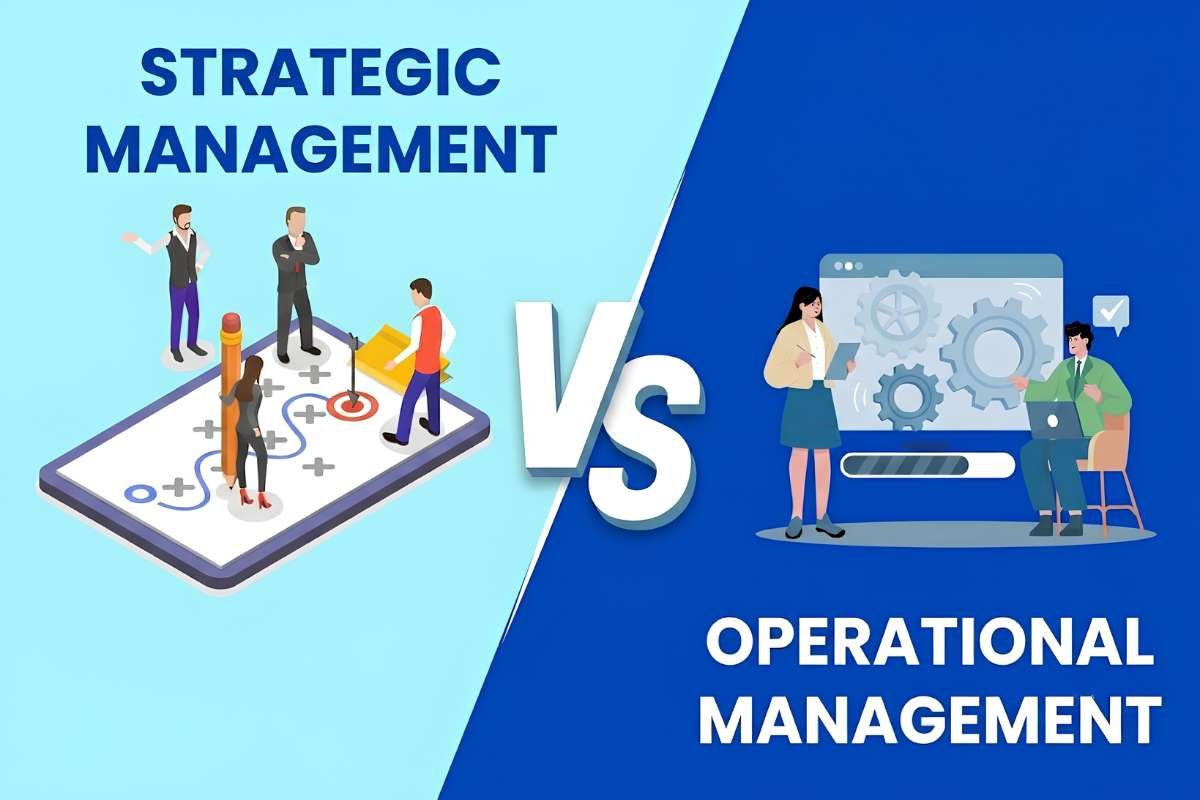
Strategic management focuses on the bigger picture: where the organization wants to go, why it should go there, and how it can build a lasting competitive position. Operational management focuses on execution: how teams, processes, resources, and workflows should work today and over the coming weeks or months.
The two approaches are different, but they are not competitors. They work together.
IBM describes operations management as the design and ongoing optimization of business operations to improve efficiency, resilience, and scalability, while strategic planning establishes broader organizational goals and direction.
What is strategic management vs. Operational management?
The simplest way to understand Strategic management vs operational management is to look at the questions each one answers.
Strategic management asks:
- Where should the business compete?
- What should the company achieve over the next few years?
- Which opportunities should receive investment?
- How can the company build or protect a competitive advantage?
- What changes in customers, technology, regulation, or competition could affect the business?
Operational management asks:
- What needs to happen today?
- Who is responsible for each activity?
- How can the process become faster or more efficient?
- Are quality, cost, inventory, staffing, and service targets being met?
- What needs to be fixed immediately?
Strategic management involves formulating and implementing major objectives while considering resources and the competitive environment. Operational management, by contrast, establishes measurable and repeatable processes that help implement broader business goals.
Strategic management: Think about the destination
Strategic management usually has a broader scope and longer time horizon.
For example, a technology company may decide to make artificial intelligence a central growth area. That decision can affect research and development, acquisitions, hiring, infrastructure, partnerships, product development, and capital allocation.
Microsoft provides a current example. In its 2025 Annual Report, the company describes AI innovation, cloud and AI infrastructure, and Copilots and agents as major areas of focus. It also says its long-term ambition is to lead in several technology areas while continuing to invest significant resources in cloud, AI, productivity, and business applications.
That is strategic thinking because the decisions shape Microsoft’s future direction rather than simply improving one day’s workflow.
Operational management: Make the strategy work

Operational management takes broader objectives and turns them into processes, responsibilities, schedules, targets, and measurable results.
Consider a retailer that wants to provide a faster and more reliable omnichannel shopping experience. The strategic decision may involve investing in digital commerce and supply-chain capabilities. Operational management then deals with inventory accuracy, warehouse processes, order fulfillment, staffing, delivery coordination, and service performance.
Walmart’s 2025 Annual Report provides a useful real-world example. The company reports investments in supply-chain automation and improvements supporting its omnichannel strategy, while also using AI and generative AI to improve customer and associate experiences and increase efficiency across supply-chain and operational activities.
This shows an important relationship between the two approaches: strategy establishes the priority; operations make the priority executable.
Strategic management vs Operational management: The difference at a glance
This section provides a direct Strategic management vs operational management comparison across purpose, time horizon, scope, decision-making, and performance.
| Factor | Strategic Management | Operational Management |
| Main purpose | Defines long-term direction and competitive priorities | Executes plans and manages daily performance |
| Primary question | Where should we go and why? | How will we get the work done effectively? |
| Time horizon | Usually long-term | Usually daily, monthly, quarterly, or annual |
| Scope | Organization-wide | Team, department, process, or function |
| Focus | Growth, positioning, competitive advantage, major priorities | Efficiency, quality, productivity, service, and consistency |
| Typical decisions | Market entry, acquisitions, product direction, major investments | Staffing, scheduling, inventory, workflows, quality control |
| Decision makers | Senior executives and business leaders | Operations managers, department heads, and team leaders |
| Risk level | Often higher because decisions can affect the entire organization | Usually narrower and closer to the execution level |
| Key measures | Growth, market position, profitability, strategic goals | Productivity, cost, quality, delivery, utilization, service levels |
| Planning style | Directional and future-focused | Detailed and action-focused |
| Example | Entering a new international market | Hiring staff and setting processes for the new market |
| Outcome | Determines what the organization should pursue | Ensures the chosen direction is executed effectively |
The distinction is not absolute. Modern businesses often connect strategic, operational, and financial planning rather than treating them as separate activities.
IBM’s integrated business planning approach, for example, brings strategic and operational planning together with financial planning and cross-functional collaboration.
This connection is important within the wider Strategic Management Framework because implementation and performance measurement help determine whether strategic choices are actually producing the expected results.
When should you think strategic vs When should you think operational?
Knowing the difference between Strategic management vs operational management is useful, but the bigger question is knowing when to switch between the two ways of thinking.
Think strategically when the decision can change the future.
Use strategic thinking when a decision has a major impact on the organization’s direction.
Think strategically when:
- Entering a new market
- Launching a major product category
- Responding to a disruptive technology
- Changing the business model
- Making a large acquisition
- Deciding where to invest capital
- Building a new competitive advantage
- Responding to major regulatory or economic changes
- Reconsidering the company’s target customers
For example, Microsoft’s continued investment in cloud and AI infrastructure is strategic because it supports its longer-term position in the technology market. Its 2025 Annual Report says the company added more than two gigawatts of new capacity during the year and operated more than 400 data centers across 70 regions.
The strategic question is not simply, “How do we run today’s data centers?”
It is: “What infrastructure do we need to support our long-term AI and cloud ambitions?”
That change in perspective is the heart of strategic thinking.
Think operationally when execution is the challenge.
Operational thinking becomes more important when the direction is already clear, but execution needs improvement. Think operationally when:
- Orders are taking too long to fulfill
- Costs are rising
- Employees need clearer workflows
- Inventory is inaccurate
- Production delays are increasing
- Customer complaints are rising
- A process contains unnecessary steps
- Quality is inconsistent
- Teams are missing short-term targets
For example, Walmart’s investments in supply-chain automation are not simply about having advanced technology. They are connected to improving the efficiency of supply-chain and operational activities while supporting the company’s broader omnichannel strategy.
The operational question becomes: “How can we make the existing system work better, faster, and more consistently?”
The best managers know when to use both.

Real business decisions rarely fit neatly into one category.
Imagine a company decides strategically to expand into a new country.
The strategic decision is: “We should enter this market because it offers long-term growth potential.”
The operational decisions include:
- Which location should open first?
- How many employees are required?
- Which suppliers should be approved?
- What inventory level is appropriate?
- How should orders be processed?
- What customer-service standards should be used?
- Which KPIs should managers monitor?
The Asana similarly explains that strategic plans establish longer-term organizational direction, while operational planning translates that direction into specific actions, timelines, responsibilities, and KPIs.
This relationship can be summarized as:
Strategic management → sets priorities → Operational management → executes priorities → Performance data → informs the next strategic decision.
That feedback loop is increasingly important because markets can change faster than traditional annual planning cycles. IBM’s current guidance on continuous planning emphasizes regularly updating plans, forecasts, resources, and strategies as business conditions change.
Why businesses need strategic and Operational management together

Treating strategy and operations as separate worlds creates problems.
A company may set an ambitious growth target without giving operational teams enough resources. Another company may focus heavily on efficiency while failing to invest in technologies or markets that will matter in the future.
A stronger approach connects both.
Strategic management provides:
- Direction
- Priorities
- Long-term goals
- Resource-allocation choices
- Competitive positioning
- Future-focused decision-making
Operational management provides:
- Execution
- Process control
- Accountability
- Efficiency
- Quality
- Short-term performance monitoring
The connection also supports better resource allocation. IBM notes that integrating strategic, operational, and financial planning can improve decision-making and resource allocation by giving organizations a more unified view of business priorities and performance.
This is also where a broader strategic management framework becomes useful. A framework connects analysis, strategy formulation, implementation, performance measurement, evaluation, and adaptation instead of treating strategy as a one-time document.
For businesses building a complete strategic-management content structure, this comparison can naturally sit between a strategic-management pillar article and supporting topics covering strategic planning, implementation, performance measurement, and operational planning.
Conclusion
The core of Strategic management vs operational management is simple: strategic management determines the direction, while operational management turns that direction into consistent action.
Strategic management looks at markets, competition, growth, technology, resources, and long-term goals. Operational management focuses on processes, people, quality, costs, productivity, and everyday execution.
Neither is more important in isolation.
A strong strategy without effective operations can remain an idea. Efficient operations without a clear strategy can make a business very good at doing the wrong things.
The strongest organizations connect both. Leaders decide where the business needs to go, operational teams determine how to execute that direction, and performance data helps everyone adjust when conditions change.
That is why successful strategic management is not about choosing strategy or operations. It is about knowing when to think strategically, when to act operationally, and how to connect the two.
FAQs
1. What is the main difference between strategic management and operational management?
Strategic management vs operational management can be summarized simply: strategic management focuses on long-term goals and business direction, while operational management focuses on daily execution, processes, and performance.
2. Is strategic management more important than operational management?
No. Strategic management sets the direction, while operational management turns that strategy into results. Both are essential for business success.
3. What is an example of strategic management?
Entering a new market, investing in AI, acquiring a company, or changing the business model are examples that demonstrate the strategic side of Strategic management vs operational management.
4. What is an example of operational management?
Managing inventory, employee schedules, production, service quality, costs, and daily workflows are common examples of operational management.