Markets evolve faster than ever. Artificial intelligence is reshaping industries, customer expectations are changing quickly, and businesses face constant competition from around the world. In this environment, making decisions based only on short-term goals is no longer enough. Organizations need a clear direction that helps them adapt, innovate, and grow over time. That direction comes from strategic management.
Whether you’re leading a startup, managing a growing company, or preparing for a leadership role, understanding this management approach helps you make informed decisions that support sustainable success. It aligns people, resources, and business goals while preparing organizations to respond confidently to change.
This guide explains everything you need to know about strategic management, including its process, models, frameworks, skills, tools, and real-world examples. You’ll also discover common mistakes to avoid, learn how successful companies develop long-term strategies, and explore practical insights that you can apply to your own organization.
What is strategic management?
It is the process of planning, executing, and improving business strategies to achieve long-term goals. It helps businesses make smarter decisions, use resources wisely, stay ahead of competitors, and adapt to changing market conditions.
In 2026, businesses face rapid changes due to AI, digital transformation, cybersecurity risks, and evolving customer expectations. Strategic management helps organizations respond to these changes, identify new opportunities, reduce risks, and build sustainable growth instead of reacting to challenges at the last minute.
Why is strategic management more important than ever in 2026?
In today’s fast-changing business world, having a great product isn’t enough. Companies also need a clear strategy to grow, innovate, and stay competitive. It gives businesses a roadmap for making better decisions and achieving long-term success.
It helps organizations:
- Set clear business goals and a long-term vision.
- Make informed decisions using data and market insights.
- Keep teams aligned and working toward the same objectives.
- Encourage innovation and continuous improvement.
- Manage risks and adapt quickly to market changes.
- Build a lasting competitive advantage and sustainable growth.
By following a strong strategic management approach, businesses can confidently navigate change, improve performance, and create long-term value for customers and stakeholders.
Top benefits of strategic management every business should know
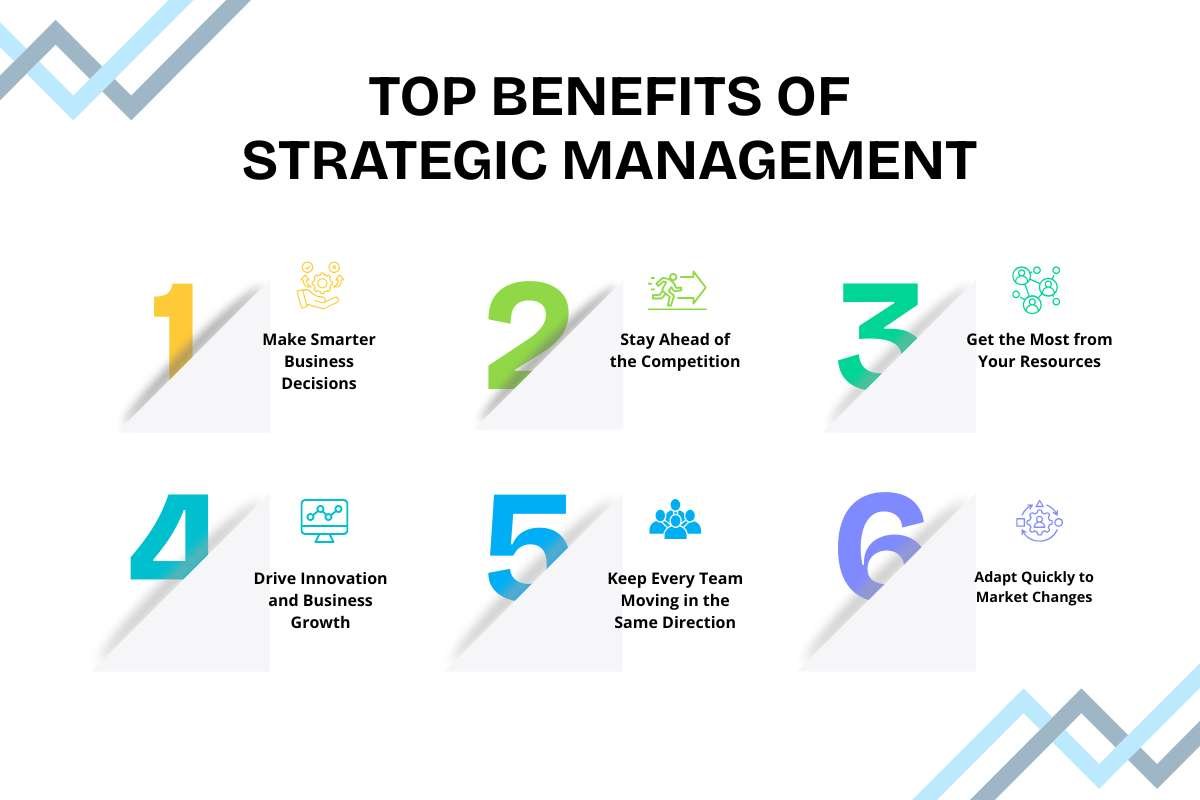
This helps businesses make smarter decisions, use resources efficiently, stay ahead of competitors, adapt to change, and achieve sustainable long-term growth. It gives every team a clear direction while improving business performance.
1. Make smarter business decisions
Every business makes important decisions about hiring, investments, technology, product launches, and expansion. It helps leaders make these decisions based on long-term goals instead of short-term challenges.
This leads to better planning, fewer mistakes, and more confident decision-making.
2. Stay ahead of the competition
Businesses succeed when they understand their customers and respond to market changes faster than competitors. Strategic management helps organizations improve products, identify new opportunities, and build a lasting competitive advantage.
As a result, businesses remain relevant and continue growing even in competitive markets.
3. Get the most from your resources
Every organization has limited time, budget, and talent. Strategic management ensures these resources are invested in the projects that create the greatest value.
This improves efficiency, reduces unnecessary spending, and supports long-term business success.
4. Drive innovation and business growth
Customer needs and market trends change constantly. Strategic management encourages businesses to embrace new technologies, improve products and services, and explore new growth opportunities.
Continuous innovation helps organizations stay competitive and prepared for the future.
5. Keep every team moving in the same direction
Growth becomes difficult when departments work toward different goals. This aligns marketing, sales, finance, operations, and HR around one shared vision.
This improves collaboration, communication, and overall business performance.
6. Adapt quickly to market changes
Business conditions can change at any time, so organizations monitor trends, manage risks, and respond with a clear plan instead of making rushed decisions.
This flexibility allows businesses to overcome challenges and achieve sustainable long-term growth.
How does the strategic management process drive long-term business success?
This Process is a step-by-step approach that helps businesses plan, execute, measure, and improve their strategies. Instead of reacting to changes, organizations use this process to make smarter decisions, stay competitive, and achieve long-term growth.
Every successful business follows this continuous cycle to adapt to changing markets and seize new opportunities. While the process may vary across organizations, it generally includes five key stages.
1. Know where you stand before making big decisions
Every successful strategy starts with understanding the business environment. Companies first evaluate their internal strengths, weaknesses, resources, and capabilities. They also study external factors such as customers, competitors, market trends, technology, and regulations.
Tools like SWOT Analysis, PESTLE Analysis, and Porter’s Five Forces help businesses identify opportunities and potential risks before making important decisions.
2. Build a strategy that supports your business goals
After gathering insights, organizations develop a strategy that aligns with their long-term vision.
This stage focuses on setting clear goals, choosing the right competitive approach, identifying growth opportunities, and deciding how to use available resources effectively. Instead of making decisions based on assumptions, businesses rely on data, customer insights, and market research.
3. Turn your strategy into real results
A great strategy only works when it is implemented successfully.
During this stage, organizations assign responsibilities, allocate budgets, create action plans, and ensure every team understands its role. Strong communication, employee training, and collaboration are essential for successful execution.
4. Measure what works and improve what doesn’t
Business conditions change constantly, so strategies need regular review.
Organizations track important performance indicators (KPIs), customer feedback, financial results, and operational efficiency to measure progress. If results don’t match expectations, leaders adjust their strategy based on real data instead of guesswork.
5. Keep improving to stay ahead of the competition
Strategic management is not a one-time project. It’s an ongoing process of learning, improving, and adapting.
Successful organizations regularly update their strategies based on new technologies, customer expectations, market trends, and business performance. This continuous improvement helps them stay competitive and prepared for future challenges.
Strategic management models that help businesses make better decisions
Strategic Management Models help businesses make better decisions by providing a structured way to assess their current position, understand market changes, solve challenges, and plan for growth. The right model depends on the business goal and the type of decision leaders need to make.
- SWOT Analysis: Identifies strengths, weaknesses, opportunities, and threats.
- PESTLE Analysis: Examines political, economic, social, technological, legal, and environmental factors.
- Porter’s Five Forces: Helps businesses understand competition, customers, suppliers, new entrants, and substitutes.
- Balanced Scorecard: Measures performance across financial results, customers, internal processes, and employee growth.
- Blue Ocean Strategy: Helps businesses identify new market opportunities instead of competing in crowded markets.
- McKinsey 7S Framework: Aligns strategy, structure, systems, skills, staff, style, and shared values.
Together, these models give leaders a practical framework for analyzing business conditions and making informed strategic decisions.
The 3 levels of strategic management every business should know
Strategic Management has three levels: Corporate, Business, and Functional. Together, they help organizations make smart long-term decisions, compete effectively, and ensure every department works toward the same business goals.
Every organization makes decisions at different levels. Some shape the company’s future, while others improve daily operations. Understanding these levels of strategic management helps businesses turn their vision into clear actions and achieve sustainable growth.
1. Corporate-level strategy: setting the company’s long-term direction
Corporate-level strategy is the highest level of Strategic Management. Senior leaders decide the company’s vision, long-term goals, expansion plans, major investments, and new business opportunities.
For example, Amazon’s move into cloud computing through AWS was a corporate-level decision that created a new growth engine for the company.
Main focus: Which markets or industries should the business enter to grow in the future?
2. Business-level strategy: winning in the market
Business-level strategy focuses on how a company competes within a specific market. It helps businesses attract customers through better products, innovation, pricing, quality, or customer experience.
For example, Apple competes by offering premium products and a seamless user experience instead of competing on low prices.
Main focus: How can the business stand out and gain a competitive advantage?
3. Functional-level strategy: turning plans into results
Functional-level strategy supports business goals through individual departments like marketing, finance, HR, operations, and IT. Each team creates action plans that contribute to the company’s overall strategy.
For example, if a company plans to expand globally, marketing builds local campaigns, HR hires regional talent, and operations strengthens the supply chain to support that growth.
Main focus: How can each department help achieve the organization’s strategic goals?
Strategic management framework: the simple system behind every successful business
This Framework is a step-by-step system that helps businesses set clear goals, make better decisions, execute strategies, measure results, and improve over time. It keeps every team aligned and focused on long-term success.
A great strategy needs more than good ideas; it needs a clear plan. This framework provides that plan by helping businesses understand where they are today, where they want to go, and how to get there.
Instead of different teams working toward different goals, the framework aligns everyone with the company’s vision. It guides every stage of the strategy, from planning and execution to performance tracking and continuous improvement.
Unlike individual tools such as SWOT or PESTLE Analysis, a strategic management framework brings the entire strategy process together. That’s why businesses of all sizes, from startups to global enterprises, use it to stay focused, adapt to change, and achieve sustainable growth.
The 5 building blocks of a successful strategic management framework

A Strategic Management Framework gives businesses a clear path from setting goals to achieving long-term success. While every company builds its framework differently, these five elements form the foundation of every successful strategy.
1. Start with a clear vision and mission
Every successful business begins with a clear purpose. A vision defines where the company wants to be in the future, while a mission explains why it exists and how it creates value for customers.
For example, Tesla’s vision to accelerate sustainable energy shapes its products, innovation, and long-term business decisions. When employees understand the company’s purpose, they make better decisions that support business growth.
2. Set clear and measurable goals
A vision becomes reality only when it’s supported by clear objectives. Businesses should set goals that are realistic, measurable, and aligned with their overall strategy.
Whether the goal is increasing revenue, entering new markets, or improving customer satisfaction, clear objectives help teams stay focused and measure progress effectively.
3. Turn strategy into action
A great strategy has no value without execution. Businesses need to assign responsibilities, allocate resources, and ensure every team works toward the same goals.
Organizations that execute their strategies consistently are more likely to achieve long-term success than those with good ideas but poor implementation.
4. Measure what matters
Tracking performance helps businesses understand whether their strategy is working. Using KPIs, financial results, customer feedback, and operational metrics allows leaders to make informed decisions.
Instead of waiting for annual reviews, successful companies monitor performance regularly and respond quickly to changing business conditions.
5. Keep improving as markets change
Business strategies should evolve with the market. Reviewing results, learning from experience, and adapting to new opportunities help organizations stay competitive.
Companies that continuously improve their strategies are better prepared for changing customer needs, new technologies, and market shifts.
The 6 strategic management skills every successful leader needs
Successful leadership requires more than creating a strong strategy. Leaders also need the skills to turn that strategy into clear actions and measurable results. The six key strategic management skills are strategic thinking, leadership and decision-making, analytical skills, communication, financial awareness, and change management.
Strategic thinking helps leaders look beyond immediate challenges, understand market trends, identify opportunities, and plan for long-term growth. Leadership and decision-making help them set a clear direction, evaluate risks, and make confident choices. Analytical skills allow leaders to use business data, customer insights, financial information, and market trends to make informed decisions rather than relying on assumptions.
Communication is equally important because even a strong strategy can fail when teams do not understand their roles or goals. Financial awareness helps leaders understand budgets, investments, costs, and ROI so they can use resources responsibly. Change management enables leaders to guide teams through changes in technology, markets, and customer expectations while keeping the business focused on its goals.
Together, these skills help business owners, managers, and future leaders make better decisions, respond to challenges, and build organizations that can adapt and grow over the long term.
Strategic management tools: 4 powerful tools every business should know
- SWOT Analysis: Identifies strengths, weaknesses, opportunities, and threats to support better business decisions.
- PESTLE Analysis: Examines political, economic, social, technological, legal, and environmental factors that may affect the business.
- Balanced Scorecard: Measures performance across finances, customers, internal processes, and employee development.
- OKRs (Objectives and Key Results): Turn business goals into clear objectives and measurable results, keeping teams aligned with strategic priorities.
The biggest strategic management mistakes that can hold your business back
Businesses can weaken even a strong strategy by setting unclear goals, ignoring market changes, communicating poorly, or failing to execute effectively. Common strategic management mistakes also include overlooking customer feedback and failing to measure performance. Clear, measurable goals keep teams focused, while regular market and customer research helps businesses adapt to changing needs. Strong communication, defined responsibilities, adequate resources, and performance tracking through KPIs such as revenue, customer satisfaction, and market share help turn strategy into measurable results. Avoiding these mistakes enables businesses to make better decisions, respond to change, and stay focused on long-term growth.
Strategic management vs Strategic planning: What’s the real difference?
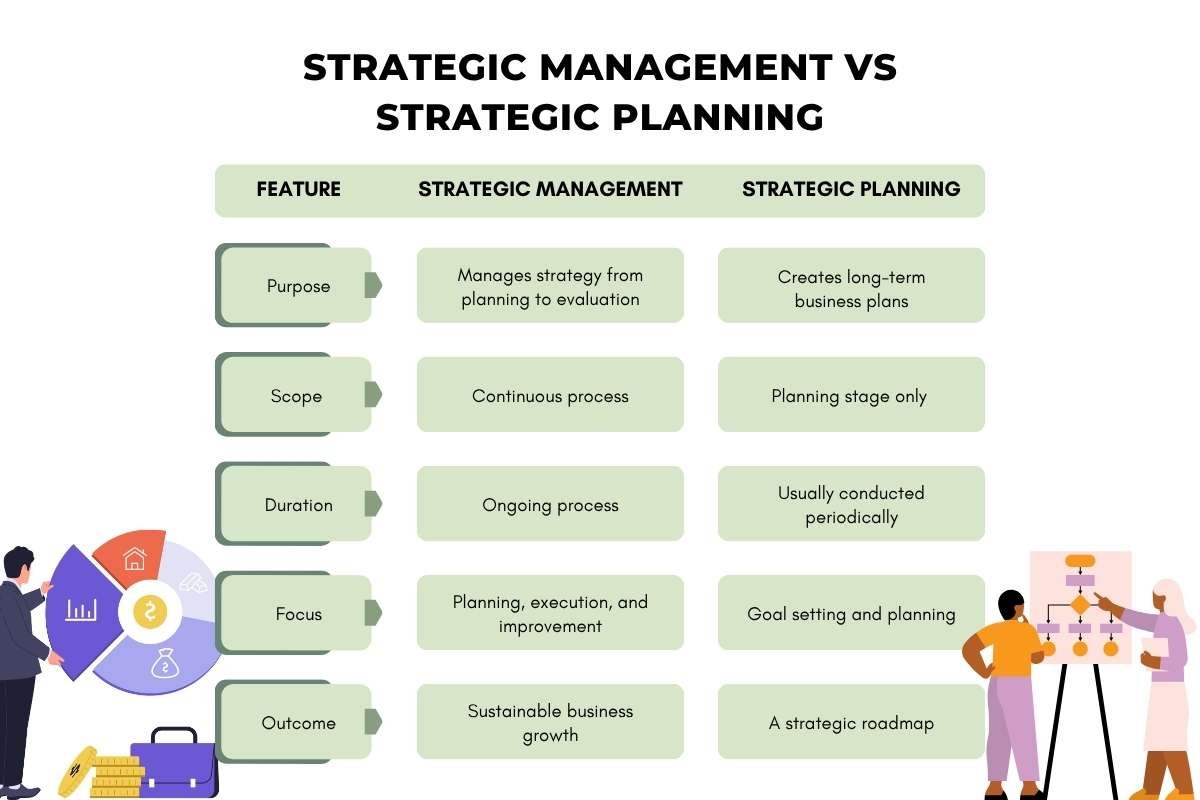
Strategic Planning focuses on creating a roadmap to achieve business goals, while strategic management is the complete process of planning, implementing, monitoring, and improving that strategy. In simple terms, strategic planning is one part of this management.
Many people use these terms interchangeably, but they serve different purposes. A business can create a strategic plan, but without proper execution and regular evaluation, that plan is unlikely to deliver long-term success.
| Feature | Strategic Management | Strategic Planning |
| Purpose | Manages strategy from planning to evaluation | Creates long-term business plans |
| Scope | Continuous process | Planning stage only |
| Duration | Ongoing process | Usually conducted periodically |
| Focus | Planning, execution, and improvement | Goal setting and planning |
| Outcome | Sustainable business growth | A strategic roadmap |
Strategic management vs operational management: Why every business needs both
It decides where the business wants to go in the future, while Operational Management focuses on running daily activities efficiently to achieve those goals.
Think of this management as setting the destination and operational management as driving the vehicle. Businesses need both to achieve long-term success.
| Feature | Strategic Management | Operational Management |
| Time Focus | Long-term | Short-term |
| Main Focus | Business growth and direction | Daily operations |
| Decision Makers | Senior leaders | Department managers |
| Goal | Competitive advantage | Operational efficiency |
How strategic and operational management work together
A successful organization connects long-term strategy with day-to-day execution.
For example, if leadership sets a strategic objective to become the market leader in customer experience, operational teams support this vision by improving response times, enhancing service quality, training employees, and implementing customer relationship management (CRM) systems.
Without effective operational management, even the strongest strategy remains only an idea. Likewise, efficient operations without strategic direction may improve short-term performance but fail to support long-term growth.
When strategic and operational management work together, organizations can adapt to change, deliver consistent value to customers, and achieve sustainable business success.
Amazon’s strategic management approach
Amazon’s approach focuses on customers, long-term growth, innovation, data, and continuous improvement. Instead of following competitors, Amazon starts with customer needs and works backward to build products, services, and processes around them. Its Leadership Principles also emphasize long-term thinking, invention, learning, and fast decision-making.
1. Put customers first and work backward
Amazon’s most important strategic principle is Customer Obsession. The company starts by understanding what customers need, then works backward to create solutions.
This approach can be seen in features such as personalized recommendations, convenient shopping, fast delivery, and easy returns. Amazon says its leaders focus more on customers than competitors and work to earn and keep customer trust.
Strategic lesson: Businesses grow stronger when they solve real customer problems instead of simply copying competitors.
2. Invest today for tomorrow’s growth
Amazon takes a long-term approach to innovation. Its expansion from online retail into cloud computing, AI, logistics, and other technology-driven services shows how the company looks beyond its current business.
Amazon Web Services (AWS), launched in 2006, is a major example of this approach. Amazon describes AWS as part of its effort to work backward from customer problems and provide technology that helps organizations innovate and scale.
Strategic lesson: Smart businesses invest in future opportunities before those opportunities become obvious to everyone.
3. Let data improve every decision
Amazon uses customer insights, business metrics, and performance data to understand what is working and what needs to change.
This data-driven approach helps teams improve products, services, operations, and customer experiences. Amazon also expects leaders to “Dive Deep,” meaning they examine details and use metrics when making decisions.
Strategic lesson: Data does not replace leadership judgment; it helps leaders make better decisions.
4. Experiment, learn, and improve
Amazon treats experimentation as an important part of innovation. Teams are encouraged to test ideas, learn from results, and improve their solutions instead of waiting for perfect answers.
Amazon’s AWS materials describe a culture of frequent experimentation and iteration, where teams use customer feedback to improve products and services.
This mindset helps Amazon respond quickly when customer expectations, technology, or markets change.
Strategic lesson: Long-term success comes from learning quickly, improving continuously, and being willing to test new ideas.
| Case Studies: LEGO: Listening to Customers During the early 2000s, LEGO experienced financial challenges after expanding into too many unrelated business areas. The company responded by simplifying operations, focusing on its core products, listening more closely to customers, and developing partnerships with popular entertainment franchises. This strategic shift helped LEGO regain profitability and strengthen its global brand. Key takeaway: Staying focused on customer value often produces stronger long-term results than pursuing every growth opportunity. |
Which strategic certification is right for you?

These certifications can help professionals build stronger skills in strategy, leadership, decision-making, and business planning. They are useful for students, managers, entrepreneurs, consultants, and executives who want to grow into strategic roles.
Some popular options include:
- Harvard Business School Online – Strategy and business leadership programs for professionals.
- Coursera – University-backed courses with flexible online learning.
- LinkedIn Learning – Practical strategy courses for managers and team leaders.
- Project Management Institute (PMI) – Programs covering strategic portfolio and organizational management.
- Chartered Management Institute (CMI) – Leadership qualifications recognized internationally.
The right strategic management certifications depend on your career goals, industry, and level of experience.
1. Strategic management lessons top CEOs use to win
The best CEOs do more than manage daily operations. They think ahead, adapt to change, understand customers, and invest in the future. Their decisions offer practical lessons for businesses of every size.
2. Satya nadella – Embrace continuous learning
When Satya Nadella became Microsoft’s CEO, he focused on building a culture of learning, collaboration, cloud computing, and innovation. This helped Microsoft adapt to a rapidly changing technology market.
Strategic lesson: Keep learning and adapt your strategy when the market changes.
3. Andy jassy – Start with the customer
Amazon CEO Andy Jassy continues Amazon’s long-standing focus on customer needs. The company uses customer feedback and behavior to improve products, services, and experiences.
Strategic lesson: Understand what customers need and build long-term trust instead of chasing quick wins.
4. Indra nooyi – Balance growth with responsibility
During her time as PepsiCo’s CEO, Indra Nooyi promoted “Performance with Purpose,” linking business growth with healthier products, sustainability, and broader social goals.
Strategic lesson: Long-term growth becomes stronger when business success and social responsibility work together.
5. Jensen huang – invest in the future
NVIDIA CEO Jensen Huang made major long-term investments in accelerated computing and AI before AI became a mainstream business priority. That forward-looking strategy helped NVIDIA become a major force in the AI computing market.
Strategic lesson: Identify important future trends early and invest before the opportunity becomes crowded.
Conclusion
Strategic management helps businesses set clear goals, make smarter decisions, use resources wisely, and respond to market changes. In 2026, it gives organizations a practical way to stay competitive while preparing for new technologies, customer expectations, and business risks.
The strategic management process and models, frameworks, skills, tools, and real-world case studies- each part helps leaders turn business goals into measurable action.
Whether you’re running a startup, managing a growing company, or building your leadership career, strong management can help you make better decisions, adapt faster, and build long-term business value.
Frequently asked questions (FAQs)
1. What is Strategic Management in simple words?
This process of planning, implementing, evaluating, and improving long-term business strategies to help an organization achieve its goals and stay competitive.
2. Why is Strategic Management important?
It helps businesses make informed decisions, adapt to market changes, improve resource allocation, manage risks, and achieve sustainable long-term growth.
3. What are the five stages of the Strategic Management process?
The five stages are environmental analysis, strategy formulation, strategy implementation, strategic control and evaluation, and continuous improvement.
4. What is the difference between Strategic Management and Strategic Planning?
Strategic planning focuses on creating long-term plans, while strategic management includes planning, implementation, performance monitoring, evaluation, and continuous improvement.
5. What skills are needed for Strategic Management?
Strategic thinking, leadership, communication, analytical ability, financial awareness, decision-making, problem-solving, and change management are among the most important skills.