
A company can have a strong vision and still struggle if that vision never reaches the people responsible for executing it.
Consider a large technology company. Its leadership may decide to invest heavily in cloud computing and artificial intelligence. That is a major company-wide decision. A specific business unit then needs to determine how it will compete in the cloud market. Marketing, finance, human resources, product development, and operations must then turn that direction into measurable actions.
This is where the Levels of strategic management become important.
Strategic management is not simply about creating a long-term plan. It involves deciding where an organization wants to go, how it will compete, and how different parts of the business will work together to reach that destination. OpenStax describes strategic management as a set of activities managers use to position a firm for successful competition.
Understanding these levels helps leaders avoid a common problem: having one strategy at the top while departments and business units follow completely different priorities.
What are the three levels of strategic management?
The Levels of strategic management are the different organizational layers at which strategic decisions are made and implemented.
For most organizations, they can be understood through three levels:
- Corporate-level strategy – decides the overall direction and portfolio of businesses.
- Business-level strategy – determines how a particular business competes in its market.
- Functional-level strategy – converts business objectives into department-specific actions.
The OpenStax distinguishes these levels by organizational scope: corporate strategy covers the entire organization, business strategy focuses on an individual business or operating unit, and functional strategy supports those objectives through areas such as marketing, human resources, and production.
The three levels work together rather than operate independently.
| Corporate strategy → Business strategy → Functional strategy → Execution → Performance |
To understand how these levels fit into the bigger picture, businesses should also understand the strategic management process, which connects strategy formulation, implementation, and evaluation.
The 3 levels of strategic management explained
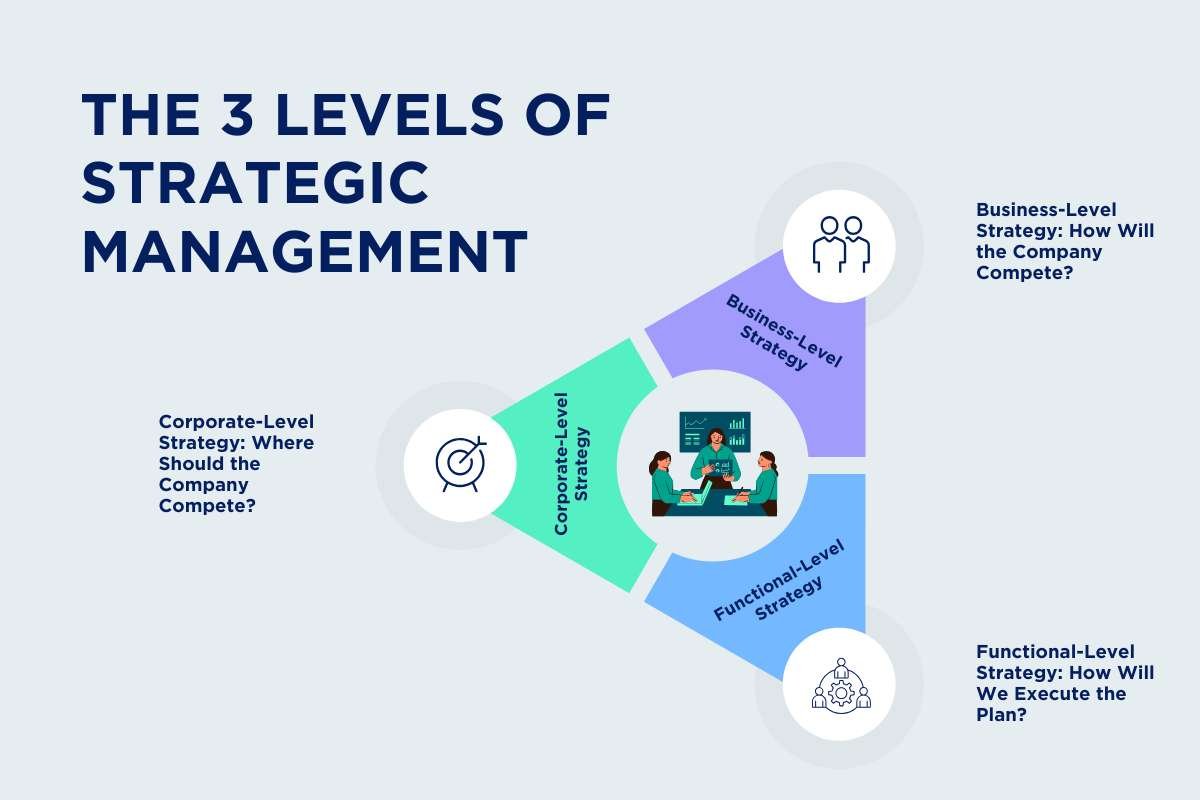
1. Corporate-level strategy: where should the company compete?
Corporate-level strategy focuses on the organization as a whole. Senior leaders decide where the company should compete, which markets to enter, where to invest, and which businesses to grow or exit.
For example, a diversified company may decide to enter a new industry, acquire another company, or expand into a new country.
This level provides the overall direction for the business.
Companies can also use different strategic management models to evaluate their growth opportunities, competitive position, and long-term direction.
2. Business-level strategy: how will the company compete?
Business-level strategy focuses on a particular business, product, or market.
The main question is simple: How will we compete successfully?
A business may compete through lower prices, better quality, innovation, customer experience, or a strong market position.
This is where tools such as strategic management tools can help businesses understand competitors, customers, resources, and market conditions.
3. Functional-level strategy: how will we execute the plan?
Functional-level strategy turns business goals into actions within individual departments. Marketing, HR, finance, operations, sales, and technology teams all create plans that support the wider business strategy.
For example, if a company wants to compete through innovation, the R&D team may develop new products, HR may hire skilled employees, and marketing may promote the company’s new offerings.
The success of this level depends heavily on strong strategic management skills, such as decision-making, communication, leadership, and problem-solving.
Corporate vs Business vs Functional-level strategy
The differences become clearer when the three levels are placed side by side.
| Strategy level | Main question | Primary focus | Typical decisions |
| Corporate | Where should we compete? | Entire organization | Diversification, acquisitions, market entry, portfolio |
| Business | How will we win? | Specific business or market | Positioning, pricing, differentiation, competitive advantage |
| Functional | How will we execute? | Individual departments | Marketing, HR, finance, operations and technology actions |
The three levels are different, but they should never work in isolation.
For example, corporate leadership may decide to expand into AI. The business unit then decides how to compete in the AI market, while marketing, HR, finance, and technology teams turn that strategy into practical action.
This alignment is one of the key foundations of effective strategic management.
How these strategy levels work together in the real world

The three levels of strategy work together like a chain. Corporate strategy sets the direction, business strategy decides how to compete, and functional strategy turns those decisions into action.
For example, a technology company may decide to make AI and cloud services major growth areas.
- Corporate level: Invest more in AI and cloud technology.
- Business level: Compete by offering reliable, secure, and easy-to-use AI and cloud solutions.
- Functional level: Marketing promotes the solutions, R&D improves the products, sales targets customers, and HR builds the required talent.
This alignment helps different teams work toward the same business goal rather than pursuing separate priorities.
| Real-World Examples Microsoft: Microsoft manages three major segments: Productivity and Business Processes, Intelligent Cloud, and More Personal Computing. Its 2025 revenue reached $281.7 billion, with Intelligent Cloud contributing $106.3 billion. This shows how different business units can work toward shared corporate priorities. For more practical examples, businesses can explore strategic management case studies and learn from strong strategic management companies. |
Why alignment between the levels matters more than the strategy document
A strategy can look excellent on paper and still produce weak results if the levels do not support one another.
For example:
- Corporate leadership prioritizes premium positioning.
- The business unit competes mainly through deep discounts.
- Marketing promotes low prices.
- Operations reduces product quality to cut costs.
The organization is effectively pursuing conflicting strategies. Good strategic management creates strategic alignment.
Corporate decisions establish direction.
Business decisions establish competitive positioning.
Functional decisions create the capabilities needed to deliver that positioning.
This is why strategy should not be treated as a document that is created once and forgotten. OpenStax notes that managers continuously scan the environment, execute existing strategies, and formulate future strategies rather than following a perfectly linear process.
Organizations should therefore monitor results, customer behavior, competitors, technology, regulation, and internal capabilities and adjust when circumstances change.
Conclusion
The Levels of strategic management provide a practical structure for understanding how organizations move from broad ambition to execution.
Corporate-level strategy determines where the organization will compete and how resources should be allocated. Business-level strategy determines how a particular business will build and defend its competitive position. Functional-level strategy translates those choices into actions across departments.
The real strength comes from alignment.
When all three levels support the same strategic direction, employees understand priorities, resources can be allocated more effectively, and departments can work toward common outcomes.
For businesses developing a broader strategic management framework, these three levels provide an essential foundation. They also connect naturally with supporting tools such as SWOT, PESTLE, Porter’s Five Forces, VRIO, the Ansoff Matrix, and strategic planning frameworks.
In simple terms:
- Corporate strategy chooses the direction.
- Business strategy chooses how to compete.
- Functional strategy makes the strategy happen.
FAQs
1. What are the three levels of strategic management?
They are corporate, business, and functional levels. Corporate sets the direction, business decides how to compete, and functional teams execute the plan.
2. What is the difference between corporate and business-level strategy?
Corporate strategy decides where to compete, while business strategy decides how to compete in that market.
3. What is functional-level strategy?
It defines how departments such as marketing, HR, finance, and operations support the overall business strategy.
4. Which level of strategy is most important?
All three are important because they work together. Strong alignment helps turn strategy into results.
5. Can small businesses use the levels of strategic management?
Yes. Small businesses can use the same approach by setting goals, choosing how to compete, and aligning their departments with those goals.
6. How do the levels of strategic management connect?
Corporate strategy sets the direction, business strategy creates the competitive approach, and functional strategy turns it into day-to-day action.