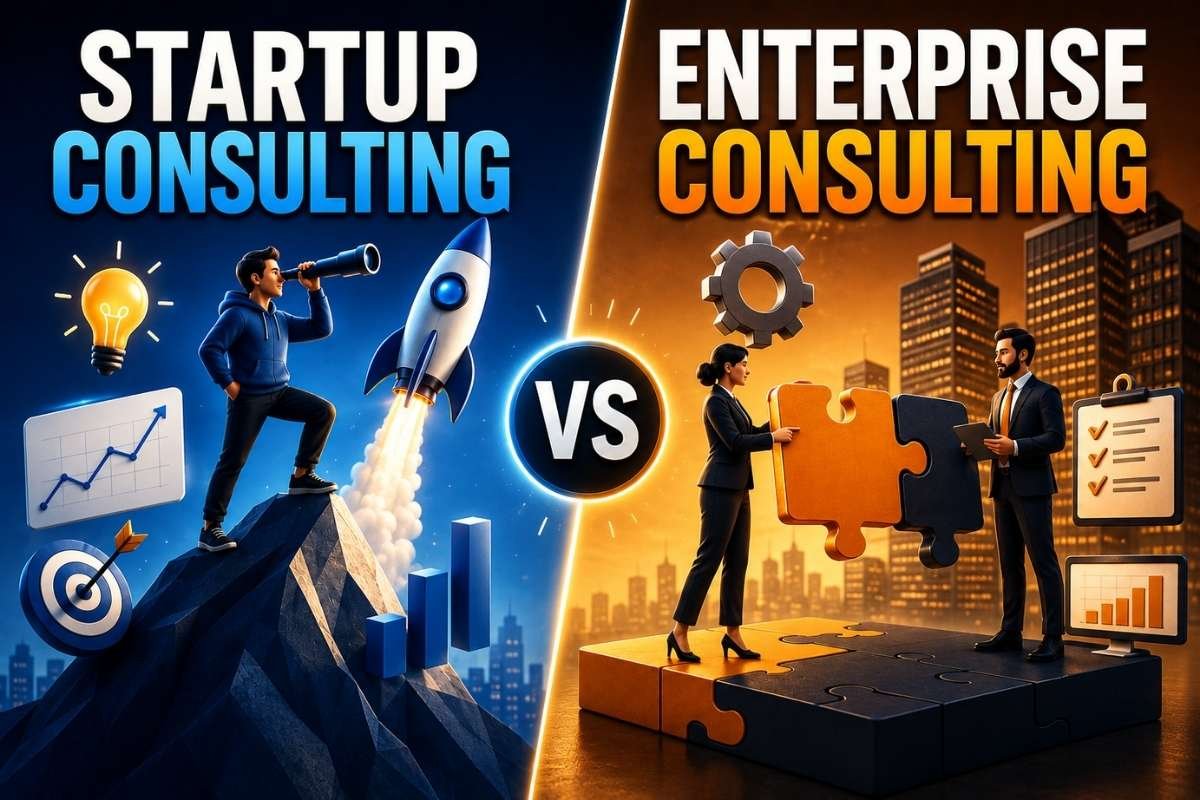
Startup consulting vs enterprise consulting differ in how businesses operate at each stage. Startup consulting focuses on speed, testing ideas, and building direction in uncertain conditions. Enterprise consulting focuses on improving systems, managing scale, and driving efficiency in established structures. The article explains their key differences and shows how each approach impacts business growth.
A founder is fighting to keep the lights on while also trying to convince early users that the product is worth their trust. Every decision feels immediate, every mistake is expensive, and advice has to be practical enough to act on tomorrow morning.
Across the table, a large organisation is dealing with entirely different pressures. Teams are layered, processes are already in place, and change has to move through systems before it can move through people. The challenge is not starting from zero, but moving something that is already massive.
Startup consulting vs enterprise consulting is really about this reality gap. One focuses on speed, uncertainty, and the need to find direction quickly. The other focuses on scale, structure, and improving what is already established. The approach changes completely depending on which side of that gap you are standing on.
In this article, we will break down the two concepts and how knowledge at both stages of a business can change where they end up in the future.
Startup consulting vs enterprise consulting: what do they mean?
Startup consulting helps new businesses in the early stages. These businesses are still testing their ideas. Consultants help founders shape a clear business model. They also guide product decisions and market entry.
Startups move fast and change often. So consultants give flexible advice. They also help with funding and early hiring. The main goal is to build something that works quickly.
Enterprise consulting works with large companies. These companies already have stable systems. They also have regular revenue and large teams. Consultants focus on improving how the business runs.
Their work is more structured. It takes more time and planning. They study operations across departments. Then they suggest changes for better efficiency.
Startup consulting focuses on speed and survival. Enterprise consulting focuses on scale and stability. Both aim to improve business results, but they work in very different environments.
Startup consulting vs enterprise consulting: key differences
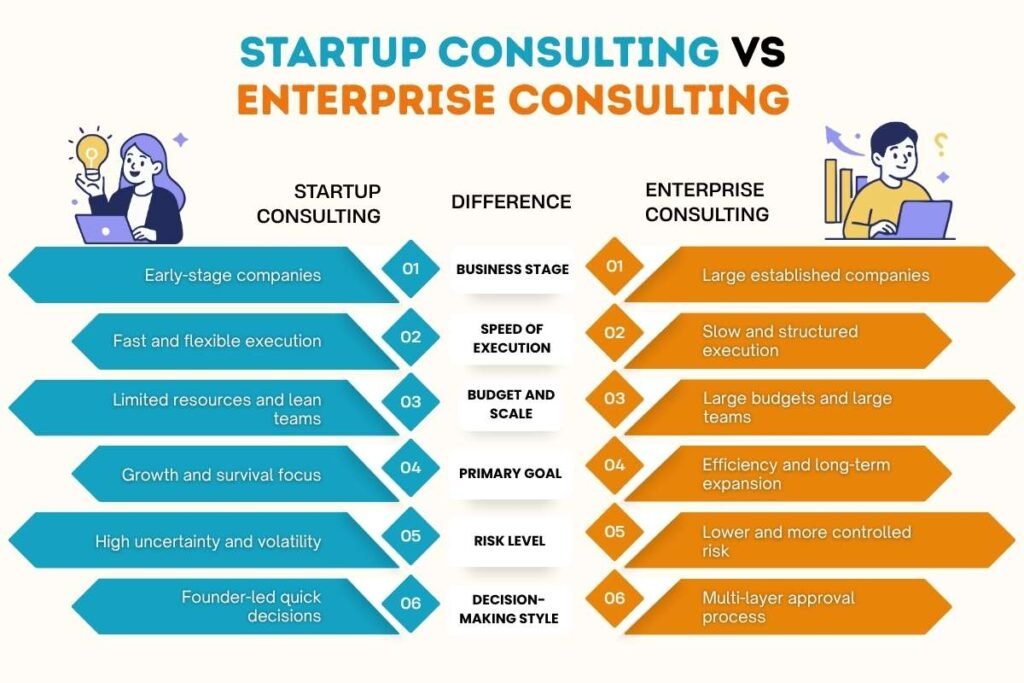
Understanding the differences between startup consulting and enterprise consulting helps set the right expectations. Both serve different types of businesses and work in very different conditions. One focuses on building from the ground up, while the other improves what already exists.
These differences affect how work is planned, how decisions are made, and how results are measured. The sections below break this down in a clear and structured way.
| Startup Consulting | Key Difference | Enterprise Consulting |
| Early-stage companies | Business stage | Large established companies |
| Fast and flexible execution | Speed of execution | Slow and structured execution |
| Limited resources and lean teams | Budget and scale | Large budgets and large teams |
| Growth and survival focus | Primary goal | Efficiency and long-term expansion |
| High uncertainty and volatility | Risk level | Lower and more controlled risk |
| Founder-led quick decisions | Decision-making style | Multi-layer approval process |
1. Business stage
Some businesses are still in the process of shaping what they actually are. Their products are not fully stable yet, and direction can shift after every round of feedback. Consulting in this space is focused on creating clarity where there is still uncertainty.
On the other side, there are companies that already operate with a strong structure. Their products are defined, and their position in the market is already clear. In such cases, consulting does not build from scratch but strengthens existing systems.
2. Speed of execution
Work in startups often moves with urgency. Ideas are tested quickly, and changes happen as soon as feedback arrives. Planning stays light so that execution does not slow down learning.
In larger organizations, work follows a more controlled path. Each step is reviewed before the next begins, and decisions move through structured stages. This reduces errors but naturally slows down execution.
3. Budget and scale
Financial limits shape how startups operate on a daily basis. Spending is usually directed toward immediate priorities like product development or acquiring early users. Small teams handle a wide range of responsibilities at the same time.
Enterprise environments operate at a very different scale. Budgets are planned across departments and over long timelines. Teams are divided into specialized roles, and responsibilities are clearly separated to manage large operations efficiently.
4. Primary goal
The main focus for early-stage companies is validation. They need to confirm that their idea works in a real market setting. Growth often takes priority even when systems are still evolving.
For established companies, the focus shifts toward refinement. Existing systems are improved, and performance is optimized across operations. Growth still matters, but it is managed within stable structures.
5. Risk level
Uncertainty is a constant factor for startups. Market response can change quickly, and many experiments do not succeed. Because of this, every decision carries a higher level of risk.
Enterprise setups are more predictable. Products are already tested, and business models are stable. Risk is still present, but it is managed through planning and structured controls.
6. Decision-making style
In startups, decisions are usually concentrated in small leadership teams. This allows fast reactions to changes in the market. Adjustments can be made quickly without waiting for multiple approvals.
Large organizations work differently. Decisions pass through several layers before execution. This improves coordination across teams and reduces mistakes, but it also slows down the pace of action.
How can each type of consulting impact a business?

Startup consulting can change how a new business takes shape in its early phase. It helps founders avoid unclear direction and wasted effort. Strong guidance can improve how quickly a product reaches the market. It also helps teams focus on what actually matters in the beginning.
It can also reduce early failure risks. Many startups struggle because they scale too early or build the wrong product. Consulting helps them test ideas in smaller steps. This improves decision-making before large resources are committed.
Enterprise consulting impacts how large companies operate on a daily basis. It helps improve systems that already exist. This can include workflow efficiency, cost control, and team coordination. Small improvements here can create large financial and operational gains.
It also supports long-term transformation. Enterprises often need to adapt to new technology or changing markets. Consulting helps them redesign processes without breaking existing stability. This keeps large organizations competitive while maintaining control.
Startup consulting vs enterprise consulting: trends and market outlook

The global business consulting market is expected to reach USD 328 billion in 2026. It is expected to grow to USD 495.9 billion by 2035. This shows steady demand across global industries. The CAGR is projected at 4.7 percent during this period.
This growth is driven by rising business complexity. Companies face faster technology shifts and stronger global competition. Many also deal with constant changes in operations and customer needs. Consulting helps them make clear decisions in uncertain conditions. Startups use it to build structure. Enterprises use it to improve scale and efficiency.
The rise in demand is also linked to digital transformation and AI adoption. Businesses need help integrating new systems into existing workflows. They want these changes without disrupting daily operations. As a result, consulting is becoming a core support system for both startups and large enterprises.
Conclusion:
Choosing the right kind of support is not about which approach sounds better on paper. It depends on the stage you are in and the problems you are trying to solve right now. A fast-moving startup company needs clarity, speed, and decisions that can be tested quickly. A large organization needs alignment, structure, and changes that can scale without breaking existing systems.
That difference is exactly what defines startup consulting vs enterprise consulting. Each approach solves a different kind of problem, and using the wrong one can slow progress instead of accelerating it.
FAQs
1. What is the main difference between startup and enterprise consulting?
Startup consulting focuses on growth, experimentation, and quick decisions. Enterprise consulting focuses on optimization, structure, and managing scale.
2. Which type of consulting is more flexible?
Startup consulting is usually more flexible because it works in uncertain and fast-changing environments.
3. Why do enterprises need a different consulting approach?
Because they deal with complex systems, larger teams, and established processes that cannot be changed overnight.