Scaling a business successfully requires more than increasing sales it demands strong systems, healthy cash flow, strategic planning, and operational efficiency. This article explains the difference between growth and scaling, outlines proven strategies for sustainable expansion, highlights common mistakes to avoid, and introduces practical frameworks such as the 4 C’s of Business Scaling and the 1% Rule. Real-world examples show how successful companies achieve long-term growth while maintaining profitability and customer satisfaction.
Every business owner wants growth, but growth alone does not guarantee success. The real challenge is scaling growing revenue without a proportional increase in costs. According to the World Bank, small and medium-sized enterprises account for around 90% of businesses worldwide and create more than 50% of global jobs. Yet only a small percentage successfully scales beyond their early growth stages.
Why? Because rapid growth often exposes weaknesses in operations, cash flow, hiring, and customer experience. More customers can mean more revenue, but without the right systems and strategy, it can also lead to inefficiencies and stalled growth.
Learning how to scale a business successfully is about building a company that can handle increasing demand while remaining efficient and profitable. In this article, you’ll learn the key signs that a business is ready to scale, proven growth strategies, common scaling mistakes to avoid, and the frameworks successful companies use to achieve sustainable long-term growth.
What does it mean to scale a business?
Many people use the terms growth and scaling interchangeably, but they are not the same. Business growth typically involves increasing revenue by adding more resources, such as employees, equipment, or operational expenses. Scaling, on the other hand, focuses on increasing revenue at a faster rate than costs.
For example, if a company doubles its sales but also doubles its expenses, it has grown. However, if it doubles its sales while increasing costs by only 20–30%, it has scaled successfully.
Scalable businesses are built to handle higher demand without significant increases in operating costs. This is why industries such as software, e-commerce, and digital services often scale faster than traditional businesses. Once the right systems, processes, and infrastructure are in place, they can serve more customers with relatively little additional cost.
At its core, learning how to scale a business successfully means creating a business model that can support long-term growth while maintaining profitability, efficiency, and customer satisfaction.
Signs your business is ready to scale

Not every growing business is ready to scale. In fact, scaling too early is one of the most common reasons businesses struggle during expansion. Research from McKinsey found that nearly 78% of companies that achieve product-market fit still fail to scale successfully, often because they expand before building the right foundation.
Before investing heavily in growth, look for these signs that indicate your business is truly ready to scale.
1. Strong product-market fit
The first indicator is consistent customer demand. If customers regularly purchase your product, renew subscriptions, refer others, and provide positive feedback, it suggests you’ve achieved product-market fit. Businesses that scale successfully typically solve a clear customer problem and generate demand beyond founder-led sales efforts.
2. Consistent revenue growth
Sustainable scaling requires predictable revenue, not occasional sales spikes. Consistent growth over several quarters demonstrates that your business model is working and can support future expansion. High-growth companies are often defined as those maintaining double-digit annual growth over multiple years.
3. Repeatable sales process
A scalable business can acquire customers through a repeatable and measurable process. If you know how much it costs to acquire a customer and can reliably generate sales through proven channels, growth becomes far less risky. A repeatable sales model is widely considered one of the strongest indicators of scale readiness.
4. Healthy cash flow
Growth requires capital. Whether you’re hiring talent, investing in technology, or entering new markets, strong cash flow ensures you can fund expansion without jeopardizing day-to-day operations. Many promising businesses fail not because of a lack of demand, but because they run out of cash during periods of rapid growth.
5. Efficient operations
If your business depends on the owner to solve every problem, it is not yet ready to scale. Strong systems, documented processes, and operational consistency are essential. Businesses that can maintain service quality while handling increasing demand are far better positioned for sustainable expansion.
When these indicators align, your business is far more likely to scale successfully. This matters because businesses that achieve successful scale-ups have an outsized impact on growth and employment. According to the OECD, just 10–15% of SMEs that successfully scale generate around 50% of all new jobs, demonstrating the significant value created by businesses that expand at the right time and in the right way.
Why do many businesses struggle to scale?
While scaling can unlock significant growth opportunities, it also introduces new challenges. Many businesses assume that rising sales automatically lead to long-term success, but the reality is often more complex. According to research from the OECD, only a small percentage of businesses successfully transition from growth to sustained scaling, despite strong market demand.
1. Limited cash flow
Cash flow is one of the biggest barriers to scaling. Growth often requires upfront investments in hiring, technology, inventory, and marketing before additional revenue is realized. Even profitable businesses can face financial strain if cash inflows fail to keep pace with expansion costs.
2. Inefficient processes
Processes that work for a small business may break down as customer demand increases. Manual workflows, outdated systems, and inconsistent procedures can create bottlenecks that slow growth and reduce productivity.
3. Hiring too quickly
Rapid expansion often leads businesses to hire aggressively. However, bringing in employees faster than the organization can train and manage them may result in lower productivity, cultural misalignment, and higher turnover costs.
4. Weak leadership structure
As businesses grow, founders can no longer oversee every decision. Without clear leadership roles, accountability, and delegation, decision-making becomes slower and operational complexity increases.
5. Lack of strategic planning
Many businesses focus on short-term growth without creating a roadmap for sustainable expansion. Entering new markets, launching products, or increasing capacity without a clear strategy can stretch resources and increase risk.
The businesses that scale successfully recognize these challenges early and address them before they become growth barriers. Building strong financial controls, scalable processes, capable leadership teams, and customer-centric strategies creates a foundation for sustainable expansion.
The good news is that these obstacles can be overcome. The next step is understanding the proven strategies that successful businesses use to scale efficiently and profitably.
How to scale a business successfully: 7 proven strategies
Once your business has a strong foundation, the focus shifts from managing growth to scaling it sustainably. Successful companies do not rely on a single tactic; they combine operational efficiency, financial discipline, technology, and talent to support long-term expansion.
1. Build scalable systems and processes
As demand grows, manual processes can quickly become bottlenecks. Documenting workflows, creating standard operating procedures (SOPs), and automating repetitive tasks help maintain efficiency while reducing operational costs. The less your business depends on manual intervention, the easier it becomes to scale.
2. Strengthen your financial foundation
Scaling requires investment, making financial planning critical. Monitor cash flow closely, create realistic growth forecasts, and maintain sufficient reserves to handle unexpected expenses. Businesses with strong financial controls are better equipped to navigate periods of rapid expansion.
3. Invest in the right technology
Technology enables businesses to serve more customers without proportionally increasing costs. Tools such as CRM platforms, marketing automation software, project management systems, and AI-powered solutions can improve productivity, streamline operations, and enhance customer experiences.
4. Hire and develop high-impact talent
People remain one of the most important drivers of growth. Rather than hiring rapidly, focus on recruiting individuals who can contribute strategically and grow with the business. Investing in employee development also helps build future leaders who can support expansion efforts.
5. Focus on customer retention
Acquiring new customers is important, but retaining existing ones is often more profitable. Research by Bain & Company shows that increasing customer retention by just 5% can increase profits by 25% to 95%. Loyal customers generate repeat business, referrals, and long-term revenue growth.
Successful scaling is not about growing as fast as possible, it’s about growing efficiently. Businesses that invest in systems, people, technology, and data-driven decision-making are far more likely to achieve sustainable growth without sacrificing profitability or customer satisfaction.
6. Expand revenue streams
Relying on a single product, service, or market can limit growth potential. Many successful businesses scale by introducing complementary offerings, targeting new customer segments, entering new geographic markets, or forming strategic partnerships that create additional revenue opportunities.
7. Make decisions using data
Scaling becomes more predictable when decisions are based on data rather than assumptions. Track key performance indicators (KPIs) such as customer acquisition cost, customer lifetime value, profit margins, revenue growth, and retention rates. These metrics provide valuable insights into what is working and where improvements are needed.
Successful scaling is not about growing as fast as possible, it’s about growing efficiently. Businesses that invest in systems, people, technology, and data-driven decision-making are far more likely to achieve sustainable growth without sacrificing profitability or customer satisfaction.
The 4 scaling techniques businesses use
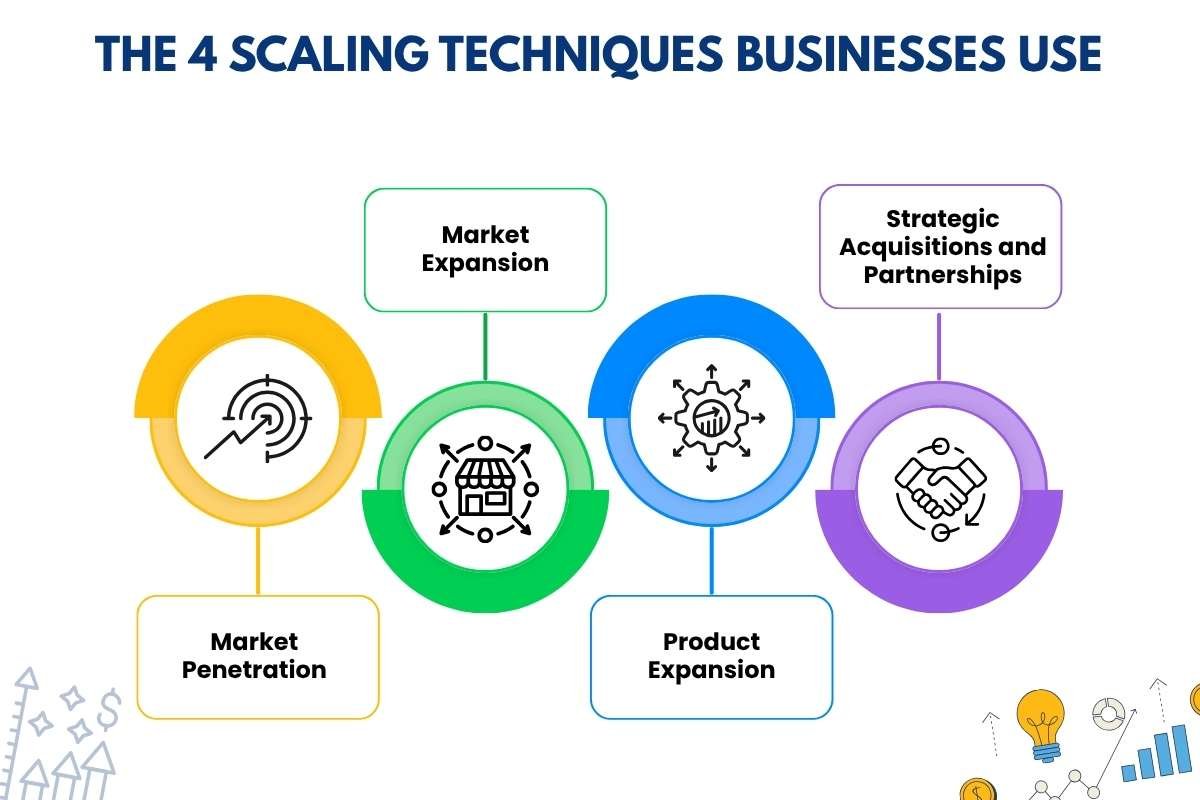
After establishing the right systems, team, and financial foundation, businesses must decide how they want to grow. While every company follows a unique path, most successful scaleups rely on one or more of four proven scaling techniques.
1. Market penetration
Market penetration focuses on increasing sales within an existing market. This can be achieved by improving marketing efforts, strengthening customer retention, increasing brand awareness, or gaining market share from competitors.
For many businesses, this is the least risky scaling strategy because it targets customers who are already familiar with the product category. Companies often use loyalty programs, targeted promotions, and upselling strategies to drive deeper market penetration.
2. Market expansion
Market expansion involves taking existing products or services into new markets. This could mean entering new cities, regions, countries, or targeting entirely new customer segments.
Many businesses adopt this strategy after achieving strong results in their primary market. While expansion creates new revenue opportunities, it also requires careful research to understand customer preferences, competition, and regulatory requirements.
3. Product expansion
Product expansion focuses on introducing new products or services to existing customers. Businesses that already have a loyal customer base can often generate additional revenue by solving related customer needs.
For example, a software company may introduce premium features, while an e-commerce brand may expand into complementary product categories. This strategy increases customer lifetime value while reducing dependence on a single offering.
4. Strategic acquisitions and partnerships
Some businesses accelerate growth by acquiring competitors, complementary businesses, or forming strategic partnerships. Acquisitions can provide immediate access to new customers, technology, talent, or markets, significantly reducing the time required to grow organically.
Although this strategy can be highly effective, it also requires careful planning, due diligence, and integration to ensure long-term success.
Choosing the right scaling technique?
The most successful businesses rarely rely on just one approach. Instead, they combine multiple scaling techniques based on their goals, resources, and market conditions. For example, a company may first strengthen its position in an existing market, then expand into new regions, and later introduce new products to increase revenue further.
The key is selecting a growth strategy that aligns with your business capabilities and customer needs. Scaling becomes far more sustainable when expansion is deliberate rather than reactive.
However, even with the right growth strategy, scaling is rarely straightforward. As businesses grow, they often encounter operational, financial, and leadership challenges that can slow progress. Understanding these obstacles is critical to overcoming them successfully.
The biggest challenges for scaleups
Scaling a business creates exciting opportunities, but it also introduces a new level of complexity. The systems, processes, and strategies that worked during the early stages may no longer be sufficient as the organization grows. In fact, many businesses struggle not because of a lack of demand, but because they are unprepared for the challenges that come with rapid expansion.
1. Managing cash flow pressure
Growth often requires significant upfront investment in hiring, technology, inventory, and marketing. While revenue may increase over time, expenses typically rise first. This creates cash flow pressure that can limit a company’s ability to scale effectively.
According to studies by the U.S. Bank, cash flow problems are among the leading reasons businesses fail, highlighting the importance of financial planning during periods of expansion.
2. Maintaining company culture
As teams grow, preserving the culture that contributed to early success becomes increasingly difficult. New hires, additional management layers, and distributed teams can dilute company values if leadership does not actively reinforce them.
Strong company cultures help attract talent, improve employee engagement, and maintain alignment as the business scales.
3. Handling operational complexity
More customers, products, employees, and markets naturally increase operational complexity. Without scalable systems and clearly defined processes, businesses can experience delays, inefficiencies, and declining productivity.
This is why many successful scaleups invest heavily in automation, process optimization, and operational infrastructure before pursuing aggressive growth.
4. Attracting and retaining talent
Finding the right people becomes more challenging as a business expands. Competition for skilled talent is intense, and hiring mistakes become increasingly costly at scale.
Beyond recruitment, businesses must also focus on employee development and retention. High turnover can disrupt operations and slow momentum during critical growth phases.
5. Maintaining customer experience
Customer expectations remain high regardless of company size. As businesses scale, maintaining consistent service quality across larger customer bases becomes more difficult.
Research consistently shows that customers are more likely to remain loyal to brands that deliver reliable and positive experiences. A decline in service quality can quickly undermine growth efforts and damage brand reputation.
While these challenges are common, they are not insurmountable. The businesses that scale most effectively anticipate these obstacles and build systems to address them before they become major roadblocks. Equally important is avoiding the mistakes that often derail growth efforts, many of which are entirely preventable with the right planning and execution.
Common scale-up mistakes to avoid
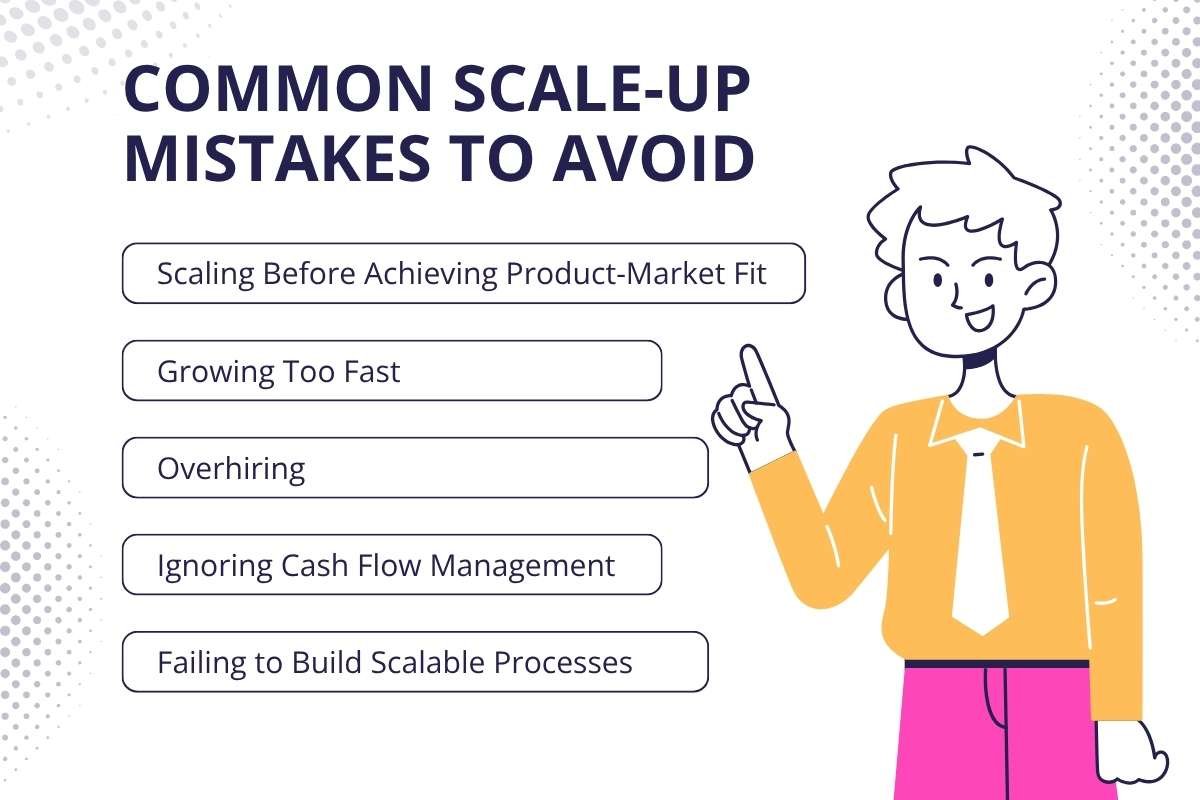
Even businesses with strong products, growing customer demand, and ambitious teams can struggle to scale if they make the wrong decisions. In many cases, it is not a lack of opportunity that causes growth to stall, it is avoidable mistakes that create operational, financial, and strategic challenges.
1. Scaling before achieving product-market fit
One of the most common mistakes is attempting to scale before validating customer demand. Expanding too early can amplify existing problems and lead to wasted resources. Before investing heavily in growth, businesses should ensure they have a proven product or service that consistently meets customer needs.
2. Growing too fast
Rapid growth may seem desirable, but expanding faster than your infrastructure can support often leads to declining service quality, operational inefficiencies, and financial strain. Sustainable growth is typically more effective than aggressive expansion without a clear plan.
3. Overhiring
Many companies assume that more employees automatically lead to more growth. However, hiring too many people too quickly can increase costs, reduce productivity, and create management challenges. Successful scaleups focus on hiring strategically rather than simply expanding headcount.
4. Ignoring cash flow management
Revenue growth does not always translate into financial stability. Businesses can become vulnerable when expenses increase faster than cash inflows. Monitoring cash flow, maintaining reserves, and forecasting future financial needs are critical during periods of expansion.
5. Failing to build scalable processes
Processes that work for a team of 10 may fail when the organization grows to 100 employees. Without documented workflows, automation, and standardized procedures, businesses often experience bottlenecks that slow growth and reduce efficiency.
Avoiding these mistakes can significantly improve the chances of scaling successfully. However, sustainable growth requires more than avoiding pitfalls; it requires focusing on the core factors that consistently drive long-term success. This is where the concept of the 4 C’s of Business Scaling becomes valuable.
The 4 c’s of business scaling
While every business follows a unique growth journey, successful scaleups tend to excel in four critical areas: Customer, Cash Flow, Capability, and Culture. Together, these pillars provide the foundation for sustainable expansion and help businesses navigate the challenges that come with growth.
1. Customer
Customers are the driving force behind every successful business. Without consistent demand and strong customer relationships, scaling becomes difficult to sustain. Businesses that scale effectively focus on understanding customer needs, improving experiences, and increasing customer retention.
Research from Bain & Company found that increasing customer retention by just 5% can boost profits by 25% to 95%, demonstrating the long-term value of customer loyalty.
Key focus areas include:
- Delivering exceptional customer experiences
- Gathering and acting on customer feedback
- Improving retention and loyalty
2. Cash Flow
Growth requires capital, making cash flow one of the most important factors in scaling. Even profitable businesses can encounter challenges if they lack the liquidity needed to fund expansion.
Strong cash flow management enables businesses to invest in technology, talent, marketing, and new opportunities without creating financial instability.
Key focus areas include:
- Monitoring cash flow regularly
- Maintaining adequate reserves
- Forecasting future financial needs
3. Capability
Capability refers to a business’s ability to execute its growth strategy. This includes having the right systems, technology, processes, and talent to support increasing demand.
As businesses grow, operational efficiency becomes a competitive advantage. Companies with scalable infrastructure can handle higher volumes without significantly increasing costs.
Key focus areas include:
- Building scalable systems and processes
- Leveraging automation and technology
- Developing leadership capabilities
4. Culture
Culture often becomes more difficult to maintain as organizations expand. However, it remains one of the most important factors influencing employee engagement, productivity, and long-term success.
A strong culture helps align teams around shared goals, supports innovation, and strengthens organizational resilience during periods of change.
Key focus areas include:
- Communicating clear values and vision
- Encouraging collaboration and accountability
- Investing in employee development
Why the 4 c’s matter?
Businesses that balance all four elements are better equipped to scale sustainably. A strong customer base generates demand, healthy cash flow funds growth, operational capability supports execution, and a positive culture keeps teams aligned and motivated.
Together, the 4 C’s provide a practical framework for evaluating whether a business is truly prepared for long-term expansion. Another principle that complements this framework is the 1% Rule, which shows how small, consistent improvements can create significant growth over time.
What is the 1% rule in business growth?

Scaling a business is often associated with major investments, bold decisions, and rapid expansion. However, some of the most significant results come from small, consistent improvements made over time. This idea is known as the 1% Rule.
The principle is simple: if a business improves by just 1% each day, those incremental gains compound over time and lead to substantial long-term growth. While a 1% improvement may seem insignificant in isolation, the cumulative impact can be transformative when applied consistently across operations, sales, marketing, customer service, and leadership.
Why Small Improvements Matter?
Many businesses focus exclusively on large-scale initiatives while overlooking smaller opportunities for optimization. Yet improving a sales conversion rate, reducing customer response times, streamlining workflows, or increasing employee productivity by even a small margin can create measurable business impact over time.
For example:
- A 1% increase in customer retention can lead to higher lifetime value and recurring revenue.
- A 1% improvement in operational efficiency can reduce costs and improve profitability.
- A 1% increase in conversion rates can generate more revenue without increasing marketing spend.
When these gains are multiplied across multiple areas of the business, their combined effect becomes significant.
Applying the 1% Rule to Scaling
Successful scaleups rarely achieve growth through a single breakthrough. Instead, they focus on continuous improvement across key business functions.
Some practical ways to apply the 1% Rule include:
- Automating repetitive tasks to improve efficiency
- Optimizing sales and marketing campaigns based on performance data
- Enhancing customer support processes
- Reducing operational bottlenecks
- Investing in employee training and development
The Power of Consistency
The 1% Rule reinforces an important lesson: sustainable scaling is not built overnight. Businesses that commit to continuous improvement are often better positioned to adapt, innovate, and maintain momentum as they grow.
While strategies, systems, and resources are essential, long-term success ultimately comes from making consistent progress in the right direction. Many of the world’s most successful companies have scaled by combining ambitious goals with a relentless focus on incremental improvements.
To see how these principles work in practice, let’s look at a few real-world examples of businesses that scaled successfully and the strategies that helped fuel their growth.
Real-world examples of businesses that scaled successfully
Understanding scaling strategies is important, but seeing how successful companies applied them in practice provides valuable lessons. While every business follows a different path, the following examples highlight common themes such as innovation, operational efficiency, customer focus, and strategic expansion.
1. Airbnb: Scaling through technology and market expansion
Founded in 2008, Airbnb started as a simple platform that allowed homeowners to rent out spare rooms to travelers. Rather than investing heavily in physical assets, the company leveraged technology to connect hosts and guests at scale.
As demand grew, Airbnb expanded into new cities and countries while continuously improving its platform, trust mechanisms, and customer experience. Today, it operates in more than 220 countries and regions, demonstrating how a scalable business model can support global growth.
Key takeaway: Build systems that allow growth without significantly increasing operational costs.
2. Netflix: Scaling by adapting to market changes
Netflix began as a DVD rental service but recognized early that consumer preferences were shifting toward digital streaming. The company successfully scaled by embracing technology, investing in content, and expanding internationally.
Instead of relying on a single revenue stream, Netflix diversified through original programming and global subscriptions. This ability to adapt helped it become one of the world’s leading entertainment platforms.
Key takeaway: Businesses that continuously innovate are better positioned to scale sustainably.
3. Shopify: Empowering other businesses to grow
Shopify scaled by solving a common challenge for entrepreneurs—creating and managing online stores. By offering a user-friendly platform with scalable tools, Shopify enabled millions of businesses to sell online without extensive technical expertise.
Its subscription-based model, ecosystem of integrations, and focus on merchant success allowed the company to grow rapidly while maintaining operational efficiency.
Key takeaway: Solving a widespread customer problem can create powerful scaling opportunities.
What Do These Companies Have in Common?
Although Airbnb, Netflix, and Shopify, operate in different industries, their scaling journeys reveal several shared characteristics:
- A strong understanding of customer needs
- Scalable systems and technology
- Continuous innovation and adaptation
- Data-driven decision-making
- Strategic expansion into new markets and opportunities
These examples demonstrate that there is no single formula for scaling a business successfully. However, companies that combine a strong foundation with the right growth strategies are far more likely to achieve sustainable, long-term success.
Conclusion:
Learning how to scale a business successfully is about more than increasing revenue—it is about building a company that can grow efficiently, profitably, and sustainably. From establishing product-market fit and strengthening cash flow to implementing scalable systems and avoiding common growth mistakes, every stage of the scaling journey requires careful planning and execution.
While challenges are inevitable, businesses that focus on continuous improvement, customer value, operational efficiency, and strategic decision-making are better positioned to thrive. By applying the strategies and frameworks discussed in this guide, you can create a foundation that supports long-term growth and turns expansion into a sustainable competitive advantage.
FAQs
1. What is the difference between business growth and business scaling?
Business growth typically requires increasing resources such as employees, infrastructure, or expenses to generate more revenue. Business scaling focuses on increasing revenue at a faster rate than costs, allowing the company to grow more efficiently.
2. When is the right time to scale a business?
A business is generally ready to scale when it has strong product-market fit, consistent revenue growth, healthy cash flow, efficient operations, and a repeatable sales process.
3. What is the biggest challenge when scaling a business?
Cash flow management is one of the biggest challenges. Rapid growth often requires significant upfront investments before additional revenue is realized.
4. What are the most effective ways to scale a business?
Some of the most effective strategies include building scalable systems, investing in technology, strengthening financial planning, retaining customers, hiring strategically, and making data-driven decisions.
5. Why do many businesses fail to scale successfully?
Many businesses struggle because they scale too early, grow too quickly, neglect cash flow management, fail to build scalable processes, or make decisions without sufficient data and planning.