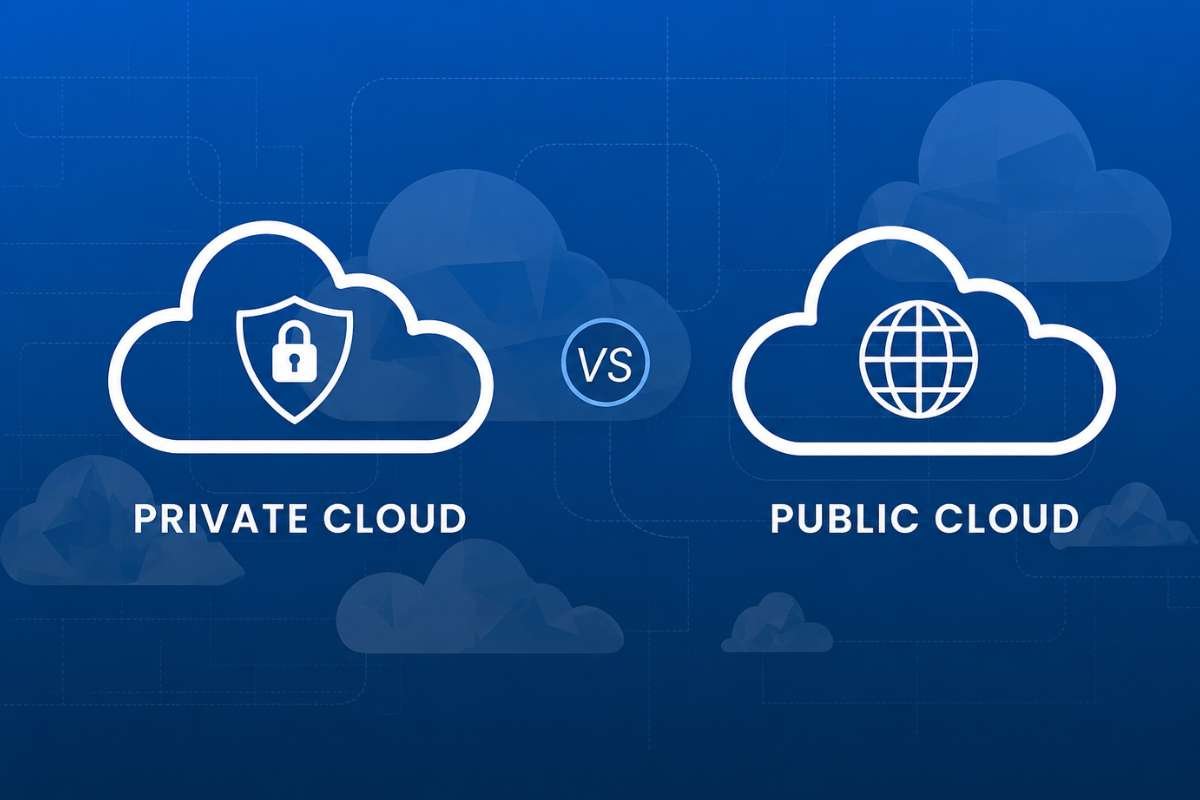
Choosing between public cloud vs private cloud depends on your priorities: scalability, control, security, compliance, and AI readiness. Public cloud offers lower upfront costs, rapid deployment, and elastic scaling, while private cloud provides dedicated infrastructure and greater control over sensitive workloads. This guide compares both models across cost, performance, and security, explores ideal business use cases, and explains how AI, compliance, and hybrid cloud strategies are shaping cloud decisions in 2026.
Public cloud vs private cloud: Which is for you? The answer is about much more than cost. Organizations must balance security, compliance, scalability, performance, and AI readiness when selecting a cloud strategy. Public cloud solutions offer flexibility and fast deployment. Whereas private cloud environments offer more control and customization. Understanding where each model excels and where it falls short can help you avoid costly technology decisions.
In this guide, we’ll compare the two approaches and break down which option is best for different business needs in 2026.
Table of Contents
Public cloud vs Private cloud: key differences at a glance
No single option is universally better: public cloud is generally better for most businesses due to lower costs and scalability, while private cloud suits organizations needing full control and strict security compliance.
Key differences: public cloud vs private cloud
| Factor | Public Cloud | Private Cloud |
| Definition | Third-party provider delivers services over the internet to multiple organizations. | A single organization exclusively uses dedicated infrastructure. |
| Ownership | Third-party provider | Single organization |
| Infrastructure Management | Provider-managed | Organization-managed |
| Cost Structure | Subscription/usage-based (pay-as-you-go) | Capital + operational costs (high upfront) |
| Security Responsibility | Shared responsibility | Full control |
| Scalability | Very high | Limited by infrastructure |
| Deployment Speed | Fast | Slower |
Public cloud brings operational efficiency across use cases. Private clouds excel in security, control, and customization.
Public cloud vs Private cloud: cost, security, and performance comparison

Understanding Public Cloud vs Private Cloud requires recognizing that neither model is universally superior. Each serves different organizational needs based on trade-offs in cost, security, and performance.
1. Cost
- Upfront costs: Private cloud demands a high initial investment for servers, storage, and networking hardware. Public cloud has no upfront costs.
- Long-term operating costs: Private cloud requires ongoing maintenance, cooling, electricity, upgrades, and IT staff. Public cloud charges only for usage, with lower ongoing costs
- Cost predictability: Public cloud offers predictable subscription/usage-based pricing; private cloud costs vary with maintenance and upgrade needs
- Resource utilization: Public cloud achieves higher utilization through economies of scale. Private cloud may suffer from underutilization since resources serve only one organization.
2. Security
- Shared responsibility model: Public cloud divides security, the provider secures the infrastructure, and the customer secures data and applications
- Dedicated environments: Private cloud provides single-tenant isolation with no shared resources
- Access controls: Private cloud enables full customization of firewalls, VPNs, and encryption. Public cloud offers standard controls with optional premium features.
- Compliance requirements: Private cloud allows organizations to tailor compliance measures. Public cloud requires continuous compliance efforts in shared environments.
3. Performance
- Resource isolation: Private cloud guarantees complete isolation; public cloud uses virtualization but shares physical hardware
- Latency: Private cloud typically has lower latency for on-premises workloads; public cloud latency varies by geography
- Workload consistency: Private cloud delivers stable performance since resources aren’t shared. Public cloud performance may fluctuate during peak usage.
- High-performance computing: Public cloud offers superior HPC scale with global data centers. A private cloud is limited by physical capacity.
Which cloud model works best for different business scenarios?
The right cloud model depends on your specific business needs. Public Cloud excels for speed and scalability, Private Cloud for control and compliance, and Hybrid Cloud for flexibility.
Best cloud model for different business scenarios:
- Startup launching quickly → Public Cloud
Startups need fast deployment without infrastructure complexity. Public cloud offers managed platforms costing $50–200/month initially.
- Healthcare compliance → Private Cloud
Healthcare requires HIPAA/GDPR compliance with dedicated environments; private cloud enables full control over encryption and access controls.
- AI model training → Public Cloud
AI training demands massive compute power and scalable accelerators; public cloud provides serverless training and dedicated clusters without upfront investment.
- Sensitive financial records → Private Cloud
Financial data needs the highest security and isolation. A private cloud ensures complete data control in your data center.
- Seasonal traffic spikes → Public Cloud
Public cloud scales instantly during demand spikes without capacity planning; you pay only for usage during peak periods
- Legacy applications → Private Cloud
Legacy systems often require custom configurations and on-premises integration; private cloud supports these without migration challenges.
- Mixed workloads → Hybrid Cloud
Hybrid cloud combines public cloud flexibility for variable workloads with private cloud security for sensitive data, ideal for banks and enterprises.
Why AI and compliance are changing cloud decisions in 2026?

In 2026, AI workloads and compliance requirements are reshaping Public Cloud vs Private Cloud decisions, with organizations choosing based on GPU access, data sovereignty, and regulatory needs.
1. AI Workloads
- GPU access: Public cloud provides instant access to NVIDIA GPUs and specialized accelerators without upfront investment; private cloud requires costly hardware purchases
- Model training: AI-native cloud platforms offer purpose-built supercomputing optimized for large language models; 90% of organizations now run self-hosted models in the cloud
- AI scalability: Public cloud scales AI workloads elastically with serverless training and dedicated clusters; private cloud is limited by physical capacity
2. Compliance trends
- Data sovereignty: New regulations require data to stay within national borders. Sovereign cloud strategies ensure data remains in specific jurisdictions.
- Industry regulations: GDPR, HIPAA, and ISO standards mandate strict security controls. Industry-specific cloud platforms embed compliance controls directly.
- Regional storage requirements: Organizations must store data in regional data centers. Hybrid models combine public cloud flexibility with private cloud regional control.
3. Emerging trends
- Sovereign cloud strategies: 2026 sees accelerated adoption of sovereign clouds that guarantee data residency and regulatory compliance within specific countries
- Confidential computing: Confidential AI enables secure processing with encryption-in-use; the Confidential Computing Summit 2026 showcases next-era AI sovereignty
- Industry-specific cloud environments: Healthcare, financial services, and manufacturing get tailored platforms with sector-specific data models, workflows, and compliance controls
When a hybrid cloud may be the better choice?

Hybrid cloud becomes the better choice when organizations need to balance the scalability of public cloud with the control of private cloud, a common scenario in enterprise architecture.
1. What is hybrid cloud?
A hybrid cloud combines public and private environments into a unified IT environment, using at least one private cloud and one public cloud connected together. This allows organizations to keep mission-critical data in a private cloud while running application development in a public cloud.
2. Common enterprise architecture
Large organizations host customer-facing services in public cloud while keeping company data in private cloud. This architecture supports vertical markets where customer interactions need scalability, but sensitive data requires security.
3. Benefits
- Flexibility: Hybrid cloud provides operational flexibility and scalability by placing each workload in the most efficient cloud format
- Compliance: Organizations meet regulatory requirements by storing regulated data privately while using the public cloud for non-sensitive workloads
- Cost optimization: Balance the public cloud’s low cost of ownership with the private cloud’s predictable usage patterns for business-critical applications
- Business continuity: Hybrid architectures enable failover capabilities and resiliency across multiple clouds, reducing vendor lock-in risks
4. Simple decision framework
- Need maximum scalability → Public Cloud
Public cloud offers automated deployments, auto-scaling, and on-demand hosting for large applications.
- Need maximum control → Private Cloud.
Private cloud provides the greatest configurability, security, and adaptability for highly regulated organizations.
- Need both → Hybrid Cloud.
Hybrid cloud serves as the midway point, delivering public cloud flexibility with private cloud security.
Conclusion:
The Public Cloud vs Private Cloud debate is not about the “best” choice. It’s about aligning your cloud strategy with your organization’s unique needs. Startups and AI workloads benefit from the speed, scalability, and cost efficiencies of the public cloud. Private cloud provides you with control, security, and compliance for healthcare and finance data. Hybrid cloud bridges both when you want flexibility. AI readiness and compliance requirements are influencing decisions and making sovereign cloud and confidential computing key considerations in 2026. Analyze your workload requirements, regulatory obligations, and growth plans before making a decision.
Ready to Decide? Identify your number one priority: scalability, control, or flexibility, and let that guide your cloud strategy.
FAQ:
1. Is Azure a public or private cloud?
Microsoft Azure is primarily a public cloud. It is a massive, globally distributed cloud computing platform where computing infrastructure (servers, storage, and networking) is owned, operated, and maintained by Microsoft.
2. Is AWS a public or private cloud?
Amazon Web Services (AWS) is primarily a public cloud provider.
3. Is Google Cloud public or private?
Google Cloud is a public cloud computing service. It operates as a multi-tenant platform where computing resources, storage, and services are shared among multiple customers and accessible over the public internet.
4. Is Amazon a public or private cloud?
AWS, or Amazon Web Services, is a public cloud service provider, not a private cloud. It’s important to know the difference between public and private clouds.
5. What are the 4 types of cloud services?
The 4 main types of cloud services are often called the cloud computing stack. They are Infrastructure as a Service (IaaS), Platform as a Service (PaaS), Serverless computing, and Software as a Service (SaaS).