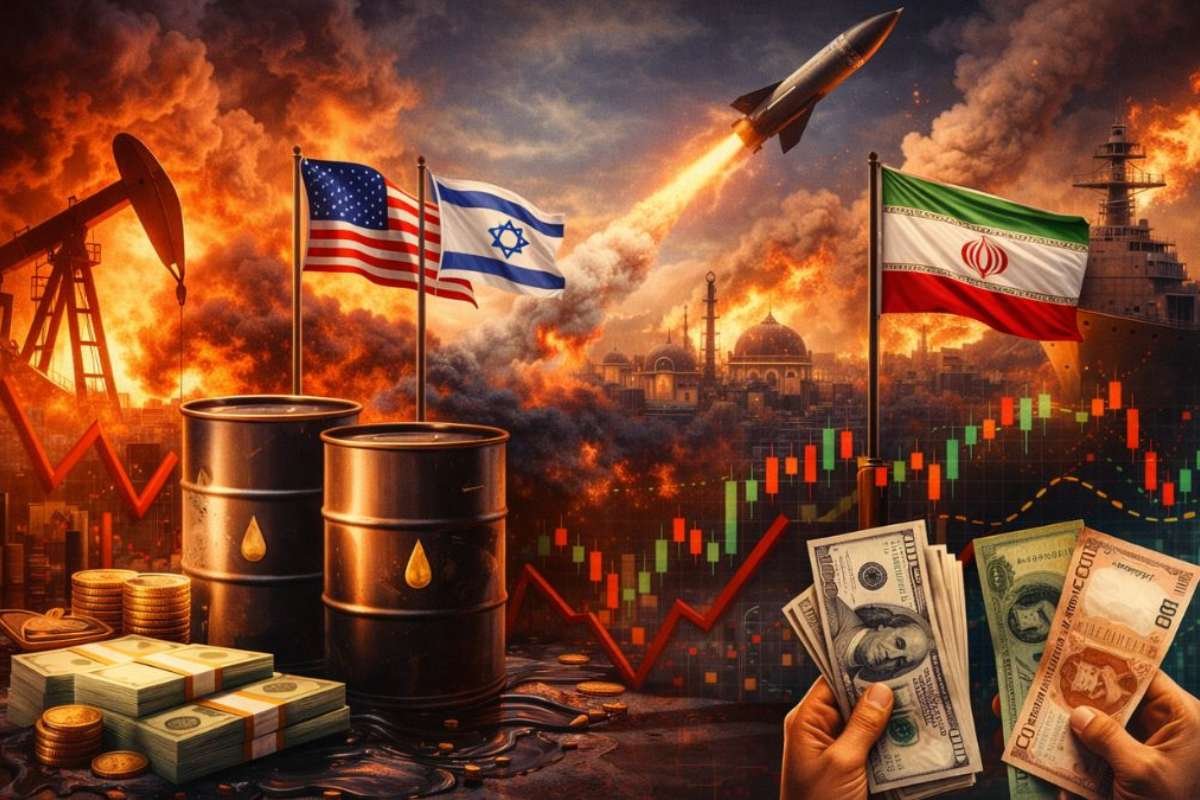
Global financial markets opened the week with sharp currency and commodity movements after renewed military activity involving the United States, Israel, and Iran created uncertainty across international trade and energy sectors, highlighting how US Israel Iran conflict currencies are influencing investor sentiment as trading resumed.
Currency Markets Shift As Investors Seek Stability
Traditional safe assets such as the Swiss franc and Japanese yen strengthened as investors moved funds toward currencies viewed as stable during periods of uncertainty. At the same time, the euro weakened against major currencies, reflecting cautious market sentiment during early trading hours.
The euro declined against both the United States dollar and the Swiss franc during the US Israel Iran conflict currencies shift, reaching levels not seen in several years against the Swiss currency. The dollar also eased against the yen and the Swiss franc but gained ground against the British pound and the Australian dollar, showing mixed global demand for reserve currencies.
Foreign exchange markets were among the first to respond, since currency trading continues across global time zones. Market participants quickly began evaluating possible economic outcomes linked to disruptions in trade routes, transportation networks, and energy supply chains.
Business owners engaged in international trade are watching currency volatility closely, as sudden exchange rate changes can influence import costs, export pricing, and profit margins. Companies that rely on cross border payments may face fluctuating transaction values in the coming days.
Energy Prices And Trade Routes Drive Market Outlook
Energy markets remain central to investor attention due to Iran’s position as a major oil producer, and the US Israel Iran conflict currencies trend reflects broader concerns tied to critical shipping routes like the Strait of Hormuz, a key passage for global oil transport, handles a significant share of worldwide energy supply.
Oil prices moved higher in early trading activity, with market participants expecting further increases depending on supply conditions. Rising oil prices often affect transportation costs, manufacturing expenses, and logistics operations, which can influence pricing decisions across multiple industries. Gold prices are also expected to rise as investors seek assets that traditionally retain value during uncertain market periods. Meanwhile, stock markets in several Gulf economies recorded declines, reflecting investor caution toward regional business activity.
Financial analysts outlined possible scenarios ranging from limited market disruption to wider economic effects if energy supply faces extended pressure. Each outcome carries different implications for inflation expectations, borrowing costs, and investment planning.
Entrepreneurs and business owners are now focusing on contingency planning as US Israel Iran conflict currencies volatility signals potential cost pressures. Companies connected to shipping, aviation, manufacturing, and energy dependent operations may experience cost adjustments if fuel prices remain elevated. Market participants continue to assess how energy availability will influence global growth trends. Changes in oil pricing often ripple across supply chains, affecting everything from freight movement to consumer goods production.
As trading continues through the week, businesses worldwide are expected to monitor currency movements, commodity prices, and transportation conditions to guide operational decisions and financial planning in an evolving global market environment.