A new teacher in California starts at $58,409 a year, while the same job in Montana pays $35,674. That is a $23,000 difference before they finish their first semester. A few years later, a California teacher can make more than $101,000, while a Mississippi educator earns $53,704. That creates a $47,000 gap for the same role. These numbers have real effects on whether teachers can afford homes, manage student loans, or stay in the profession long enough to make a meaningful impact.
The state in which a teacher works has a significant influence on their future. Starting pay rose 4.4 percent recently, the most significant jump in fifteen years, yet rising costs have reduced the value of those gains. Teachers today actually make about 5 percent less than they did ten years ago. States with low pay struggle to retain dedicated educators, leading many to burnout or consider career changes. States that invest in higher pay for teachers tend to retain experienced educators in classrooms and help achieve better outcomes for students.
Understanding teacher salaries by state, where pay is more extensive, and which states are finally prioritizing education funding, can inform essential career choices. This article lists the top 20 highest-paying states for teachers.
Understanding Teacher Salaries in 2025
The national average teacher salary reached $72,030 for the 2023-24 school year, with new teachers starting at $46,526. Starting salaries jumped 4.4 percent, the most significant increase in fifteen years. However, here’s the problem: despite these headline gains, teachers actually earn about 5 percent less than they did a decade ago when adjusted for inflation. A starting teacher in 2024 makes $3,728 less in real terms than one did in 2008.
Teachers also earn significantly less than other college-educated professionals. The Economic Policy Institute found that teachers earn between 62 cents and 90 cents for every dollar earned by workers with similar education levels. This gap varies by state but exists everywhere. Union membership makes a huge difference, too. Teachers in collective bargaining states earn 24 percent more than those in non-union states, which explains why the highest-paying states for teachers, such as New York and California, offer more substantial compensation than right-to-work states.
States that invest heavily in education tend to pay teachers better. New York spends $31,514 per student annually and offers competitive salaries. Idaho spends just $9,942 per student and struggles to attract teachers. These patterns matter because they determine whether experienced educators stay in classrooms or leave the profession, and which regions can attract talented teachers versus facing constant shortages.
The Top 20 States Ranked by Average Teacher Salary
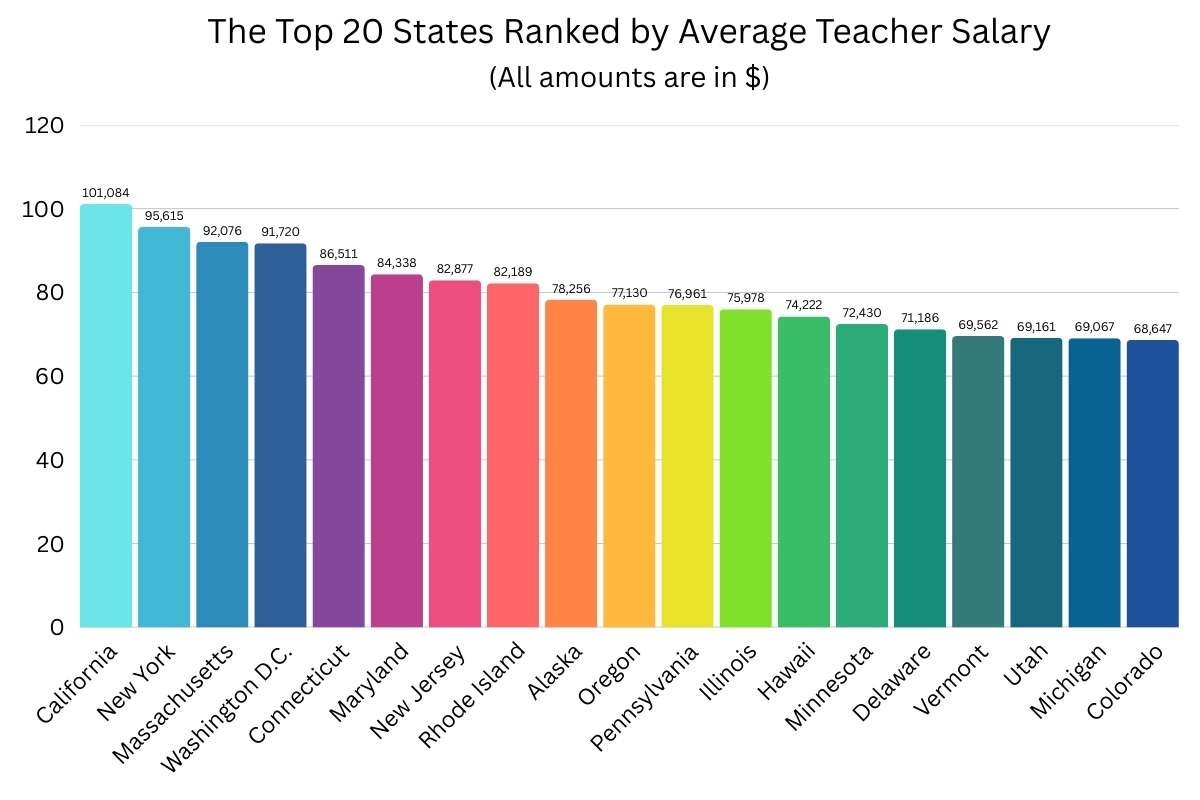
| Rank | State | Average Salary | Starting Salary | Key Note |
| 1 | California | $101,084 | $58,409 | West Coast leader; strong unions |
| 2 | New York | $95,615 | $50,077 | Highest education investment |
| 3 | Massachusetts | $92,076 | $52,616 | Top-tier funding commitment |
| 4 | Washington | $91,720 | $57,912 | High starting pay for the West Coast |
| 5 | Washington D.C. | $86,663 | $63,373 | Highest starting salary nationally |
| 6 | Connecticut | $86,511 | $49,860 | Northeast stronghold |
| 7 | Maryland | $84,338 | $54,439 | Mid-Atlantic gem |
| 8 | New Jersey | $82,877 | $57,603 | Third-highest starting salary |
| 9 | Rhode Island | $82,189 | $47,205 | Competitive compensation |
| 10 | Alaska | $78,256 | $52,451 | Cost-of-living premium |
| 11 | Oregon | $77,130 | $44,446 | Pacific Northwest appeal |
| 12 | Pennsylvania | $76,961 | $50,470 | Stable performance |
| 13 | Illinois | $75,978 | $45,061 | Best cost-of-living value |
| 14 | Hawaii | $74,222 | $51,835 | Island premium; living wage challenge |
| 15 | Minnesota | $72,430 | $44,995 | Midwest excellence |
| 16 | Delaware | $71,186 | $48,407 | Mid-Atlantic stability |
| 17 | Vermont | $69,562 | $44,524 | High per-student spending |
| 18 | Utah | $69,161 | $55,711 | Growing market opportunity |
| 19 | Michigan | $69,067 | $41,645 | Improving trajectory |
| 20 | Colorado | $68,647 | $42,421 | Mountain living appeals |
California teachers earn $32,437 more per year than their counterparts in Colorado. Over a 30-year career, that’s a $3.2 million difference before pensions and benefits.
Living Wage vs. Teacher Salary
Most people assume that a teacher earning $75,000 or $80,000 a year lives comfortably. However, comfort depends entirely on where that teacher lives. A teacher in Hawaii making $74,222 annually faces a problem: the livable wage for a single adult with one child in Hawaii is $103,670. That means Hawaii teachers fall nearly $30,000 short of what they actually need to cover rent, food, childcare, and other basics. They’re working full-time but financially underwater.
This gap between salary and a livable wage exists in almost every state, although it appears differently depending on the location. A Mississippi teacher earning $53,704 lives in a state where the livable wage is $62,865—still about $9,000 short of the state’s recommended amount. Even teachers in some of the highest-paying states for teachers face this reality. A Massachusetts teacher earning $92,076 needs $79,117 to cover living expenses, leaving a thin cushion. Only California truly offers teachers breathing room, with an average salary of $101,084 compared to a livable wage of $69,601, creating an actual surplus.
The impact of these gaps shows up in teachers’ real lives. Many people work second jobs, skip healthcare expenses to save money, or delay major purchases, such as buying a home. In states with the worst shortfalls, experienced teachers leave education for jobs that actually pay enough to live on. This creates a vicious cycle: as experienced teachers leave, schools lose institutional knowledge and have to spend more on recruiting and training replacements. Students suffer when classrooms change frequently and lack continuity.
Understanding these wage gaps is essential because it reveals which states genuinely support teachers and which ones expect them to sacrifice financially for their work. A teacher choosing a state needs to know not just the salary number, but whether that salary actually allows them to build a stable life in that state.
Regional Analysis: Understanding Geographic Patterns
1. Northeast Dominance
New York, Massachusetts, Connecticut, New Jersey, Rhode Island, Pennsylvania, and Maryland occupy the top tier of teacher pay. These states have invested heavily in public education for generations, established strong teacher unions, and prioritized salary competitiveness. The trade-off is fundamental, though the Northeast also has the highest cost of living in the nation. A $95,000 salary in New York doesn’t stretch as far as it sounds when rent and housing prices consume 40-50 percent of income. This region consistently appears on lists of the highest-paying states for teachers, despite affordability remaining a challenge.
2. West Coast Premium
California and Washington lead the West, with Oregon close behind. The tech industry’s growth in these regions has dramatically inflated housing costs, but it has also driven competitive salaries. California’s $101,084 average remains the highest in the nation, although teachers still struggle with affordability in cities such as San Francisco and Los Angeles. Washington offers a better cost-of-living value than California while maintaining strong pay. These states attract teachers willing to accept higher costs for better compensation and school resources.
3. Midwest Sweet Spot
Illinois, Minnesota, and Michigan represent the hidden gem region. These states deliver solid teacher salaries without extreme cost-of-living challenges. Illinois, in particular, offers the best value; teachers earn a decent wage while living in areas where that income actually covers housing, food, and savings. This region appeals to teachers prioritizing financial stability and work-life balance over prestige or coastal living.
4. Mountain and Southwest Emerging
Colorado, Utah, and Arizona are catching up. These states offer younger populations, affordable housing compared to the coasts, and growing education funding. Utah particularly stands out with a $55,711 starting salary despite a lower average, suggesting aggressive recruitment of new teachers. Teachers moving to these states often sacrifice some immediate wage for a better quality of life and lower cost of living.
5. South Struggling
Mississippi, Louisiana, Florida, Texas, and North Carolina lag the nation. These states have historically underfunded education, maintain weak union presence, and struggle with teacher retention. Mississippi teachers earn $53,704—nearly half what California teachers make. This region faces persistent teacher shortages and rarely competes with the highest-paying states for teachers, relying more on educators relocating for family or personal reasons rather than salary appeal.
The Salary Gap Crisis: Why These Disparities Exist
The $47,000 difference between California and Mississippi teachers reflects decades of different policy choices, funding models, and political priorities. Understanding why these gaps exist helps explain whether they will narrow or widen in the coming years, and why the highest-paying states for teachers consistently rank at the top of national rankings.
Historical Underfunding in Southern States
Southern states have consistently spent less on public education than the national average. This pattern can be traced back to historical inequities in school funding and persists to this day. Mississippi spends $9,942 per student annually, while Massachusetts spends $26,123, a 2.6 times difference. When states allocate less money overall to education, teacher salaries are the first to suffer. Teachers in the South aren’t lazy or less qualified; they work within systems that have fewer resources to distribute, which also affects how far states are from the highest-paying states for teachers.
Union Strength and Collective Bargaining
The 24 percent salary premium in union states accounts for a significant portion of the regional divide. California, New York, Massachusetts, and New Jersey all have strong teacher unions that negotiate salary schedules, protect against pay cuts, and push for regular increases. States like Mississippi and Texas have weaker union presence, giving individual districts and states more flexibility to keep salaries low. Union contracts offer predictable salary growth and job security, which non-union teachers often lack, helping solidify these states among the highest-paying states for teachers.
Tax Revenue Models and Education Funding Priorities

States fund schools differently. Some rely heavily on income taxes, others on property taxes, and a few on sales taxes. States with strong income tax bases (like New York and California) can fund education more generously. States relying on property taxes struggle when wealthy areas hoard resources for their own schools while poor areas fall behind. Federal funding addresses some gaps but doesn’t eliminate them. States that choose to prioritize education, through budget allocation and tax policy, tend to allocate more funds to teachers. States that treat education as a secondary expense tend to keep salaries low, widening the gap between them and the highest-paying states for teachers.
Cost of Living Doesn’t Explain Everything
While the cost of living is a factor, it doesn’t fully explain salary disparities. Even after adjusting for regional differences in prices, California teachers earn significantly more than their counterparts in Mississippi. A teacher in California earns more in real terms, not just in nominal dollars. This suggests that state wealth, education policy, and political will matter more than simple economics. Wealthy states pay teachers better because they can afford to and because they’ve chosen to.
The highest-paying states for teachers tend to share several commonalities: strong unions, education-focused budgets, higher state tax revenues, and a political commitment to public schools. These factors work together to create regions where teaching is a solid middle-class career and areas where it remains financially precarious.
Starting Salaries: The Critical First Year
A teacher’s starting salary determines whether they can afford to stay in the profession or must seek higher-paying work immediately. The national average starting salary sits at $46,526, but this masks enormous regional variation that shapes teachers’ earliest career decisions. The following are the 10 states with the highest starting salaries for teachers.
| Rank | State | Starting Salary | Annual Growth Potential |
| 1 | Washington D.C. | $63,373 | $86,663 (avg) |
| 2 | California | $58,409 | $101,084 (avg) |
| 3 | Washington | $57,912 | $91,720 (avg) |
| 4 | New Jersey | $57,603 | $82,877 (avg) |
| 5 | Maryland | $54,439 | $84,338 (avg) |
| 6 | Utah | $55,711 | $69,161 (avg) |
| 7 | Alaska | $52,451 | $78,256 (avg) |
| 8 | Massachusetts | $52,616 | $92,076 (avg) |
| 9 | Hawaii | $51,835 | $74,222 (avg) |
| 10 | Pennsylvania | $50,470 | $76,961 (avg) |
Bottom 10 States by Starting Teacher Salary
| Rank | State | Starting Salary | Annual Growth Potential |
| 41 | Ohio | $40,982 | $60,458 (avg) |
| 42 | Kentucky | $40,161 | $59,827 (avg) |
| 43 | Missouri | $38,871 | $58,292 (avg) |
| 44 | Nebraska | $38,811 | $55,104 (avg) |
| 45 | Montana | $35,674 | $52,614 (avg) |
| 46 | Mississippi | $39,156 | $53,704 (avg) |
| 47 | West Virginia | $36,245 | $54,389 (avg) |
| 48 | Idaho | $37,892 | $50,625 (avg) |
| 49 | Oklahoma | $37,456 | $49,872 (avg) |
| 50 | South Dakota | $36,891 | $48,927 (avg) |
Key Facts:
- D.C. teachers earn 77% more than Montana teachers in year one ($63,373 vs. $35,674)
- Only 30% of districts nationally offer starting salaries of $50,000+
- 34 states pay starting teachers below $40,000
- Over 5 years, the D.C./Montana gap totals approximately $139,485 in cumulative earnings difference
Starting salary reveals state commitment. High-paying entry positions attract talent and reduce turnover. Low starting salaries drive experienced teachers out and create perpetual recruitment crises.
The Master’s Degree Advantage
How Advanced Education Affects Teacher Pay?
| Degree Level | National Average Salary | Average Salary Bump | Percentage Increase |
| Bachelor’s Degree | $68,450 | — | — |
| Master’s Degree | $72,102 | +$3,652 | +5.3% |
| Specialist/Certificate | $73,891 | +$5,441 | +7.9% |
| Doctorate (Ed.D) | $76,340 | +$7,890 | +11.5% |
State-by-State Master’s Degree Premium
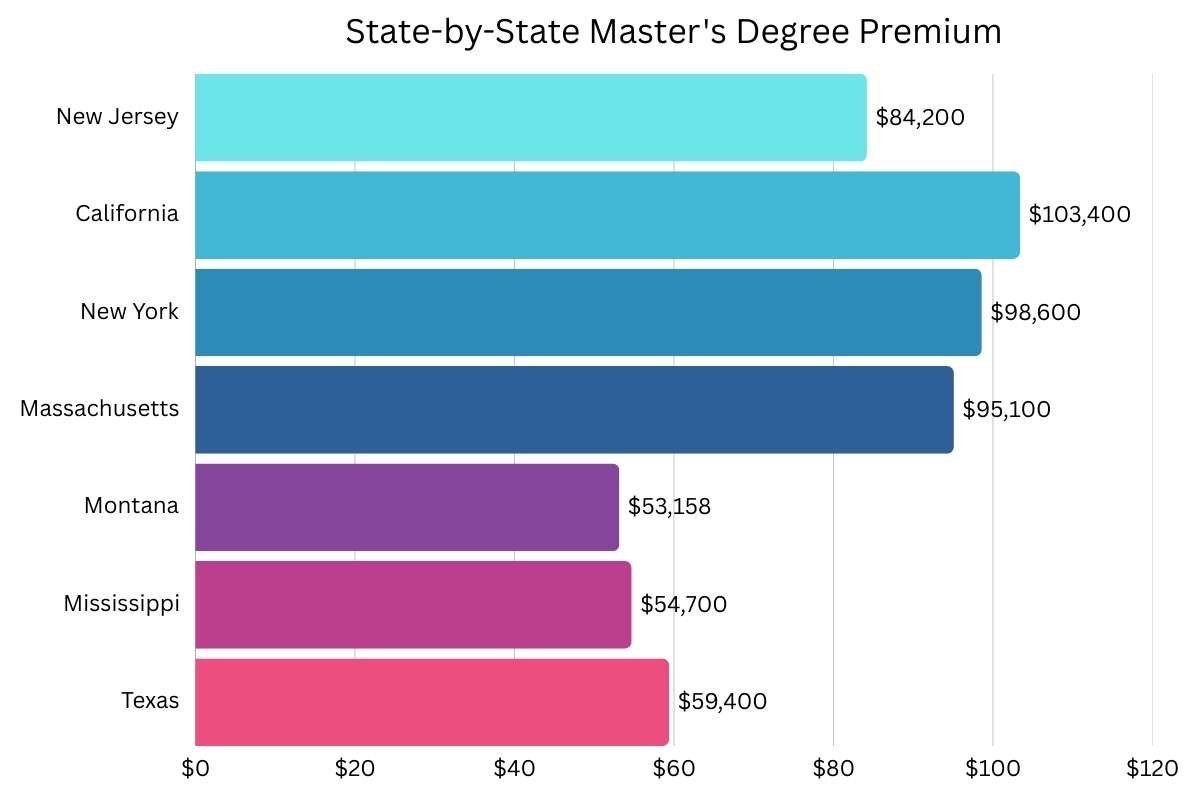
| State | Bachelor’s Average | Master’s Average | Bump | Worth It? |
| New Jersey | $78,500 | $84,200 | +$5,700 | Yes |
| California | $97,200 | $103,400 | +$6,200 | Yes |
| New York | $91,100 | $98,600 | +$7,500 | Yes |
| Massachusetts | $88,900 | $95,100 | +$6,200 | Yes |
| Montana | $50,100 | $53,158 | +$3,058 | Maybe |
| Mississippi | $51,400 | $54,700 | +$3,300 | Maybe |
| Texas | $56,800 | $59,400 | +$2,600 | Maybe |
Key Points:
- 92% of large school districts reward advanced degrees
- Pursuing a master’s while teaching requires careful planning
- Online programs and district tuition assistance can offset costs
- ROI takes 8-12 years in lower-paying states, 4-6 years in higher-paying states
- Master’s degrees also open doors to administrative roles (principals earn $120,000+)
Is a $3,652 annual bump worth 2 years of study, tuition costs, and lost free time? In New Jersey or California, the answer is yes—the bump exceeds $6,000. In Montana or Mississippi, you’re looking at a $3,000 increase that takes years to recoup financially.
Beyond Base Salary: Compensation Packages That Matter
Teacher compensation extends far beyond the annual salary number. Health insurance quality, retirement security, loan forgiveness programs, and professional development support can add tens of thousands of dollars to your actual earning potential. When comparing the highest-paying states for teachers, these hidden benefits often matter as much as base pay.
Health Insurance Coverage by State
| State | Employer Covers | Employee Cost | Dental | Vision | Notes |
| California | 85-100% | $0-200/month | Yes | Yes | Comprehensive coverage |
| New York | 90-100% | $0-150/month | Yes | Yes | Among the best in the nation |
| Massachusetts | 85-95% | $50-200/month | Yes | Yes | Strong coverage |
| Washington | 80-90% | $100-250/month | Yes | Yes | Good value |
| Texas | 60-75% | $200-400/month | Limited | Limited | Gaps common |
| Mississippi | 50-70% | $300-500/month | Limited | No | Minimal coverage |
| Montana | 55-75% | $250-450/month | Limited | No | Teacher burden high |
Pension vs. 401(k): The Long-Term Impact
Most states use defined-benefit pension systems. A few have shifted to 401(k)-style plans.
- Pension states (CA, NY, MA, NJ): Teachers receive guaranteed retirement income for life. A 30-year teacher might receive 50-70% of their final salary annually for life—value: $500,000-$1,000,000+ over retirement.
- 401(k) states (some Southern states): Teachers rely on market returns and personal contributions. No guarantee. Significantly riskier for teachers.
- Hybrid systems (increasing): Some states offer both. Teachers get smaller pensions plus 401(k) matching.
Student Loan Forgiveness Programs
| Program | Eligibility | Forgiveness Amount | Years Required |
| Public Service Loan Forgiveness (PSLF) | All teachers | Up to $250,000 | 10 years |
| State-Specific Programs | Teachers in specific states | $5,000-$25,000 | 3-5 years |
| California SLRP | CA teachers in shortage areas | $20,000 | 4 years |
| New York TSAP | NY teachers in high-need schools | $4,250-$17,000 | 3-4 years |
| Texas Teacher Loan Repayment | TX teachers | $10,000 | 4 years |
Professional Development & Tuition Support
- California: $5,000-$10,000 annual professional development budgets
- New York: Tuition reimbursement up to $4,500/year for master’s programs
- Massachusetts: Graduate tuition assistance; 40+ hours paid professional development annually
- Texas: Limited; most districts offer $500-$1,500 annually
- Mississippi: Minimal; typically $200-$500 per teacher annually
Performance Bonuses & Subject-Specific Pay
Some states offer additional compensation for high performance or hard-to-fill subjects:
- STEM Teachers: +$2,000-$5,000 in many states
- Special Education: +$1,500-$4,000 annually
- Bilingual/ESL: +$1,000-$3,500 annually
- Performance Bonuses: $1,000-$8,000 for high test scores (varies by state/district)
The Compensation Advantage
A teacher in California earning $101,084 with full health coverage, a substantial pension, and $10,000 professional development support is actually earning closer to $125,000 in total compensation. A teacher in Mississippi earning $53,704 with limited health benefits, 401(k) exposure, and $500 professional development support has actual compensation of around $58,000. The real gap is even larger than salary numbers suggest.

Conclusion: Making Your Teacher Salary Decision
Teacher salaries by state matter more than most people realize. A California teacher earning $101,084 with comprehensive benefits and a substantial pension builds genuine financial security, while a Mississippi teacher earning $53,704 with minimal support faces constant financial stress. That gap reflects state choices, not differences in work ethic. The Northeast and West Coast include many of the highest-paying states for teachers because they have prioritized education funding and strong unions. The Midwest delivers solid value with reasonable salaries and lower living costs, while the South continues to struggle and lose experienced teachers year after year.
Where you teach influences your entire financial future: research complete compensation packages, not just base salary. Compare actual living costs in your target state. Consider your starting point carefully, since some states offer clear pathways to $90,000 while others cap out around $65,000. The profession needs better funding everywhere, but until that happens, your state choice determines whether teaching becomes a stable career or a financial sacrifice.