
The role of leadership in shaping the future of education is pivotal, requiring a blend of vision, dedication, and an unwavering commitment to cultivating an environment where students can thrive intellectually and personally. At the heart of such an institution lies a leader who not only embraces these values but also channels them into daily practice to inspire both staff and students alike. Effective school leadership aligns educational excellence with community values, fostering growth, creativity, and resilience within the school culture.
Nick Johnstone currently serves as the Principal of Toowoomba Anglican School, where he brings his extensive experience and passionate dedication to guiding the school community towards these goals. His leadership is marked by a focus on academic achievement, wellbeing, and the holistic development of every student. Under his guidance, Toowoomba Anglican School continues to uphold its strong commitment to faith, learning, and community service, positioning itself as a nurturing and forward-thinking educational institution.
A Leadership Path Rooted in Community and Service
Nick’s journey into education began in Bundaberg, Queensland, where he was raised with a strong sense of community and service. After earning a science degree from Griffith University, he felt drawn to teaching—a profession that combined his passion for science, curiosity, and his natural ability to connect with others. He started his teaching career at Baralaba P–10 Campus, where he quickly realized that education involved not only delivering curriculum but also understanding the lives and circumstances of children.
A significant turning point in his career occurred at St Luke’s Anglican School in Queensland, where he led the Science department, Middle School, and eventually K–12 Curriculum. It was there that he embraced the power of relational leadership, understanding that when teachers feel valued and supported, they are motivated to innovate, and when students face challenges in a supportive environment, they thrive. Later, as Principal at Geraldton Grammar School in Western Australia and Bishop Druitt College in New South Wales, NicNick Johnstone k gained valuable experience managing community change, strategic renewal, and large-scale innovation.
These experiences equipped him well to take on his current role at Toowoomba Anglican School in 2025, where he leads a school respected as one of Queensland’s premier institutions with a deep commitment to holistic education.
Rooted in Community, Focused on Excellence
Toowoomba Anglican School (TAS) is distinguished by its strong commitment to tradition and close community connections. At its core, TAS operates like a “village school,” where students are well known and families feel warmly welcomed. The school’s Anglican values guide all aspects of school life, emphasizing love, hope, and service.

At the same time, TAS is progressive and ambitious. Over the years, it has developed one of the state’s leading performing arts programs and consistently achieves excellent academic results. TAS functions as both a day and boarding school, with boarding available for students across all primary and secondary year levels. Nick Johnstone is a firm supporter of co-education and has chosen to lead only co-educational schools throughout his career spanning over 30 years. The school’s carefully nurtured village atmosphere remains a core strength of its community.
Toowoomba Anglican School Awards & Recognitions

- Boarding School of the Year, Australian Education Awards (2020, 2021)
- Gold Award, Australian International Music Festival (2023)
- Queensland’s Most Outstanding Tennis School (2024)
- Top 150 Schools for Literacy & Numeracy in Australia (2024)
- Three-time Downs Rugby Super Schools Cup Champions (First XV) (2023, 2024 & 2025)
- Celebrating holistic education as a core strength.
Turning Decline into Growth
One of the most difficult periods in Nick Johnstone’s leadership was when Bishop Druitt College faced declining enrolments and low morale within the community. He recognized that communities often see decline as part of their identity, and changing this mindset required trust, a clear vision, and perseverance. His first step was to listen carefully to parents, students, and staff. Over the first few months, he met with each staff member individually to understand their perspectives and to build trust. Together, they developed a strategic plan that set an ambitious future while also acknowledging and valuing the school’s existing strengths.
Through initiatives such as establishing a Wellbeing Hub, focusing on Indigenous education, and launching innovative middle-year learning programs like the Kaizen Initiative, they began to tell a new story of growth and potential. Within a few years, the college achieved record enrolments and reached its strongest financial and reputational position in history. Personally, Nick Johnstone learned that meaningful change does not happen through quick solutions, but by fostering hope and maintaining momentum in the everyday life of a community.
Milestones That Reflect Impact and Innovation
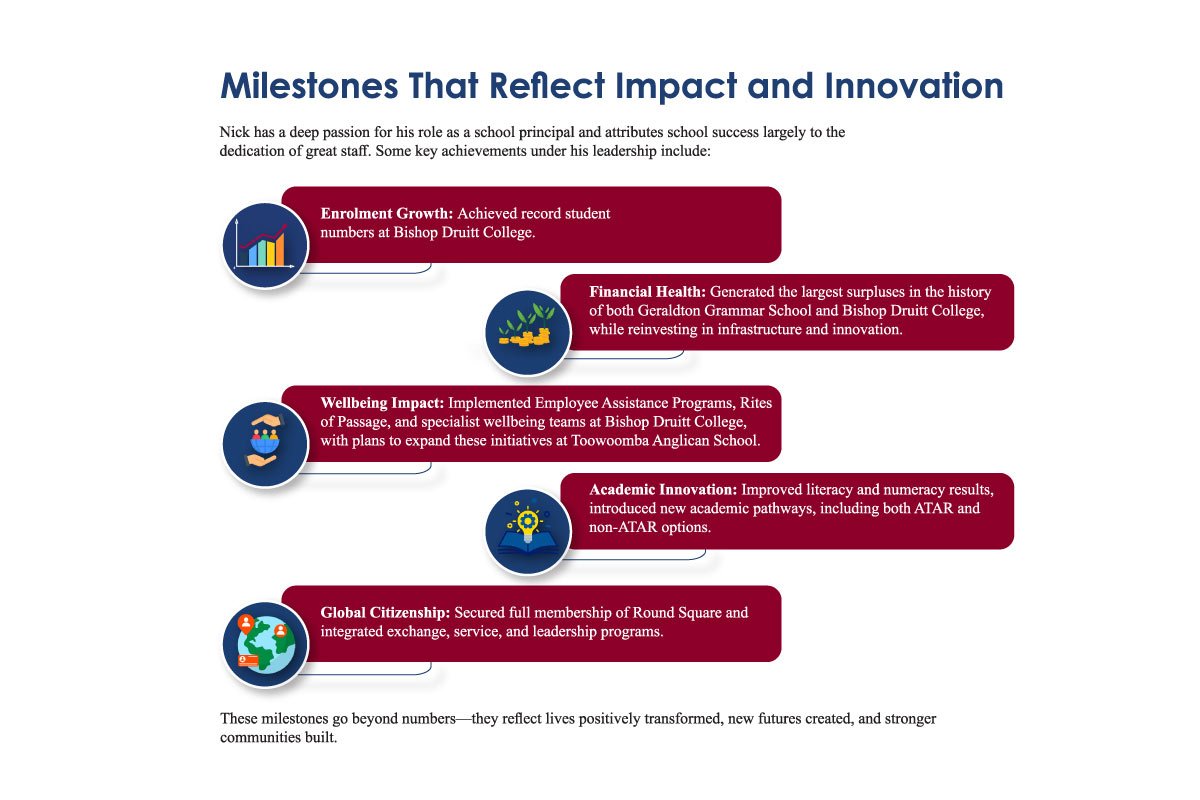
Nick Johnstone has a deep passion for his role as a school principal and attributes school success largely to the dedication of great staff. Some key achievements under his leadership include:
- Enrolment Growth: Achieved record student numbers at Bishop Druitt College.
- Financial Health: Generated the largest surpluses in the history of both Geraldton Grammar School and Bishop Druitt College, while reinvesting in infrastructure and innovation.
- Wellbeing Impact: Implemented Employee Assistance Programs, Rites of Passage, and specialist wellbeing teams at Bishop Druitt College, with plans to expand these initiatives at Toowoomba Anglican School.
- Academic Innovation: Improved literacy and numeracy results, introduced new academic pathways, including both ATAR and non-ATAR options.
- Global Citizenship: Secured full membership of Round Square and integrated exchange, service, and leadership programs.
These milestones go beyond numbers—they reflect lives positively transformed, new futures created, and stronger communities built.
Transparency and Inclusion in School Leadership
Nick Johnstone emphasizes that “transparency is built into governance: clear communication with School Council, staff, and families ensures decisions are ethical and accountable.” Inclusion at Toowoomba Anglican School is guided by both policy and culture, with active efforts to gather formal and informal feedback through focus groups and surveys.
The school’s Anglican values form the foundation for its commitment to dignity, respect, and service. By incorporating wellbeing programs, feedback systems, and continuous improvement processes, TAS strives to create a safe and supportive environment where every student, parent, and staff member feels respected and valued.
Innovative Frameworks Advancing Learning and Culture
- BDC Investigations: Neuroscience-based early learning.
- Kaizen Initiative: Student- and staff-led middle years electives.
- World Options: Stage 5 electives on global issues.
- Wellbeing Models: TAS’s “Me-We-Us” and Resilience Project.
- TAS Pedagogical Framework: Led by Dr Brett Rangiira for teaching excellence.
These foster a values-driven culture where teachers are empowered to innovate and experiment.
Strengthening Community Through Partnerships

Toowoomba Anglican School (TAS) has established several key partnerships that enhance its educational community and programs. As an Anglican school, TAS is affiliated with both Anglican Schools Australia at the national level and the Anglican Schools Commission in Queensland. The school is also a founding member of the Queensland Combined Independent Schools sports competition, serving schools in the Darling Downs region. In addition, TAS is a member of the Coalition of Regional Independent Schools Australia (CRISA). Looking ahead, the school has applied to join Round Square, an organization that aligns with its values and will provide broader international opportunities to enrich its teaching and learning.
Leadership Guided by Feedback and Reflection
Nick Johnstone believes that “feedback is a gift.” Whether it comes from students, parents, or staff, he views it as an opportunity to review practices, improve leadership, and build trust. At Bishop Druitt College, biennial surveys provided valuable insights into parent and staff satisfaction, which directly shaped the school’s strategy. At Toowoomba Anglican School, Nick actively engages with the community by walking the grounds, visiting classrooms, and hosting open forums to foster a culture where feedback is welcomed rather than feared.
In 2026, the school will begin a new strategic planning cycle, starting with a comprehensive survey to gather feedback, ideas, and aspirations from the entire community. Nick Johnstone reflects, “Personally, criticism has taught me humility.” He acknowledges that no leader is perfect, but what matters most is demonstrating openness, responding thoughtfully, and showing that feedback leads to meaningful growth.
Recognizing Leadership Through Media
Nick’s leadership and contributions to education have been featured in several notable publications. In 2024, he wrote “The Way – an Ancient Path for a Modern Pilgrim” for The North Coast Anglican Journal (Spring Edition, pp. 36-39). He also shared his reflections in “Reflections on Leadership: My Journey through the Oxford Strategic Leadership Programme” on the Said Business School Oxford University Alumni Blogs.
Additionally, Nick was featured in the March 2024 edition of K-12 Digest in a “Principal in Focus” article titled “Charting a Course for Excellence” (pp. 34-50). Since 2018, he has been a regular education contributor for Coffs Coast Focus Magazine. These recognitions highlight his dedication to educational leadership and innovation.
Building Hopeful, Resilient, and Globally Aware Students
Nick Johnstone recently discussed the future of education on the Futurist podcast, addressing key changes expected in the sector. He highlighted three major disruptors shaping traditional schooling.
First, artificial intelligence (AI) will transform assessment and teaching methods by enabling personalized learning; in the near future, every student could have an AI tutor tailored to their learning style and academic needs. Second, student wellbeing and mental health remain critical issues. Schools will need to shift focus from crisis management to fostering genuine human connections and hope, as many wellbeing challenges arise from excessive digital interaction but limited real community engagement. Third, global citizenship will become increasingly important, with schools emphasizing character education alongside cultural literacy, resilience, and adaptability.
Over the next five years, Toowoomba Anglican School aims to embrace these changes fully. Its vision is to graduate students who are not only academically strong but also hopeful, resilient, and culturally aware. The school aspires to be recognized as a leader in combining academic excellence with the holistic growth of students.
Preparing Students for a Tech-Rich Future
Nick Johnstone emphasizes that “technology integration must be purposeful, not tokenistic. I’m a big believer that technology should only be used if it enhances the educational experience.” He also embraces the educational philosophy of experiential learning.
Early in his career, Nick Johnstone led one of Australia’s first K–12 Google Apps rollouts at St Luke’s Anglican School. Later, at Geraldton Grammar School, he successfully oversaw the adoption of Google Suite and SEQTA as the school’s learning management system. At Bishop Druitt College, he introduced a learning analytics platform that combined academic and wellbeing data into visual dashboards, enabling teachers to make informed, evidence-based decisions. The school also implemented the Schoolbox learning management system, which helped launch the BDC Horizons Online School.
At Toowoomba Anglican School, technology is viewed as a tool to enhance human connection, creativity, and critical thinking. The school believes digital tools should support teaching methods, not the other way around. Whether through immersive digital learning, data-informed teaching, or the use of AI in personalized learning pathways, TAS aims to prepare students not just for exams but for a future that is adaptable and rich in technology.
Preparing Students for Tomorrow’s World
Nick Johnstone’s long-term vision for Toowoomba Anglican School is to establish it as the leading co-educational day and boarding school in regional Australia—one that honors tradition while remaining deeply focused on people and boldly preparing for the future. The upcoming Strategic Plan will be developed collaboratively and will outline a clear path forward, emphasizing growth in academic innovation, wellbeing, and global citizenship, alongside strengthened community and industry partnerships.
Key priorities include launching the TAS Pedagogical Framework, integrating AI and micro-credentials into learning, expanding the middle years program, and enhancing pathways through agricultural innovation and partnerships with industry and universities. The school will continue to broaden sporting opportunities, cultural intelligence initiatives, and engagement with Round Square exchanges to ensure students become globally aware, resilient, and hopeful. In addition, infrastructure developments such as a new Wellbeing Hub, a Performing Arts Centre, and updated boarding facilities will further support TAS’s commitment to excellence and care.