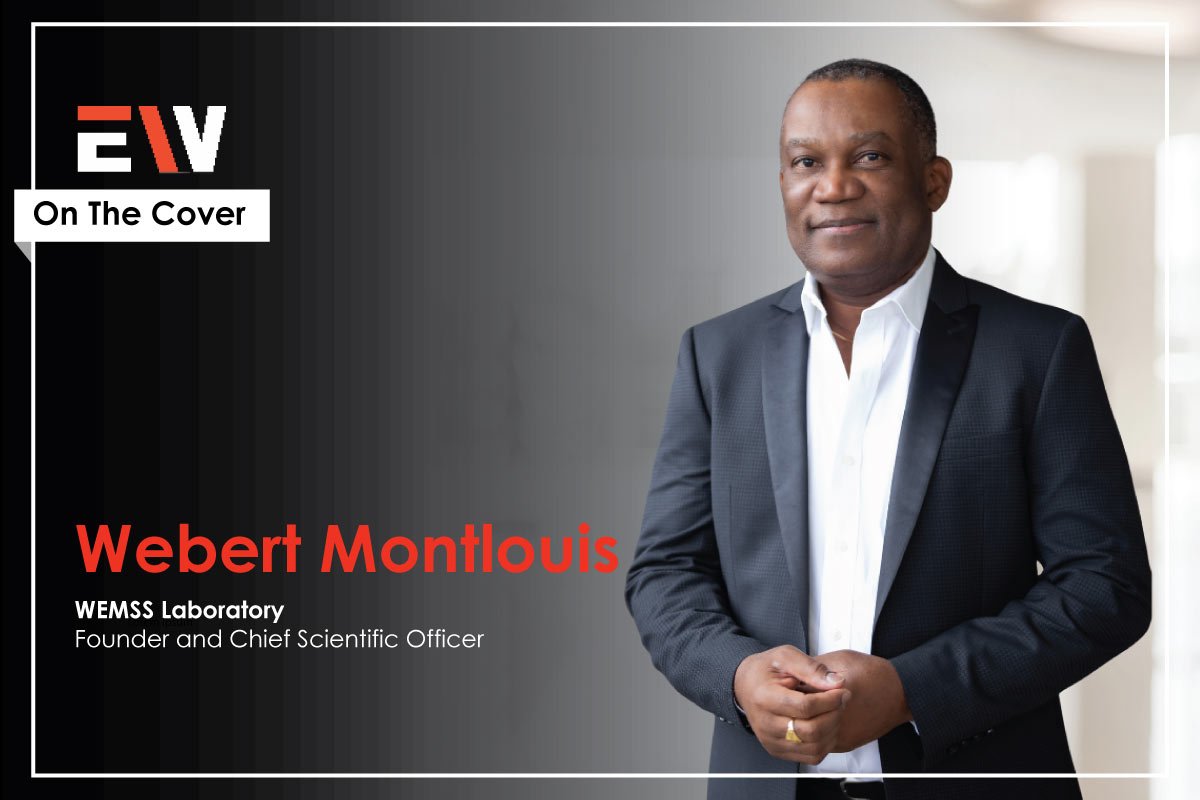
At a time when scientific progress is increasingly measured by velocity, scale, and visibility, Webert Montlouis stands apart as a leader guided by a different and far more enduring standard one rooted in depth rather than hype, architecture rather than improvisation, and rigor rather than expedience. As Founder and Chief Scientific Officer of WEMSS Laboratory, Montlouis is advancing a new paradigm for sensing, communication, and intelligent systems one anchored in principled design, long-term resilience, and uncompromising scientific accountability.
Operating at the convergence of advanced sensing architectures, AI-enabled signal processing, post-quantum security, biomedical systems, and next-generation wireless communications, WEMSS Laboratory reflects Montlouis’s deeply held conviction that lasting scientific excellence does not emerge from isolated breakthroughs or incremental optimizations. Instead, it is built through cohesive systems thinking grounded in first principles, enabling innovations that are robust, interpretable, and engineered for real-world complexity.
This philosophy, quietly radical in an era driven by rapid commercialization and performance benchmarks, has positioned Montlouis as one of the most influential scientific leaders shaping the future of global research.
The Journey from Doctoral Curiosity to Independent Scientific Vision
Webert Montlouis’s journey into science was never motivated by commercial ambition or entrepreneurial aspiration. From the outset, his goal was clear and singular: to pursue an advanced degree and contribute meaningfully to foundational scientific knowledge. His early academic path was shaped by intellectual curiosity, analytical discipline, and a desire to understand systems at their most fundamental level.
Although he accumulated professional experience prior to his doctoral studies, Montlouis never envisioned a permanent transition into industry. His focus remained firmly on research, on asking difficult questions, engaging deeply with theory, and advancing knowledge in ways that would endure beyond immediate applications.
Following the completion of his PhD, Montlouis accepted an interview opportunity with an organization whose work closely aligned with his doctoral research. This decision was driven not by career strategy, but by intellectual alignment. During this period, he established WEMSS Laboratory as a consulting entity, initially focused on chip design and specialized technical problem-solving.
At the time, WEMSS Laboratory was conceived as a temporary structure an intellectual bridge rather than a destination. Its purpose was pragmatic: to provide a platform for applied technical engagement while Montlouis evaluated his next steps within the broader research ecosystem.
Over time, however, a deeper realization began to take shape. Montlouis recognized a growing need for an independent scientific institution, one free from narrow programmatic constraints, rigid funding directives, and short-term deliverables. He saw that many of the most pressing scientific challenges required long-horizon thinking, architectural freedom, and the ability to pursue high-risk, high-reward ideas without compromise.
This realization marked a pivotal shift. WEMSS Laboratory evolved from a consulting framework into a fully operational research laboratory, dedicated to rigorous, exploratory, and high-impact scientific inquiry. Independence was no longer incidental; it became essential.
Leadership Forged Through Scientific Rigor
Building a science-driven organization is rarely linear, and Montlouis’s leadership philosophy was forged through direct experience leading complex, high-stakes initiatives. Early in his postdoctoral career, he became known for an uncompromising commitment to scientific rigor across every dimension of work, from theoretical formulation and mathematical analysis to system-level implementation and validation.
This approach led him to direct multiple senior technical teams addressing national security–related challenges, environments in which precision, accountability, and systems-level judgment are not optional, but foundational. In these settings, the cost of error is high, and success depends on disciplined reasoning, transparent communication, and trust.
During this period, colleagues repeatedly expressed a desire to work under Montlouis’s leadership. Some went so far as to indicate a willingness to forego compensation during the early stages of WEMSS Laboratory, an extraordinary testament to the trust he had earned as a scientist and leader.
The challenge Webert Montlouis faced was not attracting talent, but responsibly stewarding that trust: determining how to accept these commitments while ensuring collective success, professional integrity, and long-term sustainability. Similar dynamics emerged at subsequent organizations, reinforcing his belief that mission-driven collaboration and shared intellectual ownership are central to sustainable scientific leadership.
These experiences shaped a leadership model grounded not in hierarchy or authority, but in credibility, accountability, and shared purpose.
The Core Problem WEMSS Laboratory Solves

At its core, WEMSS Laboratory addresses a fundamental limitation in modern scientific and engineering systems: the widespread tendency to optimize components in isolation rather than reimagining systems holistically.
Across sensing, communications, and intelligent systems, prevailing approaches often focus on incremental improvements, better algorithms, faster processors, or higher-resolution sensors without questioning whether the underlying architecture itself is sufficient. Webert Montlouis identified this as a structural flaw.
WEMSS Lab is advancing a new paradigm for sensing, one that moves beyond incremental refinement toward fundamentally rearchitected systems capable of operating in complex, uncertain, and data-rich environments. Rather than treating sensing as a collection of disconnected elements, the laboratory integrates:
- Theory
- Signal processing
- Hardware-aware system design
- Data-driven intelligence
This unified approach enables capabilities that conventional methods cannot reach, particularly in environments characterized by uncertainty, limited observability, or adversarial conditions.
Crucially, these architectural foundations extend beyond sensing alone. WEMSS Lab applies its core principles to 6G and beyond wireless communication, biomedical systems, and quantum information science, with particular emphasis on post-quantum security, an area of growing global urgency as quantum technologies mature.
| WEMSS Laboratory’s Scientific Focus Areas | ||
|---|---|---|
| Domain | Core Challenge Addressed | WEMSS Lab’s Approach |
| Advanced Sensing Systems | Fragility in complex environments | System-level architectural redesign |
| AI Signal Processing | Scalability and interpretability | Hardware-aware, principled model selection |
| 6G & Future Communications | Robustness and security | Integrated sensing–communication frameworks |
| Biomedical Systems | Translational reliability | Explainable, resilient architectures |
| Quantum Information Science | Post-quantum vulnerability | Future-proof sensing and communication models |
Breakthroughs Defined by Direction, Not Headlines
While many of WEMSS Laboratory’s initiatives remain in active research phases, its ambition is unmistakable. The lab intentionally pursues high-risk, high-reward scientific problems, prioritizing long-term impact over short-term validation or publicity.
Rather than chasing headlines, WEMSS Lab focuses on directional breakthroughs research trajectories that have the potential to reshape entire domains once fully realized. This approach requires patience, intellectual courage, and a tolerance for uncertainty qualities that Webert Montlouis views as essential to genuine innovation.
Equally central to this mission is mentorship. Webert Montlouis considers talent development inseparable from scientific advancement. Students and early-career researchers are embedded directly into these challenging projects, gaining exposure to real-world complexity and learning to navigate ambiguity with rigor and confidence.
Through this dual emphasis on bold research and human capital development, WEMSS Laboratory positions itself as both a generator of new knowledge and a training ground for the next generation of scientific leaders.
A Leadership Mindset Refined by Experience
One of the most significant shifts in Montlouis’s leadership philosophy emerged through real-world lessons in collaboration. Early in his career, he relied heavily on his own technical expertise when making decisions. While efficient, this approach proved limiting.
A pivotal project revealed that insufficient engagement with both senior and junior voices had led to avoidable delays and missed alternatives. Since then, Webert Montlouis has embraced collaborative decision-making, systematically integrating diverse perspectives while maintaining technical discipline.
This evolution also strengthened his commitment to upward communication ensuring that critical concerns are clearly articulated to senior leadership when decisions carry systemic risk. The result is a leadership style grounded in trust, accountability, and foresight.
Scientific Processes Rooted in First Principles
While WEMSS Laboratory has not formalized a proprietary framework by name, it operates under a deeply intentional research and leadership model. Contributors are selected and developed not merely for output, but for their:
- Analytical discipline
- Adaptability
- Commitment to first principles
- Capacity for systems-level reasoning
Research begins at the conceptual and architectural level, assessing technology readiness, fundamental limitations, and the scope of basic research required. This enables informed decisions about hardware–software balance, scalability, and real-world deployment.
| WEMSS Laboratory Research Philosophy | |
|---|---|
| Principle | Application |
| Systems-Level Design | Co-design across sensing, algorithms, and hardware |
| First-Principles Reasoning | Avoidance of ad-hoc optimization |
| Long-Term Impact | Preference for foundational breakthroughs |
| Responsible Transition | Early assessment of scalability and integration risk |
Steering Science Through an Era of Global Disruption

From Webert Montlouis’s vantage point, artificial intelligence and quantum information science represent the defining technological frontiers of the current era. Post-quantum communication, in particular, is emerging as a strategic necessity rather than a theoretical concern.
He observes a growing shift away from indiscriminately large AI models toward architecturally aligned, problem-specific designs. Simultaneously, advances in AI hardware processor architectures, computational throughput, and energy efficiency are expected to reshape system design over the next five years.
Quantum computing, while still nascent, is progressing unevenly across regions, underscoring the importance of coordinated national strategies and sustained investment.
Transparency, Ethics, and Scientific Trust
Trust is foundational to WEMSS Laboratory’s operations. The lab adheres to best practices in ethical research, data integrity, and regulatory compliance, supported by standardized data management, version-controlled repositories, and reproducible workflows.
Ethical considerations are embedded directly into project design, with attention to societal, environmental, and human impact. Accountability is reinforced through structured roles, regular reviews, and transparent documentation, ensuring that scientific credibility is never compromised for expediency.
A Vision Anchored in Endurance
Webert Montlouis’s influence does not rest on scale, funding milestones, or media visibility. It rests on judgment, discipline, and an uncompromising commitment to scientific integrity. Through the WEMSS Laboratory, he is advancing a model of leadership that recognizes excellence as something built patiently through architecture, mentorship, and trust.
As global science confronts unprecedented complexity, Montlouis’s work serves as a reminder that the most influential leaders are not those who chase trends, but those who design the foundations on which future discoveries will stand.