SK Telecom has announced an extensive artificial intelligence transformation strategy aimed at redesigning its telecom operations, infrastructure, and services marking a significant step in the SK Telecom AI transformation as the company prepares for growing demand driven by AI adoption across industries. The initiative signals a shift from traditional telecom services toward an AI-focused operating model supported by major investment and system redesign.
Telecom Infrastructure Set For Complete AI-Driven Overhaul
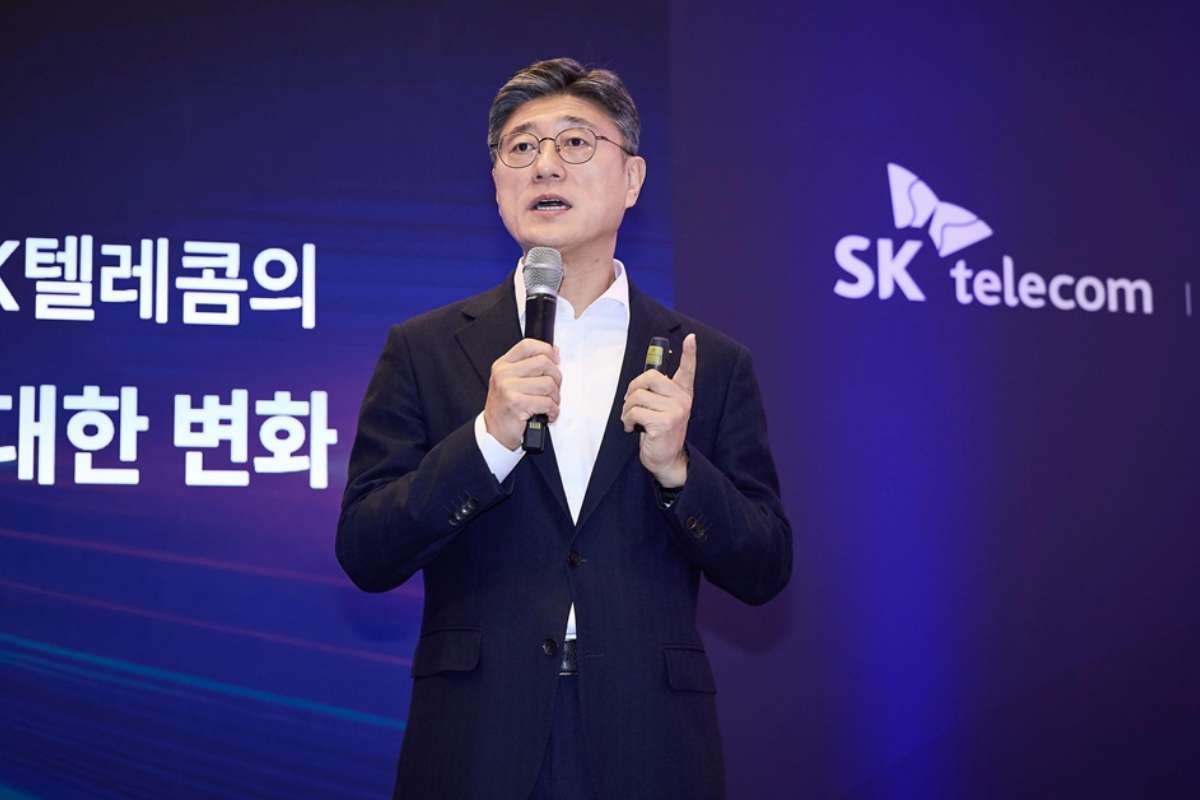
Chief Executive Officer Jeong Jae heon outlined the company’s vision during a press conference in Barcelona, emphasizing that existing telecom systems were not built to support modern AI requirements. According to the company, legacy information technology environments create limitations in data collection, processing, and service delivery needed for advanced AI applications.
To address these challenges, SK Telecom plans to rebuild its integrated computing environment that supports network operations and customer services as part of its SK Telecom AI transformation. Core systems including billing, circuit management, and sales platforms will be redesigned using AI based architecture. The company expects these upgrades to enable more personalized service plans and membership offerings based on customer usage patterns and behavioral data.
Security modernization also forms a central part of the transformation. SK Telecom intends to deploy a zero trust security framework supported by network segmentation and AI driven monitoring systems. These measures aim to strengthen protection across operational networks while managing increasing volumes of data generated by AI services.
Company leadership indicated that investment required for the transition will reach several trillion won, reflecting the scale of infrastructure redesign needed to support future telecom and digital service growth.
Expansion Of AI Models And Data Center Capacity
Alongside infrastructure upgrades, SK Telecom revealed plans to expand its proprietary AI model known as A.X K1 a key component of the SK Telecom AI transformation. The company aims to increase the model’s parameter capacity from 519 billion to 1 trillion, placing it among the largest AI systems developed globally. The expansion is intended to support enterprise applications and industry specific AI solutions.
Rather than competing directly with global technology firms across all AI categories, SK Telecom plans to focus on regional and industry focused deployments. Company leadership noted that organizations and markets seeking localized AI capabilities may represent future opportunities for deployment beyond domestic operations.
The telecom operator is also collaborating with technology partners including SK hynix and NVIDIA to develop manufacturing focused AI solutions. These systems are designed to analyze production data in real time, helping manufacturers reduce defect rates and improve equipment performance through automated analysis.
Infrastructure development remains another major priority. SK Telecom plans to construct ultra large AI data centers across the country with combined capacity exceeding one gigawatt. These facilities are expected to support computing demand generated by advanced AI workloads and enterprise adoption.
Internally, the company is preparing organizational changes to align employee workflows with AI and automation. Leadership emphasized that operational processes and workplace practices will evolve alongside technological upgrades.
For entrepreneurs and business owners, the announcement reflects how telecom providers are repositioning themselves as digital infrastructure companiesthrough the SK Telecom AI transformation. As connectivity, data processing, and intelligent automation converge, telecom networks are increasingly becoming foundational platforms for enterprise innovation and future digital ecosystems.