A good strategy is not only about having a big idea. It is about making the right choices, putting people behind them, and turning those choices into measurable results.
This is why strategic management lessons from top CEOs are useful for businesses of every size. A CEO may lead a global company, a consulting firm, or a growing technology business. Still, the core challenge remains similar: decide where the business should go and make sure the organization can get there.
Enterprise Wired’s Cover Stories highlight leaders who approach this challenge in different ways. Their stories show that strategic leadership can come from technology, people development, customer understanding, disciplined execution, or a combination of all four.
The lessons also closely connect to the fundamentals of strategic management, including strategy formulation, execution, evaluation, and adaptation.
What are strategic management lessons from top CEOs?

Strategic management lessons from top CEOs are practical ways leaders set goals, respond to change, manage resources, lead teams, and turn business plans into results.
In simple terms, strategic management follows:
Vision → Decisions → Action → Measurement → Improvement
| Real-world examples show how this works: Microsoft: Satya Nadella shifted Microsoft toward cloud computing while promoting a culture of learning, teamwork, and customer focus. Adobe: Shantanu Narayen led Adobe’s shift from traditional software licenses to a cloud-based subscription model, creating new growth opportunities. Starbucks: Brian Niccol’s “Back to Starbucks” strategy refocused the company on coffee, customer experience, stores, and service. Starbucks reported global comparable-store sales growth in Q4 FY2025. |
These examples show one key lesson: good CEOs do not simply follow old strategies. They adjust their decisions when customers, markets, and business conditions change.
Top 5 strategic management lessons from Enterprise Wired’s cover stories
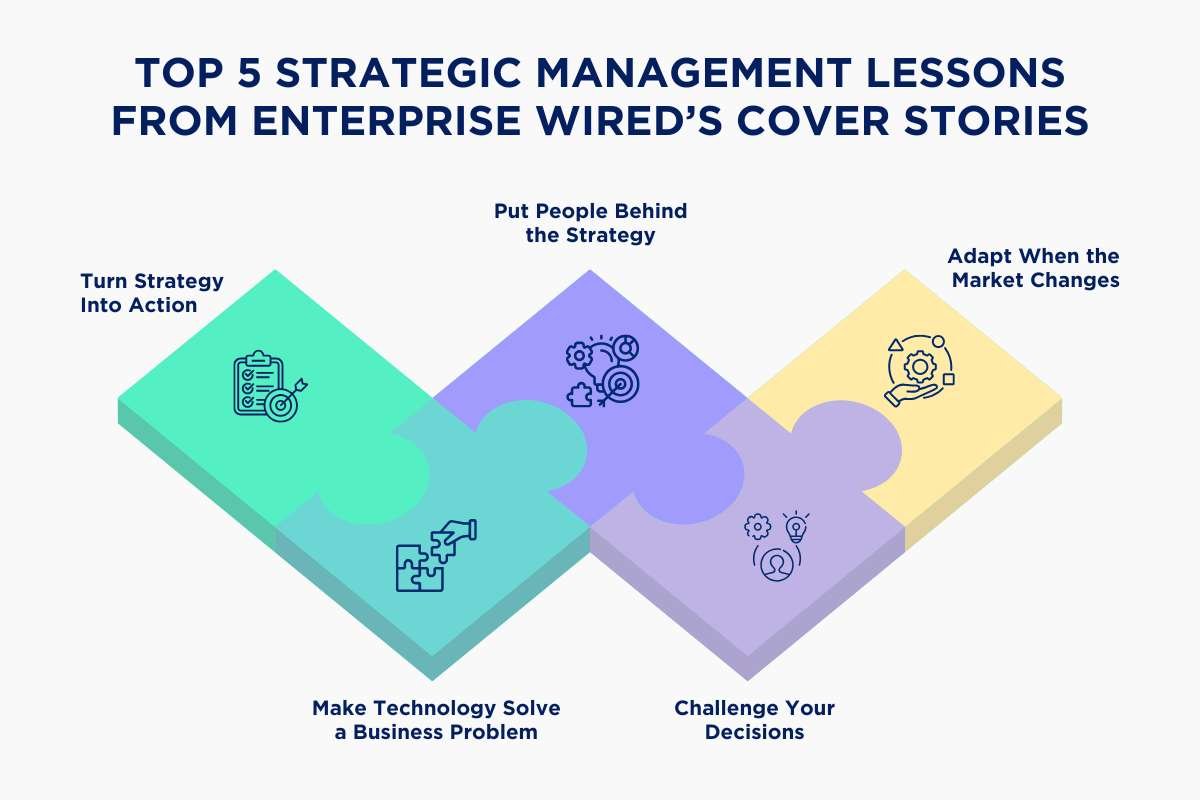
Enterprise Wired’s On The Cover features leaders who show how strong strategies create real business results. Here are five key strategic management lessons from top CEOs.
1. Turn strategy into action
A strategy works only when teams execute it.
- James J. McGraw Jr. of KMK Consulting shows the value of turning business plans into measurable action.
- Lesson: Set clear goals, assign responsibilities, track results, and adjust when needed.
2. Make technology solve a business problem
Technology should support business goals.
- Faizan Ul Haq’s work with ERP and digital transformation at Balubaid Group shows how better systems and processes can improve business performance. Microsoft also shows how cloud and AI can become part of a wider business strategy.
- Lesson: Use technology to solve real problems, not simply because it is new.
3. Put people behind the strategy
Even a great strategy can fail without the right people.
- Philip Berry’s leadership work highlights the importance of employee skills, leadership development, and organizational culture.
- Lesson: Train employees, share clear goals, and give teams the support they need.
4. Challenge your decisions
Better questions can lead to better decisions.
- Wayne Cole’s CEO peer-group approach encourages leaders to question assumptions, consider different views, and stay accountable.
- Lesson: Seek honest feedback, compare options, and review your decisions.
5. Adapt when the market changes
A good strategy must evolve with the market.
- Saibal Samaddar emphasizes learning, unlearning, and relearning. Starbucks’ “Back to Starbucks” strategy also shows how a company can refocus while responding to changing customer needs.
- Lesson: Protect your core strengths, but change when the market demands it.
What do these CEO lessons have in common ?

The key strategic management lessons from top CEOs follow a simple cycle:
Vision → People → Decisions → Execution → Measurement → Adaptation
Successful leaders do more than set goals. They build the right people, processes, and systems to achieve those goals.
A strong strategy should answer five basic questions:
- Where are we now?
- Where do we want to go?
- Why does it matter?
- How will we get there?
- How will we measure progress?
Answering these questions can help businesses avoid common problems such as unclear goals, poor execution, weak tracking, and resistance to change.
For a deeper understanding, see Enterprise Wired’s strategic management guide and its guide on strategic management vs. operational management.
Conclusion
The key strategic management lessons from top CEOs are simple: set clear goals, understand customers, develop people, use technology wisely, and adapt to change.
Leaders such as James J. McGraw Jr., Faizan Ul Haq, Philip Berry, Wayne Cole, and Saibal Samaddar show how these principles can turn business strategy into real results.
Companies such as Amazon, Microsoft, PepsiCo, and Starbucks follow similar ideas. Their experiences show that long-term growth depends on clear priorities, strong teams, effective execution, and continuous learning.
For business leaders, the most important question is not just what strategy to choose, but how to turn that strategy into measurable results. That is what makes strategic management a real business advantage.
FAQs
1. What are the main strategic management lessons from top CEOs?
Set clear goals, understand customers, build strong teams, use technology wisely, and adapt to change.
2. Why are CEO lessons useful for small businesses?
They help small businesses make better decisions, focus on priorities, and use limited resources effectively.
3. How does technology support strategic management?
Technology helps businesses improve decisions, automate work, manage data, and achieve strategic goals.
4. Why is adaptability important in strategic management?
Adaptability helps businesses respond to changing customers, markets, competition, and technology.