
The strategic management process is a structured cycle businesses use to understand their current position, set goals, choose a direction, execute plans, and measure results. The five main stages are goal setting, strategic analysis, strategy formulation, strategy implementation, and strategy evaluation. In 2026, AI agents are adding another layer by helping organizations analyze data, identify opportunities, automate strategic workflows, and monitor performance.
A business can have a strong product, talented employees, and sufficient funding, yet still struggle if it does not know where it is going.
That is where strategy becomes important.
The strategic management process gives organizations a practical way to move from where they are today to where they want to be. Instead of making isolated decisions, leaders connect business goals with market conditions, resources, competitive threats, execution, and performance.
The process is also becoming more dynamic. Businesses now operate in markets shaped by artificial intelligence, changing customer expectations, economic uncertainty, new competitors, and fast-moving technology.
AI agents are adding to this change. Unlike basic software that follows fixed instructions, AI agents can perform multi-step tasks, coordinate workflows, analyze information, and act on behalf of users or organizations. McKinsey defines an AI agent as software with the ability to act on behalf of a user or system and perform complex tasks.
However, AI does not replace strategic leadership. It can strengthen the process, but executives still need to make the important choices, accept risk, allocate resources, and remain accountable for outcomes.
What is the strategic management process and why is it important?

The strategic management process is a continuous approach organizations use to set direction, analyze their environment, develop strategies, implement them, and evaluate performance.
OpenStax describes strategic management as a set of activities managers use to put their organizations in a stronger position to compete successfully. It includes vision and mission development, strategic analysis, objectives, strategy creation and implementation, and performance evaluation.
It matters because strategy connects big decisions with everyday business actions.
It can help organizations:
- Set clear long-term priorities
- Understand market opportunities and threats
- Use resources more effectively
- Make better competitive decisions
- Respond to changing customer needs
- Connect departments around shared objectives
- Measure whether strategic decisions are producing results
- Adjust plans when market conditions change
Strategy is not simply about creating a document. Roger Martin, a leading strategy thinker, explains that strategy involves making clear choices about “where and how to play.”
That distinction is important. A business plan may describe activities, but strategy determines which choices deserve the organization’s resources and attention.
The 5 stages of the strategic management process that turn strategy into action
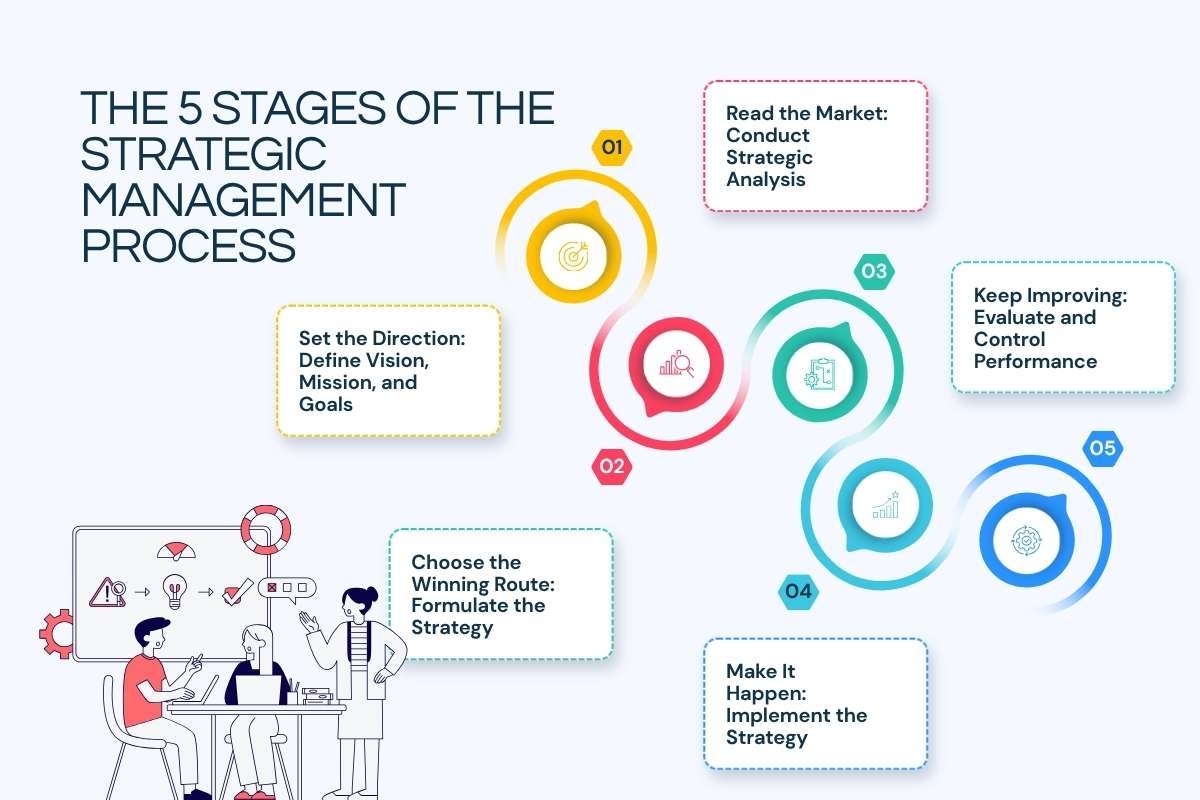
There are different versions of the strategic management process, but most frameworks follow the same basic logic: understand the situation, decide what matters, choose a direction, execute it, and learn from the results. OpenStax also notes that real-world strategic management is not always perfectly linear; managers often work on several activities at the same time.
1. Set the direction: Define vision, mission, and goals
The first stage establishes what the organization wants to achieve and why it exists.
A vision describes the desired future. A mission explains the organization’s purpose and the value it aims to provide. Strategic goals then turn this direction into measurable outcomes.
The goals should be specific enough to guide decisions without becoming a long list of unrelated targets.
Expert insight: Roger Martin’s strategy framework emphasizes that winning requires deliberate choices about where and how an organization will compete.
How AI agents help: An AI strategy agent can organize historical business data, summarize customer feedback, compare performance against targets, and identify patterns that leaders should consider while setting goals.
For example, an agent could analyze sales, churn, customer reviews, and market data before a leadership meeting. Instead of replacing executives, it prepares the evidence they need to make better decisions.
2. Read the market: Conduct strategic analysis
Once the direction is clear, the organization needs to understand its environment. Strategic analysis examines both internal and external factors.
Internal analysis may include:
- Financial performance
- Employee capabilities
- Technology
- Brand strength
- Operational efficiency
- Customer relationships
External analysis may include:
- Competitors
- Customer behavior
- Economic conditions
- Regulations
- Technology trends
- Industry changes
Common tools include SWOT analysis, PESTLE analysis, competitor analysis, Porter’s Five Forces, and market research.
For example, a retailer considering expansion may discover strong demand in a region but also find high logistics costs and aggressive local competitors. That information could change the expansion strategy before the company commits significant resources.
Michael Porter has consistently emphasized that strategy is different from simply improving operations. Sustainable advantage requires a distinctive position and meaningful choices.
How AI agents help: AI agents can continuously collect and summarize market signals from approved data sources. They can monitor competitor changes, customer sentiment, industry reports, sales trends, and internal performance dashboards.
This is particularly useful because strategic analysis is no longer a once-a-year exercise.
Real-world example: McKinsey reports that AI agents are increasingly being used for complex workflows and that organizations are experimenting with agentic systems. Its 2025 global survey found that 62% of respondents said their organizations were at least experimenting with AI agents, although most companies were still working toward enterprise-wide scale.
3. Choose the winning route: Formulate the strategy
Analysis creates information. Strategy formulation turns that information into choices.
At this stage, leaders decide:
- Which markets to target
- Which customers to prioritize
- How the company will compete
- Which products or services to develop
- Where to invest
- What the organization should stop doing
- How resources should be allocated
Suppose a company discovers that it cannot compete effectively on price against larger rivals. It may instead choose a differentiation strategy based on premium service, specialized expertise, or superior product quality.
This is where strategic thinking matters most. Leaders cannot pursue every opportunity at the same time.
Harvard Business Review’s strategy research highlights that companies need to make choices about what they will and will not do, whom they will and will not serve, and where they will allocate resources.
How AI agents help: AI agents can support scenario planning by comparing possible strategies against different assumptions.
For example:
- What happens if demand falls 15%?
- What happens if a competitor cuts prices?
- What happens if customer acquisition costs rise?
An AI agent can model different scenarios and present potential outcomes. Executives can then challenge the assumptions and choose the strategy that best fits the company’s goals and risk tolerance.
4. Make it happen: Implement the strategy
A strong strategy has little value if nobody executes it.
Strategy implementation converts decisions into actions. It may involve budgets, people, technology, processes, responsibilities, deadlines, and performance indicators.
For example, if a company decides to expand into a new market, implementation could require:
- Hiring a local sales team
- Adapting the product
- Building distribution partnerships
- Launching localized marketing
- Setting revenue targets
- Monitoring customer acquisition costs
Leadership must also communicate the strategy clearly. Employees need to understand not only what is changing but also why.
How AI agents help: The AI agents can coordinate tasks across departments, generate status updates, identify missed deadlines, summarize project risks, and route issues to the right people.
Microsoft’s 2025 annual report provides a useful example of how agent-based systems are moving into real business workflows. Microsoft reported more than 230,000 organizations using Copilot Studio to extend Microsoft 365 Copilot or build their own agents. It also described agents supporting areas such as sales, hiring, learning, software development, healthcare documentation, security, and IT.
This shows an important shift: AI agents are increasingly being connected to business processes rather than used only as standalone chat tools.
Microsoft also recommends creating a business plan before adopting AI agents so organizations can identify where agents can deliver measurable value and where traditional software may be more appropriate.
5. Keep improving: Evaluate and control performance
The final stage asks a simple but critical question: Is the strategy actually working?
Organizations should compare real results against strategic objectives and identify gaps.
Useful indicators may include:
- Revenue growth
- Profit margins
- Market share
- Customer retention
- Customer acquisition cost
- Employee productivity
- Product adoption
- Operational costs
If performance falls below expectations, leaders should investigate why.
The answer could be poor execution, unrealistic targets, changing market conditions, incorrect assumptions, or a competitor’s unexpected move.
Evaluation therefore does not simply mean checking whether targets were achieved. It creates feedback for the next strategic decision.
OpenStax’s strategic management framework includes measuring and evaluating performance as a core activity and emphasizes that the process operates as a cycle rather than a rigid sequence.
How AI agents help: AI agents can continuously monitor KPIs, detect unusual changes, generate performance summaries, and alert managers when results move outside predefined thresholds.
However, governance remains essential. Deloitte notes that organizations adopting agentic AI need to consider governance, skills, human collaboration, and accountability.
How AI agents are changing the strategic management process

AI agents are not simply another productivity tool. Their strategic value comes from their ability to connect data, reasoning, workflows, and actions.
Deloitte reported in 2025 that more than 80% of Indian organizations were exploring autonomous agents, while 50% identified multi-agent workflows as a key focus area.
At the same time, organizations should avoid treating AI agents as automatic decision-makers.
| A useful approach is: AI analyzes → AI recommends → humans decide → AI executes approved actions → AI monitors → humans review. |
This creates a human-AI operating model rather than handing strategic control entirely to software.
McKinsey’s 2025 research supports this cautious but practical approach. Although AI use is widespread, nearly two-thirds of respondents said their organizations had not yet begun scaling AI across the enterprise. The research also found that companies achieving more value tend to redesign workflows rather than simply add AI to existing processes.
This principle applies directly to strategic management.
A company should not ask: “Where can we put an AI agent?”
It should ask: “Which strategic decision or workflow would improve if an AI agent handled the right part of it?”
That difference can prevent unnecessary AI adoption and keep technology connected to business outcomes.
Conclusion
The strategic management process gives organizations a repeatable way to move from ambition to measurable results.
Its five stages- setting direction, analyzing the environment, formulating strategy, implementing decisions, and evaluating performance- help leaders make connected decisions instead of reacting to individual problems.
AI agents can strengthen every stage by improving research, scenario analysis, workflow coordination, monitoring, and decision support. But technology should support strategy, not replace strategic accountability.
The strongest organizations in 2026 will not necessarily be those using the most AI. They will be those that combine clear strategic choices, reliable data, capable people, responsible AI, disciplined execution, and continuous learning.
That is what turns strategy from a document into a competitive advantage.
FAQs
1. What is the strategic management process?
The strategic management process is a continuous cycle of setting organizational direction, analyzing internal and external conditions, developing strategy, implementing it, and evaluating results.
2. What are the five stages of the strategic management process?
The five commonly used stages are goal setting, strategic analysis, strategy formulation, strategy implementation, and strategy evaluation and control.
3. Why is the strategic management process important?
It helps organizations align goals, resources, people, and decisions. It also provides a structured way to respond to competition, market changes, risks, and new opportunities.
4. How does AI support strategic management?
AI agents can analyze business and market data, identify patterns, support scenario planning, coordinate workflows, monitor KPIs, and provide decision-support insights across the strategic management process.
5. Can AI replace strategic managers?
No. AI can support research, analysis, execution, and monitoring, but strategic leaders remain responsible for making major choices, evaluating risks, setting priorities, and accepting accountability for outcomes.
6. Is strategic management a one-time process?
No. Strategic management is continuous. Organizations need to review assumptions, monitor performance, respond to changes, and update their strategies as conditions evolve. OpenStax also notes that managers often perform several strategic activities simultaneously rather than following a perfectly linear sequence.
7. What is the difference between strategic management and strategic planning?
Strategic planning mainly focuses on deciding goals and actions for the future. Strategic management is broader because it includes analysis, strategy development, implementation, performance evaluation, and ongoing adjustment.