Strategic management models help businesses understand their market, assess internal capabilities, choose growth strategies, and measure results. The most useful models include SWOT, PESTEL, Porter’s Five Forces, BCG Matrix, Ansoff Matrix, Balanced Scorecard, and McKinsey 7-S. The right choice depends on the business question, not on using as many frameworks as possible.
A business can have a great product, talented employees, and strong sales and still struggle to grow.
Why? Because good business performance requires more than individual decisions. Leaders need to understand where the business stands, what is changing around it, where opportunities exist, and how resources should be used.
This is where strategic management models become useful.
These models give managers a structured way to examine a business before making important decisions. A company entering a new market may use PESTEL and Porter’s Five Forces. A business deciding where to invest may use the BCG Matrix. A company trying to connect strategy with measurable results may use the Balanced Scorecard.
However, no single model answers every strategic question.
The best approach is to use the framework that matches the decision at hand and combine it with reliable market information, financial data, customer insights, and management judgment.
Harvard Business School notes that more than 90% of competition occurs at the business-unit level, highlighting why understanding competitive position is central to strategy.
As Michael Porter puts it, “A company can outperform rivals only if it can establish a difference that it can preserve.”
What is a strategic management model?
A strategic management model is a structured framework that helps an organization analyze its current position, understand its environment, make strategic choices, and translate those choices into action.
In simple terms, it helps answer questions such as:
- Where are we now?
- What is happening in our industry?
- What are our strengths and weaknesses?
- What opportunities should we pursue?
- What threats could affect us?
- How can we compete more effectively?
- How should we measure progress?
Strategic management models are not business plans by themselves. Instead, they act as decision-making tools within the broader strategic management process.
For example, a company could use:
- PESTEL → to understand the external environment
- Porter’s Five Forces → to understand industry competition
- SWOT → to connect internal capabilities with external conditions
- Ansoff Matrix → to evaluate growth options
- Balanced Scorecard → to track execution
This connects naturally with the broader strategic management process because frameworks are most useful when they support analysis, strategy formulation, implementation, and evaluation.
Which strategic management models do strategists actually use?
There are dozens of strategy frameworks. Trying to use all of them can create more confusion than clarity. The following models remain particularly useful because each addresses a different strategic question.
1. SWOT analysis: Start by understanding where you stand

SWOT stands for:
- Strengths
- Weaknesses
- Opportunities
- Threats
It combines internal and external analysis in one simple framework.
Strengths and weaknesses relate to factors inside the organization, such as brand reputation, technology, skills, costs, or financial resources.
Opportunities and threats relate to external conditions, such as changing customer preferences, competitors, regulation, technology, and economic conditions.
Example: Imagine a regional food-delivery company.
Its SWOT analysis could identify:
| Area | Example |
| Strength | Strong presence in smaller cities |
| Weakness | Limited delivery network |
| Opportunity | Growing online food ordering |
| Threat | Competition from larger platforms |
The value comes from what management does next. If the company has strong local knowledge but limited resources, it might focus on markets where its local relationships create an advantage rather than competing everywhere.
Best for: Quickly assessing the overall strategic position.
2. PESTEL analysis: See what is changing outside the business
PESTEL examines six external forces:
- Political
- Economic
- Social
- Technological
- Environmental
- Legal
It is particularly useful when a company operates in a market affected by regulation, economic changes, technology shifts, or changing consumer behavior.
Example: Consider an electric vehicle company.
Its PESTEL analysis might examine:
- Government incentives for EV adoption
- Interest rates and consumer purchasing power
- Growing demand for cleaner transportation
- Battery and charging technology
- Environmental expectations
- Vehicle safety and emissions regulations
The company cannot control these factors, but it can prepare for them.
Best for: Market entry, long-term planning, risk assessment, and industries facing major external changes.
A useful way to remember it is: PESTEL tells you what is changing around the business.
That makes it a useful starting point before applying other strategic management models.
3. Porter’s five forces: Understand the competition before you compete

Michael Porter’s Five Forces examines five sources of competitive pressure:
- Rivalry among existing competitors
- Threat of new entrants
- Bargaining power of suppliers
- Bargaining power of buyers
- Threat of substitutes
Harvard Business School describes the framework as a way to understand the competitive forces operating in an industry and how economic value is divided among industry participants. Porter first introduced the framework in 1979.
Example: Suppose a new company wants to enter the online grocery market.
Before investing heavily, it could examine:
- How aggressively existing platforms compete
- How easy it is for new competitors to enter
- Whether suppliers have strong negotiating power
- How easily customers can switch platforms
- Whether alternatives can replace online grocery services
This can reveal whether an attractive-looking market is actually difficult to compete in.
Porter’s framework also emphasizes that industry structure and a company’s position within that industry both influence profitability.
Best for: Competitive analysis, market entry, pricing decisions, and positioning.
Expert insight: Porter argues that strategy requires creating a meaningful difference that competitors cannot easily copy.
4. BCG matrix: Decide where to invest and where to pull back
The Boston Consulting Group’s Growth Share Matrix evaluates business units or products according to market growth and relative market share.
It creates four categories:
- Stars: High growth, high market share
- Cash Cows: Low growth, high market share
- Question Marks: High growth, low market share
- Dogs: Low growth, low market share
BCG explains that the framework was designed to help diversified companies allocate resources among business units. Its classic logic is to use cash generated by mature businesses to support businesses with stronger future growth potential.
Example: A consumer-goods company may have:
- A mature product generating steady cash
- A fast-growing product gaining market share
- A new product with uncertain demand
- An aging product in a shrinking market
Instead of giving every product the same budget, management can use the matrix to think about different investment priorities.
Best for: Product portfolios, investment allocation, and diversified companies.
5. Ansoff matrix: Find the right path to growth
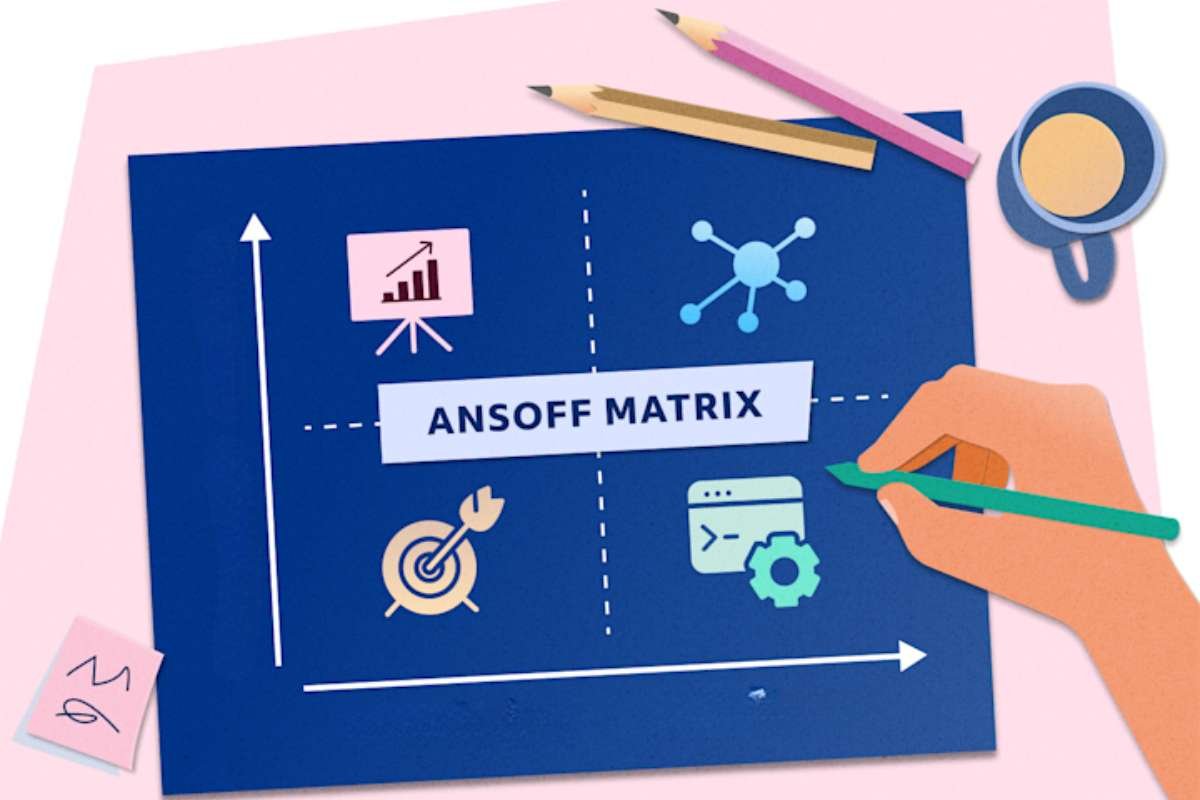
The Ansoff Matrix helps companies evaluate growth through four options:
| Strategy | Market | Product |
| Market penetration | Existing | Existing |
| Product development | Existing | New |
| Market development | New | Existing |
| Diversification | New | New |
The model starts with a straightforward question:
Should we sell more of what we already have, enter new markets, create new products, or do both?
Example: A coffee brand could:
- Sell more coffee through existing stores – market penetration
- Launch a new cold-brew range – product development
- Enter another country – market development
- Move into an unrelated consumer category – diversification
The risk generally increases as the company moves further away from its existing products and markets.
Best for: Growth planning, expansion, product launches, and market-entry decisions.
This framework can also complement your strategic management for startups because young companies often need to choose between deepening their existing market and expanding into new opportunities.
6. Balanced Scorecard: Turn strategy into measurable action
Creating a strategy is only half the job. Leaders also need to know whether the strategy is working.
The Balanced Scorecard helps organizations monitor strategy from multiple perspectives rather than relying only on financial results.
The traditional framework considers:
- Financial performance
- Customer outcomes
- Internal processes
- Learning and growth
Harvard Business Review explains that Kaplan and Norton developed the Balanced Scorecard through research involving 12 companies and designed it to combine financial measures with operational indicators such as customer satisfaction, internal processes, and organizational learning.
Kaplan and Norton famously wrote, “What you measure is what you get.”
Example: A software company could measure:
- Revenue growth
- Customer retention
- Product delivery time
- Employee skills development
This gives leaders a broader view of whether the strategy is producing sustainable progress.
HBR also documents how companies, including Apple Computer and Advanced Micro Devices, used the Balanced Scorecard to measure performance and support strategy.
Best for: Strategy execution, performance measurement, KPIs, and organizational alignment.
This is closely connected to your strategic control and evaluation.
7. McKinsey 7-S Framework: Make sure the organization can execute
A strategy can fail even when it is sound.
Why? Because the organization may not have the structure, people, systems, or culture required to execute it.
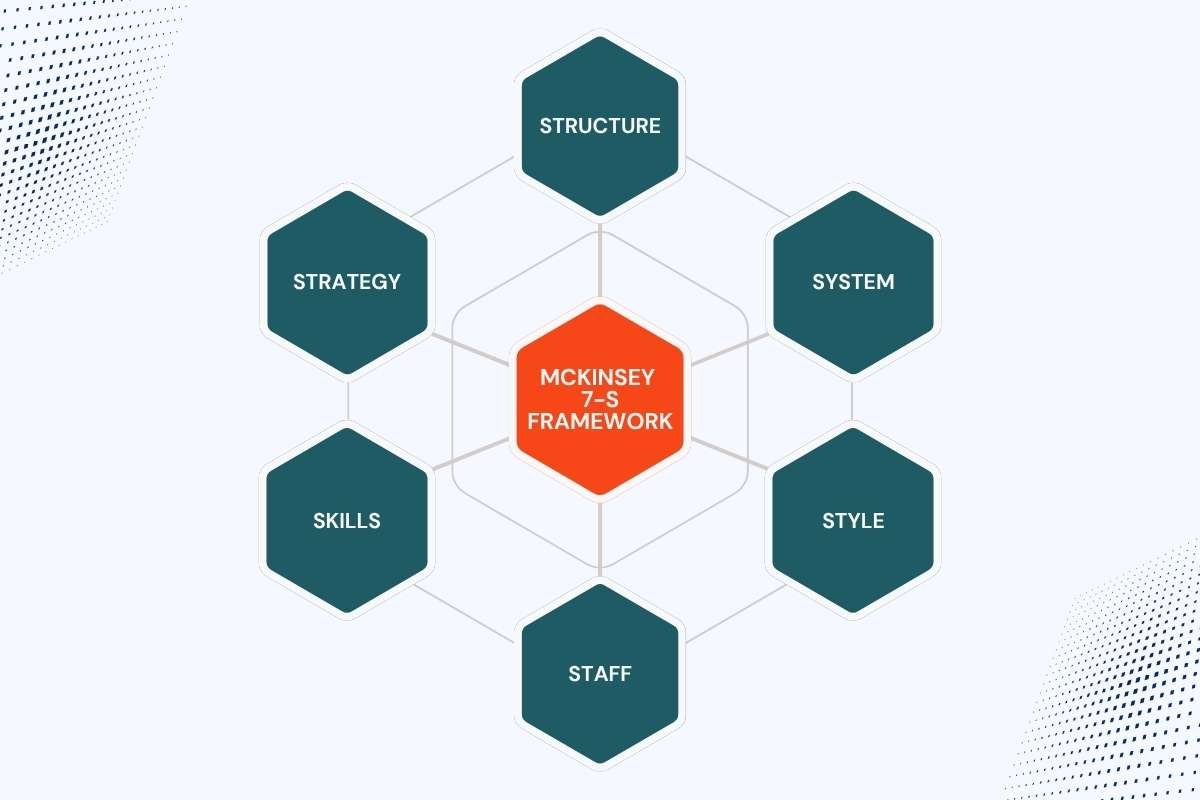
The McKinsey 7-S framework examines seven interconnected elements:
- Strategy
- Structure
- Systems
- Shared values
- Skills
- Style
- Staff
McKinsey explains that the framework was developed to address organizational coordination and emphasizes that these elements influence one another.
Example: Suppose a traditional retailer wants to become a digital-first company. Changing its website is not enough.
It may also need:
- Digital skills
- New reporting structures
- Faster decision-making systems
- Leadership support
- Employee training
- A culture that encourages experimentation
The 7-S framework helps leaders examine those connections.
Best for: Organizational change, transformation, restructuring, and strategy execution.
How should you choose the right strategic management model?
The easiest approach is to start with the business question, not the framework.
| Business question | Useful model |
| What is happening around us? | PESTEL |
| What are our strengths and weaknesses? | SWOT |
| How competitive is our industry? | Porter’s Five Forces |
| Where should we invest? | BCG Matrix |
| How can we grow? | Ansoff Matrix |
| Are we executing our strategy? | Balanced Scorecard |
| Can our organization support the strategy? | McKinsey 7-S |
In practice, strategists often combine models.
For example:
PESTEL → Five Forces → SWOT → strategic choice → Balanced Scorecard
This creates a logical flow from external analysis to execution rather than treating every framework as a separate exercise.
Conclusion
The best strategic management models make complicated business decisions easier to understand.
SWOT helps organizations assess their position. PESTEL reveals external forces. Porter’s Five Forces explains industry competition. The BCG Matrix supports portfolio decisions. Ansoff helps identify growth options. The Balanced Scorecard connects strategy with performance measurement, while McKinsey 7-S examines whether the organization is ready to execute.
The key is not to use every framework available.
Instead, choose the model that answers the question you are trying to solve, support it with reliable evidence, and turn the findings into clear decisions and measurable actions.
That is what makes strategic management practical, not simply theoretical.
FAQs
1. What are strategic management models?
They are frameworks that help businesses analyze situations, make decisions, and achieve strategic goals.
2. What are the most common strategic management models?
Popular models include SWOT, PESTEL, Porter’s Five Forces, BCG Matrix, Ansoff Matrix, Balanced Scorecard, and McKinsey 7-S.
3. Which strategic management model is best?
There is no single best model. The right choice depends on the business goal, such as competition, growth, or performance.
4. How do companies use strategic management models?
Companies use them to assess markets, competitors, resources, risks, growth opportunities, and business performance.
5. Are strategic management models still useful in 2026?
Yes. They remain useful when combined with current market data, technology trends, customer insights, and business analysis.
6. What is the difference between a strategic management model and framework?
Both provide structured ways to support strategic thinking and decision-making. The terms are often used interchangeably.