This article explains process optimization consulting and how it improves business performance by analyzing and redesigning workflows that appear normal but hide inefficiencies. It covers how consultants study processes, map and analyze workflows, implement improvements, and track results over time. It also explores key business impacts and challenges faced.
Most inefficiencies do not announce themselves. They hide inside routines that feel normal. Inside approvals that take a little too long.
Handoffs that create confusion.
And systems that no one questions because they have “always worked.”
Over time, these patterns settle in and can start taking over how the entire business operates. The challenge is not spotting one broken step. It is recognizing that the way work flows from start to finish might be doing more harm than good, even when outcomes seem acceptable on the surface.
Process optimization consulting steps into that exact blind spot. It looks beyond isolated problems and focuses on how everything connects, breaks, and repeats. The goal is not to fix one issue, but to rethink how work moves so the business stops carrying inefficiencies it no longer needs.
Let us first understand exactly what it is.
Process optimization consulting is a service that helps businesses improve how their workflows operate. Consultants analyze each step in a process, identify delays or waste, and redesign it to make it faster, more efficient, and consistent.
The goal is to reduce costs, improve output, and create smoother operations. Instead of relying on guesswork, businesses get structured systems that align processes with clear goals and measurable results. Now, let us take a look at how it works.
How does process optimization consulting work?

To understand how it delivers results, it is important to look at the step-by-step framework it follows. The process is structured to move from understanding current operations to improving and sustaining them. Each stage builds on the previous one and helps consultants identify gaps, redesign workflows, and guide implementation in a controlled way.
1. Process discovery
Consultants study how work happens inside the business. They do not rely only on documents, because real execution often differs from written processes. They observe teams during daily tasks, conduct interviews, and review system data. This helps them find where delays, confusion, or waste actually begin. The goal is to build an accurate view of current operations.
2. Process mapping
Consultants break the workflow into clear steps from start to finish. They document how tasks move across teams and systems. This shows handoffs, dependencies, and decision points that often stay hidden. It also reveals duplicate work and unclear ownership. The result is a full view of how the process functions today.
3. Process analysis
Consultants evaluate each step using data. They study cycle time, cost, error rates, and output quality. This helps them separate useful steps from inefficient ones. It also highlights bottlenecks that slow down the process. The focus is on finding the exact cause of inefficiency.
4. Process redesign
Consultants rebuild the workflow to improve efficiency. They remove unnecessary steps and simplify complex flows. Responsibilities get clearly defined to avoid confusion. Where needed, they introduce automation to reduce manual effort. The redesigned process focuses on speed, accuracy, and clarity.
5. Implementation
The new process is introduced to teams. Consultants guide the rollout and support training. Employees learn updated steps and responsibilities. This reduces errors during transition. The aim is smooth adoption without disrupting operations.
6. Monitoring
Consultants track performance after implementation. They compare new results with baseline data. Metrics like time, cost, and accuracy show improvement levels. Any gaps between design and execution are identified quickly. This ensures the process works in real conditions.
7. Continuous improvement
Processes are refined over time. Consultants adjust workflows based on performance data. Small inefficiencies are fixed regularly. This keeps the system aligned with business changes. It ensures long-term operational stability.
So, I hope you have a clear idea of what consulting for process optimization is. But is it truly effective? How exactly does it affect a business?
How does process optimization consulting impact a business?

Process optimization consulting changes how a business operates at the core. It does not just improve individual tasks. It improves the entire flow of work across teams and systems.
1. Cost reduction
Businesses reduce operational waste through better process design. Unnecessary steps get removed. Rework decreases because errors are identified early. This leads to lower operational costs without reducing output quality.
2. Faster operations
Workflows become more direct and structured. Tasks move through fewer delays and handoffs. Teams spend less time fixing issues and more time completing core work. This improves the overall speed of delivery.
3. Higher productivity
Employees work with clearer roles and fewer interruptions. They no longer repeat tasks or deal with unclear instructions. This increases focus and improves output per employee.
4. Better accuracy and quality
Standardized processes reduce variation in outcomes. Clear steps lower the chance of mistakes. This improves consistency in product or service delivery. Customers receive more reliable results.
5. Improved decision making
Processing data gives leaders better visibility into operations. They see where time and resources are used. This supports faster and more informed decisions. It also reduces guesswork in planning.
What are the challenges faced in process optimization consulting?
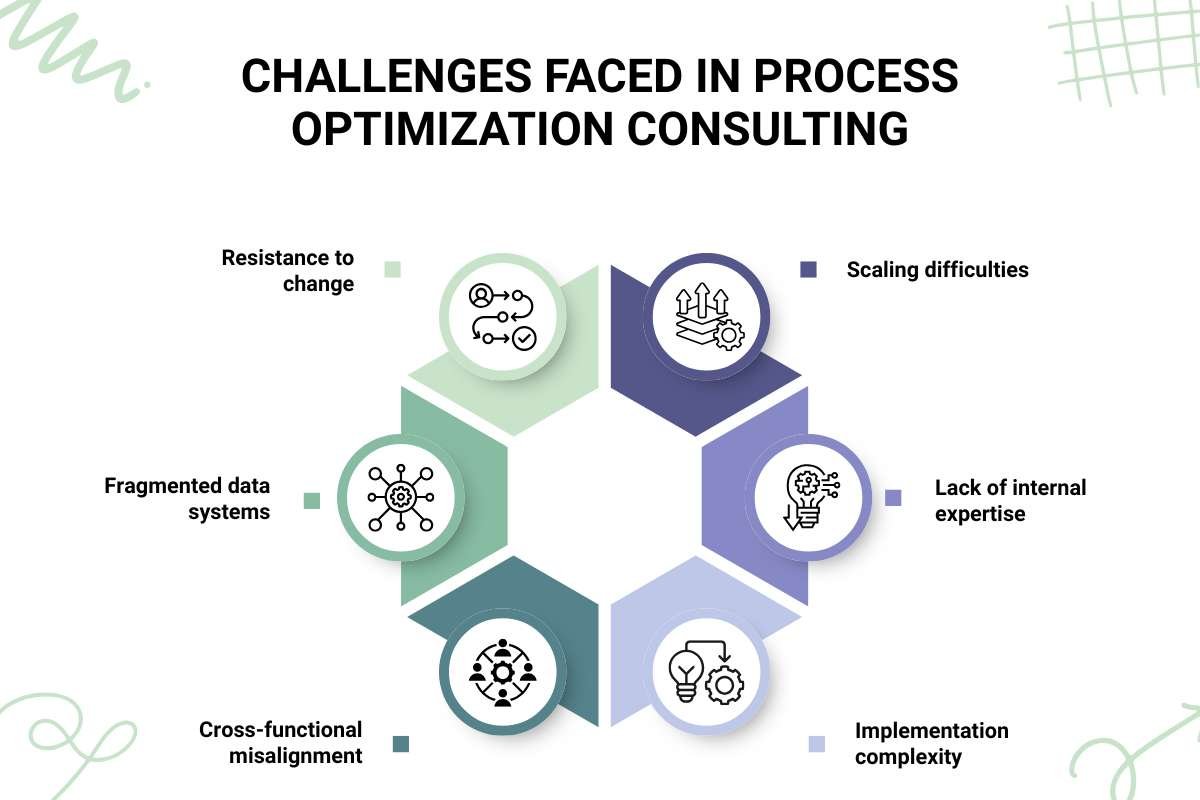
While process optimization consulting improves efficiency, the execution is not always smooth. Many organizations struggle when applying these changes in real environments. Issues such as resistance to change, poor data quality, and misaligned teams often slow down progress. These challenges shape how effectively improvements are implemented and sustained over time.
1. Resistance to change
Employees often resist new workflows because they are familiar with existing systems. Even inefficient processes feel safer than new ones. This slows adoption and delays results across teams.
2. Fragmented data systems
Many organizations use disconnected tools and inconsistent data sources. This blocks a clear end-to-end view of operations. A 2026 PwC operations survey found that 87% of leaders say poor data quality limits transformation success.
3. Cross-functional misalignment
Departments often follow different goals and KPIs. This creates conflict during process redesign. Improvements in one area may slow another, reducing overall efficiency.
4. Implementation complexity
Large organizations struggle during rollout. Training, coordination, and system integration create friction. Even well-designed processes can fail if execution is inconsistent.
5. Lack of internal expertise
Many companies lack in-house process optimization skills. This increases reliance on external consultants. Without internal ownership, long-term adoption becomes weaker.
6. Scaling difficulties
A process that works in one team may not perform the same elsewhere. Differences in systems and workflows create inconsistency. Scaling improvements across the organization remains a challenge.
Case study: All healthcare and brewster consulting
The Challenge
All Healthcare worked with Brewster Consulting Group to fix broken project execution. Project intake had no standard process. Each department handled requests in its own way. This created confusion and duplicate work. Teams also worked in silos. Leadership could not see a clear project status, which slowed decisions.
Consulting approach
Brewster Consulting set up a Project Management Office for All Healthcare. They built one central system for project intake. This made every request follow the same path. They also created a prioritization model.
It ranked projects based on business value and urgency. A resource tracking system was added to balance team workloads. A single reporting system gave leadership real-time updates on all projects.
The outcome
All Healthcare gained better control over project work. All projects are now entered through one system. This reduced confusion across teams. Leaders could track progress in real time. Workloads became more balanced across departments. This reduced duplicate effort and improved delivery speed.
Key takeaways
- PMO improved project visibility at All Healthcare
- Standard intake reduced confusion and duplicate requests
- Prioritization improved focus on important work
Conclusion:
At some point, adding more effort stops producing better results. Teams stay busy, systems stay active, and yet the output does not reflect the energy being put in. That gap is usually not visible in day-to-day operations because everything still appears to be moving.
The real shift happens when businesses start questioning how work is structured instead of how hard people are working. Process optimization consulting brings that question to the center. It exposes where time gets absorbed without impact and where simple adjustments can change how smoothly everything connects. Once those points are addressed, improvement stops feeling incremental and starts becoming structural.
People also ask
1. What problem does process optimization consulting solve?
It addresses inefficiencies in workflows that slow down execution, even when teams are performing well individually.
2. Does it require changing tools or systems completely?
Not always. Many improvements come from refining existing workflows rather than replacing entire systems.
3. How quickly can results be seen?
Some improvements are immediate, especially in time savings, while bigger structural changes take longer to fully reflect in outcomes.