Hybrid cloud computing allows businesses to balance scalability, security, compliance and cost while supporting AI and modern workloads. This article covers how hybrid cloud environments work, why adoption is growing and which workloads are best suited for public, private or hybrid environments. It also discusses key business advantages, real-world use cases, common implementation hurdles and practical considerations for organizations considering a hybrid cloud strategy.
Businesses find themselves at a crossroads, where the need for agile cloud services is at odds with the need to control sensitive data, ensure regulatory compliance, and maintain existing infrastructure investments. Hybrid cloud computing has emerged as a pragmatic solution to balance these priorities. It allows organizations to combine public and private environments into a single operating model rather than choosing between them. Hybrid cloud is fast becoming a strategic foundation for modern enterprise technology, with increasing AI workloads, edge computing, and data governance needs.
This article explores why adoption is accelerating, how hybrid environments operate, and what organizations should consider before deploying a hybrid cloud strategy.
Table of Contents
Hybrid cloud computing: definition and business value
Hybrid Cloud Computing is a computing environment that uses a mix of on-premises infrastructure (or private cloud) and public cloud so that data and applications can move between them. This results in a cohesive, flexible IT system where workloads are moved based on performance, security, and cost needs.
What makes it different?
Simply using multiple environments isn’t a hybrid cloud. The key difference is orchestration and interoperability. The hybrid cloud connects these environments so they operate as one standardized technology with shared data, resources, and management. Without this integration, you just have separate silos.
Immediate business value
- Flexibility: Run sensitive workloads privately while scaling non-sensitive tasks in the public cloud
- Cost efficiency: Pay for extra public cloud resources only when needed, reducing maintenance costs
- Security + scalability: Keep data private while leveraging the public cloud’s unlimited resources
- Business continuity: Data replication across environments protects against disasters
- Avoid vendor lock-in: Maintain the ability to move data if the public cloud becomes unsustainable.
Research shows hybrid cloud generates 2.5 times greater business value than single-cloud approaches. And up to 13 times more benefits when paired with enterprise transformation.
Why enterprises are accelerating hybrid cloud adoption?

Enterprises are rapidly embracing Hybrid Cloud Computing, driven by six critical factors:
1. AI and GPU demand
AI projects require specialized hardware like GPUs or TPUs that are expensive to purchase and maintain. Hybrid Cloud Computing lets businesses access these resources on-demand through the public cloud, optimizing utilization while keeping costs low.
2. Regulatory compliance
Industries like finance and healthcare face strict regulations (GDPR, HIPAA, PCI-DSS). Hybrid architecture enables sensitive data to stay on-premises while still leveraging public cloud scalability, ensuring compliance without sacrificing innovation.
3. Data sovereignty
Data sovereignty means information is governed by the laws of the country where it’s stored. Hybrid Cloud Computing allows companies to keep sensitive data in-country on-premises or private cloud while using hyperscaler technology for less sensitive workloads.
4. Cost optimization
Public cloud services are pay-only-when-needed, reducing capital expenditure. Organizations optimize operational costs by running steady workloads privately and bursting to the public cloud during peak demands.
5. Cloud repatriation trends
Rising cloud costs are prompting enterprises to move some workloads back to private infrastructure. Hybrid models support this “cloud repatriation,” balancing cost efficiency with continued cloud benefits.
6. Business resilience
Hybrid Cloud Computing enhances disaster recovery and business continuity by distributing workloads across environments. This redundancy reduces downtime risk and prevents vendor lock-in.
The core components of a modern hybrid cloud environment:
A modern hybrid cloud environment integrates multiple infrastructure layers and technologies to create a unified, flexible computing platform.
1. Public cloud
Third-party services (AWS, Azure, Google Cloud) offering unlimited scalability and pay-as-you-go pricing for workloads needing elastic resources.
2. Private cloud
A cloud environment dedicated to one organization, either on-premises or hosted, providing enhanced security and control over sensitive data.
3. On-prem infrastructure
Traditional data centers and legacy systems that become “private cloud” when enhanced with virtualization, automation, and self-service capabilities.
4. Containers and kubernetes
Containers package applications with dependencies for portability across environments. Kubernetes automates the deployment, scaling, and management of containerized workloads across the entire hybrid architecture.
5. APIs
Application Programming Interfaces enable different cloud environments to communicate and share data, forming the backbone of integration between public, private, and on-premises systems.
6. Networking
Technologies like VPNs, WANs, AWS Direct Connect, and Google Cloud VPN provide secure connectivity between environments, enabling seamless data movement.
7. Unified management platforms
Centralized consoles allow businesses to monitor, govern, and automate infrastructure across all environments from a single control plane, providing visibility and simplified operations.
Which workloads belong in public, private, and hybrid environments?
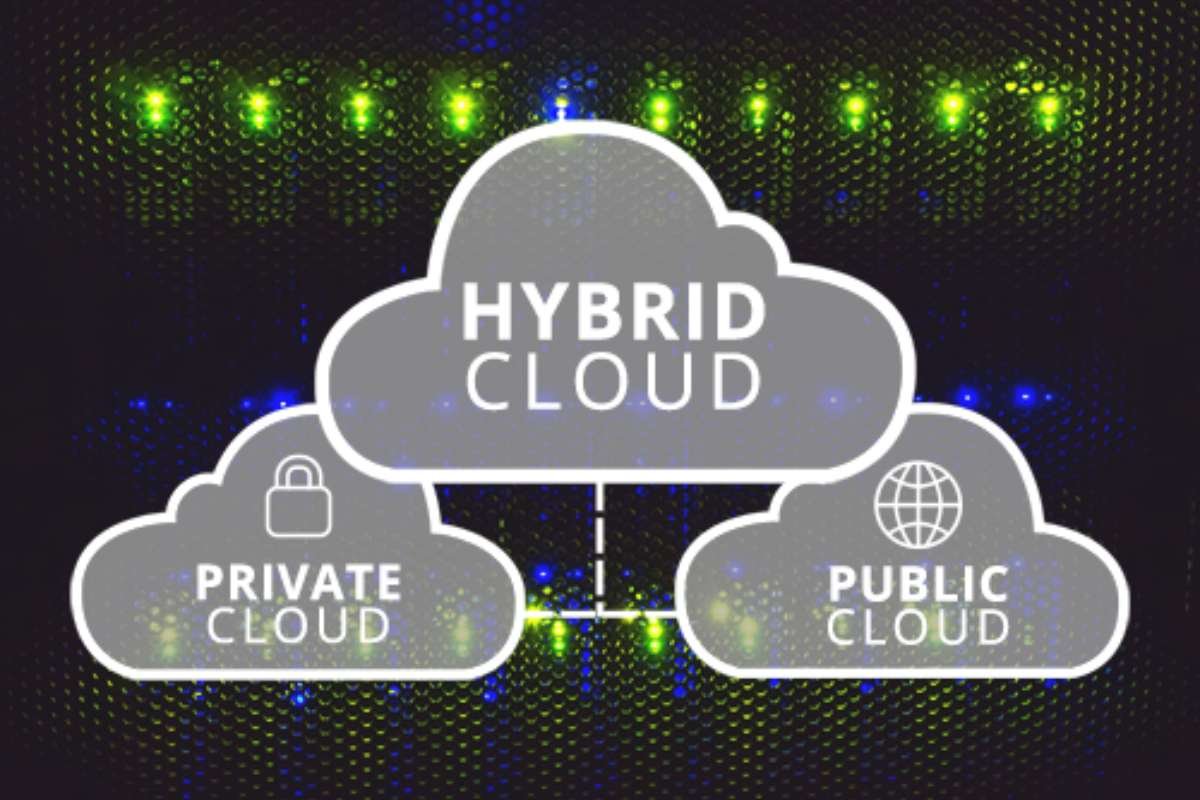
Workload placement is the strategic process of determining the optimal location for running applications based on performance, cost, and compliance requirements.
1. Workload placement guide
| Workload | Best Environment |
| AI Training | Public Cloud |
| Financial Data | Private Cloud |
| Analytics | Hybrid |
| ERP Systems | Hybrid |
| Disaster Recovery | Public Cloud |
| Edge Applications | Hybrid |
2. Cost
Public cloud offers pay-as-you-go pricing ideal for variable workloads like AI training. Private cloud reduces costs for steady, predictable workloads.
3. Latency
Edge applications need ultra-low latency, requiring a hybrid deployment that keeps processing close to users while maintaining central management.
4. Security
Financial data and sensitive financial records demand a private cloud’s dedicated environment with enhanced control and encryption.
5. Compliance
HIPAA, GDPR, and PCI-DSS regulations often require data to stay in specific locations. Hybrid Cloud Computing balances compliance needs with scalability by keeping regulated data private while using the public cloud for non-sensitive processing.
ERP systems and analytics benefit from hybrid environments, combining private data security with public cloud scalability for reporting and processing bursts.
Real-world use cases of hybrid cloud computing:
Behind every backend integration of Hybrid Cloud Computing, real people notice the difference in speed, reliability, and security. Here is how daily human experiences change across those same use cases:
1. Banking customers:
A user opens their mobile banking app on payday. Because the public cloud handles the massive morning traffic surge, the interface loads instantly. Meanwhile, the user enjoys peace of mind knowing their actual bank account balance and private PIN remain isolated safely on a locked-down local server.
2. Patients & doctors:
A physician pulls up a patient’s life-saving medical imaging files on a tablet in seconds during a critical consultation. The hospital’s on-site network serves the file instantly without relying on a spotty internet connection, while a medical researcher halfway across the world accesses anonymized versions of the same data via the public cloud to find disease trends.
3. Factory workers:
An assembly line technician receives an automated alert on their smartwatch stating that a mechanical arm will overheat in two hours. The local edge sensors predicted this drop in performance by comparing real-time operational data with historical patterns processed by the cloud, keeping the worker safe and preventing a plant-wide shutdown.
4. Holiday shoppers:
A consumer browses a massive flash sale on Black Friday. Despite millions of people clicking “Buy Now” at the same moment, the website does not crash. The shopper experiences a smooth checkout because the system automatically borrows computing power from the public cloud to handle the rush.
5. AI developers:
A software engineer designs a new virtual assistant. Instead of waiting weeks for local computer hardware to process millions of images, the engineer safely uploads the code to massive public cloud processors, completing the task overnight and speeding up their workflow.
Here are the biggest challenges in hybrid cloud adoption:
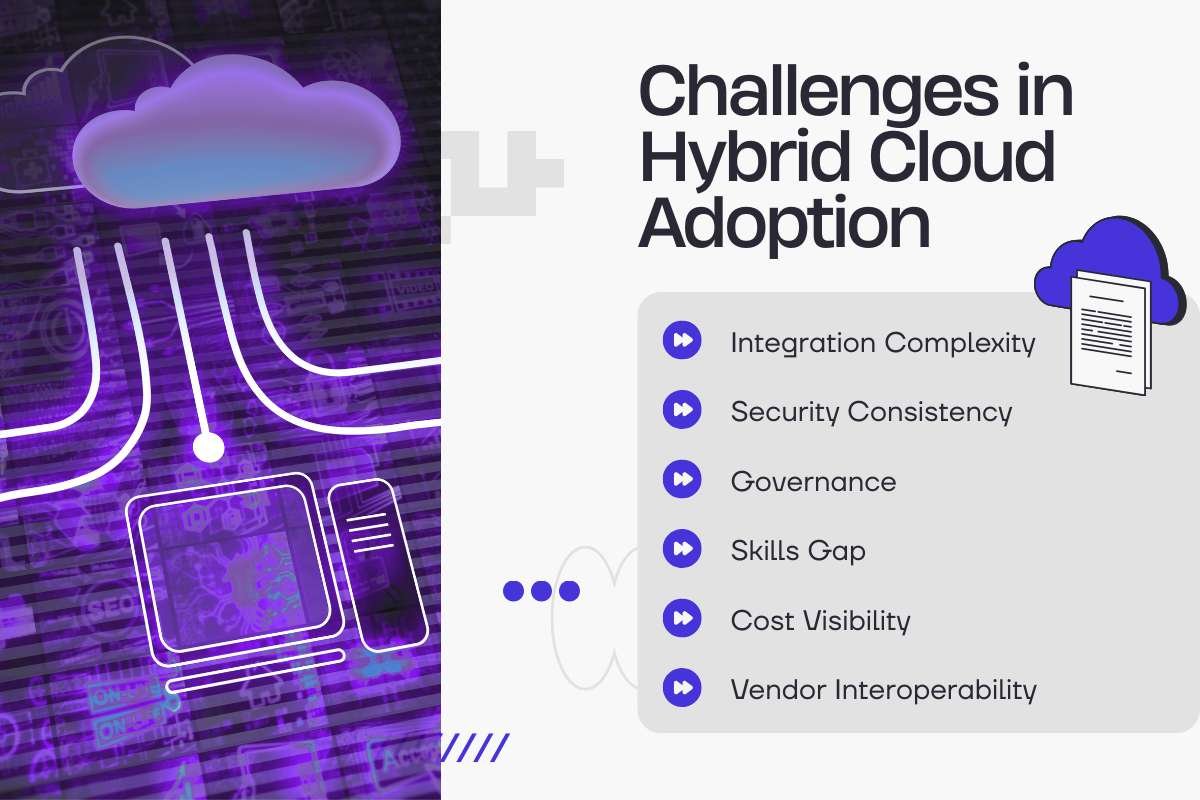
Despite its benefits, Hybrid Cloud Computing adoption faces several significant hurdles that organizations must address. The following is referred from John Granger, Chairman, IBM Consulting, speculation of challenges.
1. Integration complexity
Many companies have a “hodge-podge” of public, private, and on-premises assets that weren’t designed to work together. Creating a unified, integrated platform requires moving from discrete components to a cohesive architecture.
2. Security consistency
Unintegrated cloud components increase security risks. Organizations struggle to maintain consistent security policies, capabilities, and procedures across all environments, making it difficult to detect and respond to incidents quickly.
3. Governance
Establishing unified governance across multiple environments is challenging. Without centralized oversight, teams operate in silos, leading to inconsistent policies and compliance gaps.
4. Skills gap
Talent shortages leave companies with too few developers and engineers who possess the critical cloud skills needed for integrated hybrid operations. Existing staff are spread too thin across all areas.
5. Cost visibility
Costs can increase by up to 50% when moving data between environments. Unpredictable costs make it difficult to manage cloud investments without a single view showing how and where services are consumed across the enterprise.
6. Vendor interoperability
The partner ecosystem is overwhelming, with each group bringing competing interests. Businesses struggle with vendor lock-in concerns and ensuring different platforms work together seamlessly.
Conclusion:
Hybrid cloud computing has moved from being a compromise to a strategic imperative for modern enterprises. It allows organizations to run AI workloads, support edge computing, and maintain data sovereignty without compromising innovation by balancing agility with security, compliance, and cost control. There are challenges, of course, such as integration complexity and skills gaps. But the business value is 2.5x greater than single-cloud approaches. It explains the accelerating adoption across banking, healthcare, manufacturing, and retail.
Is it time to change your IT strategy? Begin the process of determining whether a hybrid cloud strategy is appropriate for your organization by mapping out your current workloads and determining which workloads would benefit most from a flexible, integrated cloud environment.
FAQ:
1. What is hybrid cloud computing?
Hybrid cloud computing is an IT infrastructure that combines on-premises data centers or private clouds with public cloud services (like AWS or Azure).
2. What are the 4 types of cloud computing?
The 4 main types of cloud computing are categorized by deployment model. They are Public, Private, Hybrid, and Multicloud.
3. What is hybrid computing with an example?
A hybrid computer is a specialized computing system that combines the best features of both analog and digital computers.
4. What is a real-life example of a hybrid cloud?
A hybrid cloud combines private on-premises infrastructure with public cloud services (like AWS or Azure). A classic example is a Retail E-commerce Business.
5. Is AWS a hybrid cloud?
AWS Storage Gateway is a set of hybrid cloud storage services that provide on-premises applications with access to virtually unlimited cloud storage.
Links and Sources:
https://www.cloudflare.com/learning/cloud/what-is-hybrid-cloud
https://www.ibm.com/think/insights/benefits-of-using-containers-in-a-hybrid-cloud