Consider living in a large neighborhood where practically every business, from the neighborhood bakery to the toy manufacturer across the street, is a “Small Scale Industry.” The World Bank claims that because they account for over half of all jobs and approximately 90% of all businesses, small businesses are the foundation of our global economy. They are more than just tiny stores; they are the backbone of the world economy.
In fact, organizations such as the OECD have found that these businesses make up 99% of all businesses in many nations. They provide opportunities for people to work locally and assist in transforming innovative concepts into tangible products. This guide will explain the workings of these tiny but powerful industries and why they are more significant now than they have ever been.
What Are Small Scale Industries?
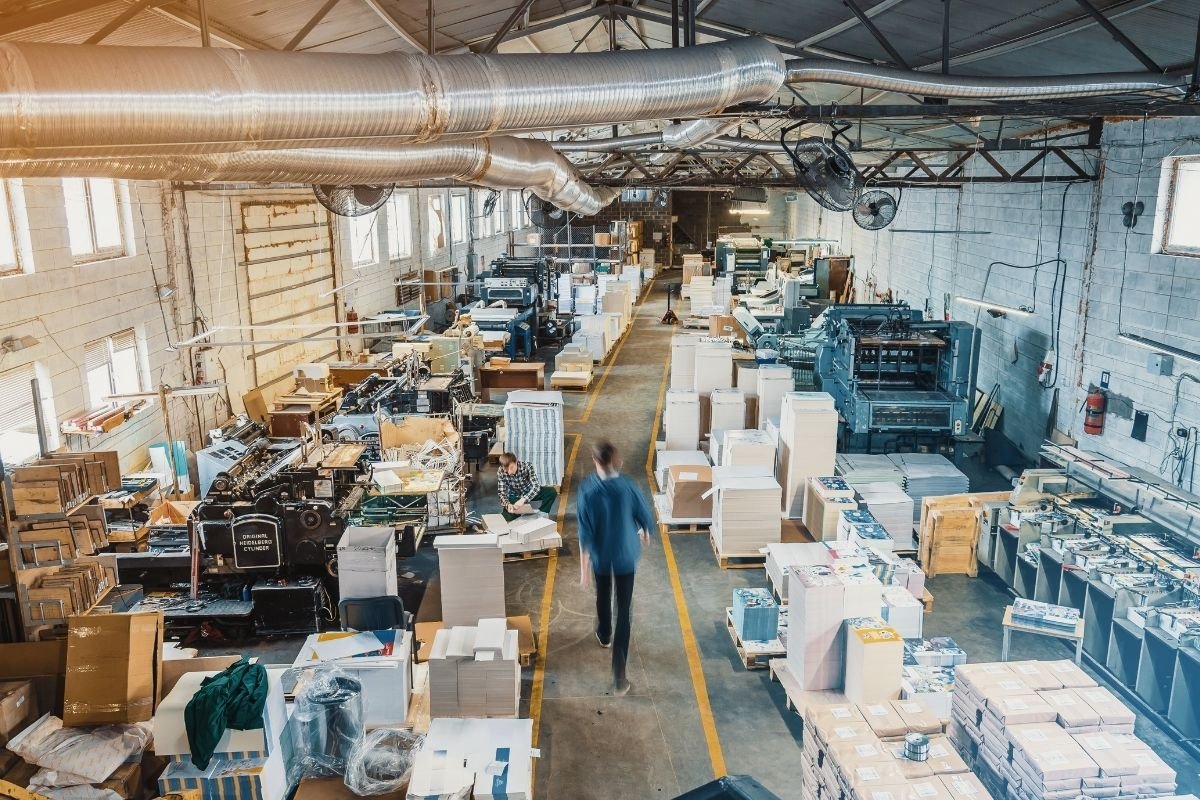
Small Scale Industries (SSIs) are often called Small and Medium Enterprises (SMEs). They are businesses that operate on a smaller amount of capital and with fewer employees than massive corporations. Instead of giant factories, they usually work out of smaller workshops or offices. These businesses focus on local production and use simpler machinery to create goods or provide services.
Core Characteristics
What makes these industries special isn’t just their size. It’s how they function:
- Flexible Operations: They can change their products quickly to meet new trends without needing to redo an entire assembly line.
- Faster Decision-Making: Since there are fewer layers of management, owners can make big choices in minutes rather than months.
- Close Customer Relationships: They often know their customers by name, allowing for personalized service and high-quality care.
Expert Insight: Smaller firms act like speedboats compared to large corporate “tankers.” Their size allows them to adapt to market changes and economic shifts much faster than big businesses.
Examples of Small Scale Industries:
Small scale industries are the quiet powerhouses behind global brands and local convenience alike. While we often think of them as standalone shops, many function as ancillary industries, specialized units that produce essential components for giant corporations. For example, a small factory in Germany might exclusively manufacture high-precision screws for an international car brand, making it a critical link in the global supply chain.
1. Manufacturing-Based
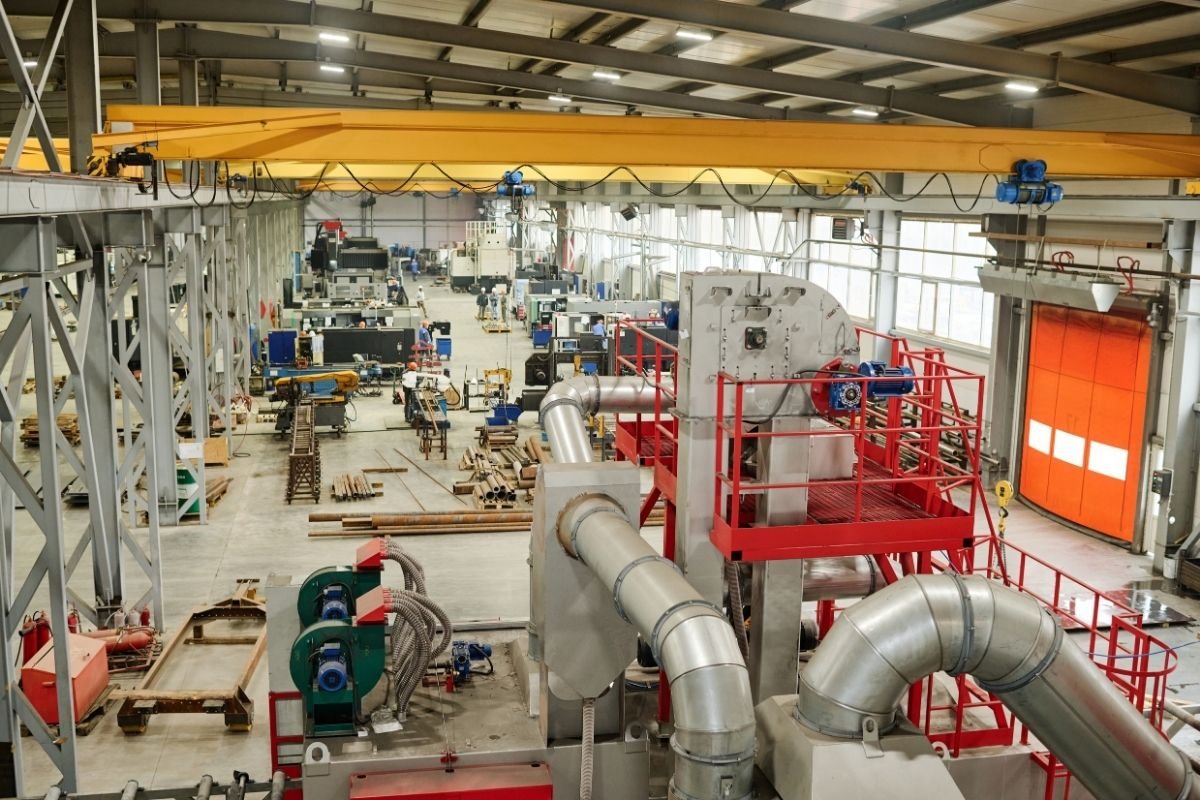
These industries transform raw materials into finished or semi-finished goods.
- Sustainable Textiles: Eco-friendly clothing brands in Vietnam or Portugal that use traditional weaving with modern, sustainable fibers.
- Artisanal Handicrafts: High-end pottery or hand-carved furniture workshops in Italy and Japan that export to global luxury markets.
- Boutique Food Processing: Specialized units producing organic honey, cold-pressed oils, or fermented beverages (like Kombucha) that cater to health-conscious consumers worldwide.
2. Service-Based
Instead of physical goods, these firms provide expertise and labor.
- Creative & Digital Agencies: Small teams in Brazil or Eastern Europe providing high-tech web design and AI-driven marketing for global startups.
- Specialized Logistics Support: Independent courier services or “last-mile” delivery firms that ensure packages reach remote areas where large carriers don’t go.
- Technical Repair Services: Shops specializing in the micro-soldering of smartphones or the maintenance of high-end medical equipment.
3. Innovation-Driven
These are often high-growth firms that solve very specific technical problems.
- Niche Tech Startups: Companies developing specific software for vertical farming or urban water management.
- Specialized Suppliers: Firms that 3D-print custom prosthetic limbs or aerospace parts on demand for larger engineering firms.
Global Impact: SMEs by the Numbers
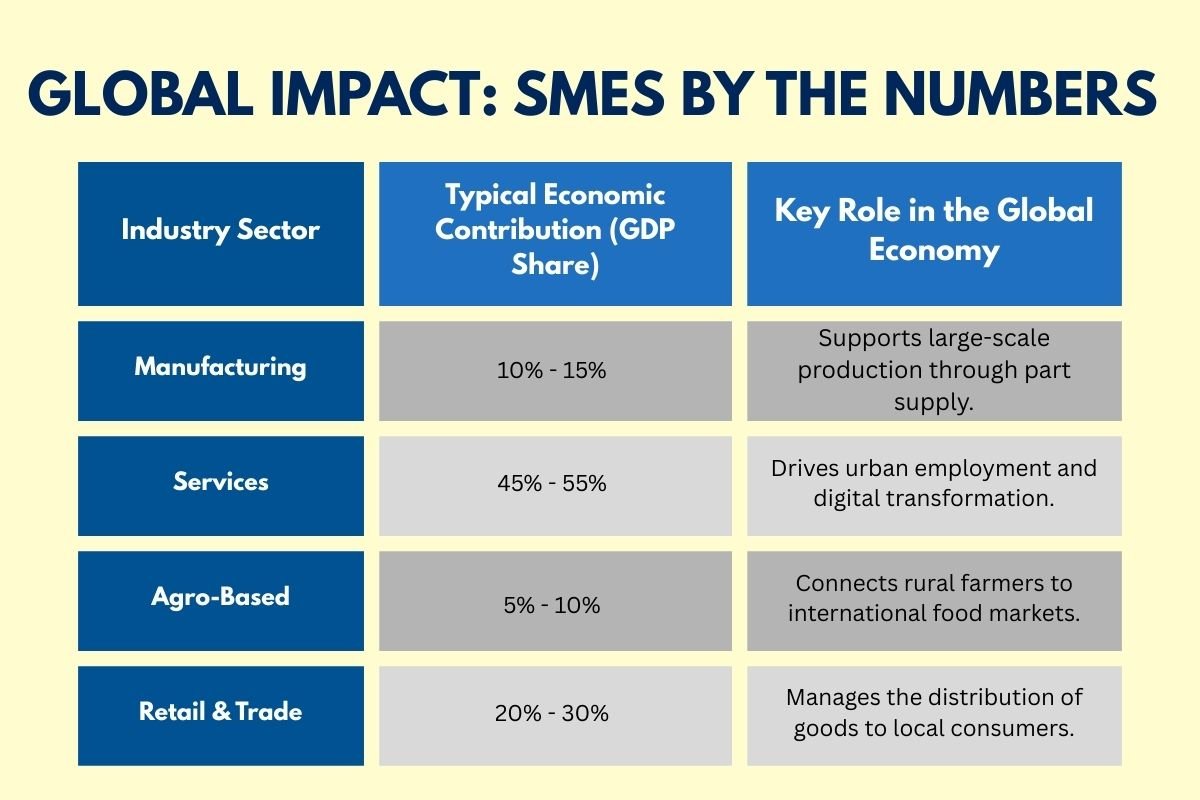
According to data from the World Bank and the OECD, here is how different sectors typically contribute to the global economy:
| Industry Sector | Typical Economic Contribution (GDP Share) | Key Role in the Global Economy |
| Manufacturing | 10% – 15% | Supports large-scale production through part supply. |
| Services | 45% – 55% | Drives urban employment and digital transformation. |
| Agro-Based | 5% – 10% | Connects rural farmers to international food markets. |
| Retail & Trade | 20% – 30% | Manages the distribution of goods to local consumers. |
Types of Small Scale Industries:
To understand how these businesses fit into the world, it helps to group them by what they do. Organizing them this way. It is a process called taxonomy. This makes it easier for governments to provide the right support and for consumers to find what they need.
1. Manufacturing Enterprises
These units focus on creating tangible products. They use raw materials and labor to build items from scratch.
- Examples: Furniture makers, plastic toy factories, and bakeries.
- Economic Role: They add value to raw materials and create physical wealth.
2. Service Enterprises
These businesses don’t sell a “thing” you can hold; instead, they sell their time and expertise.
- Examples: Auto-repair shops, dry cleaners, and software consulting firms.
- Economic Role: They support the daily lives of citizens and keep other businesses running smoothly.
3. Artisan & Traditional Industries
These are often rooted in culture and heritage. They rely heavily on human skill and craftsmanship rather than heavy machinery.
- Examples: Hand-woven carpets, traditional jewelry, and hand-painted ceramics.
- Economic Role: They preserve cultural history and provide vital income for rural communities.
4. Export-Oriented Units (EOUs)
These are a special class of small businesses that send most of their products to other countries.
- Global Impact: They are essential for foreign exchange generation, meaning they bring international currency (like Dollars or Euros) into their home country’s economy.
- Quality Standard: Because they sell globally, they often have the highest quality standards and use the latest technology to compete on the world stage.
Advantages of Small Scale Industries:
“SMEs are the main source of jobs in the business sector, accounting for about 70% of total employment on average.” OECD (Organization for Economic Cooperation and Development).
Small scale industries do more than just sell products; they serve as the foundation for a healthy society. Because they are spread across different towns and villages rather than being clustered in one giant city, they play a vital role in reducing regional inequality.
Key Advantages
- Accessible Entrepreneurship: Because they require lower capital (less money to start), they open the doors for talented people from all backgrounds to start their own businesses.
- Job Creation: These industries are labor-intensive, meaning they hire more people per dollar invested than large, automated factories. This directly improves the quality of life for local families.
- Innovation & Competition: Small firms are the “idea labs” of the economy. They force larger companies to stay sharp by introducing new products and creative ways of solving problems.
- The Flexibility Edge: While a massive corporation is like a giant ship that takes miles to turn, an SSI is like a nimble jet ski. Their flexibility allows them to pivot their entire business model in days to meet a sudden market demand or adopt a new technology.
Disadvantages of Small Scale industries:
While small scale industries are vital, they face hurdles that large corporations rarely do. Acknowledging these risks is essential for a balanced perspective on the SME landscape.
Key Disadvantages
- High Failure Rates: Statistically, SMEs face significant bankruptcy risks, often failing within their first five years. This usually happens because they lack a “financial cushion” to survive sudden market slumps or unexpected expenses.
- Limited Capital for Expansion: Because small firms have fewer assets to pledge as collateral, banks often view them as high-risk. This makes it difficult to secure loans for new machinery or global scaling.
- Employment Instability: Jobs in some small sectors can be temporary or seasonal. Unlike large firms with massive reserves, a small business may have to reduce its staff immediately if a single large contract is lost.
- Lack of Economies of Scale: Because they buy raw materials in smaller quantities, they often pay higher prices than big companies, which can lead to thinner profit margins.
Major Challenges Facing Small Scale Industries:

Deep obstacles prevent small businesses from competing on a global scale. These limitations frequently create a “vicious cycle” in which scarce resources impede the very advancements required for expansion.
- Limited Access to Finance: Small firms often lack the collateral required by traditional banks, leading to a massive “funding cliff.”
- Technological Gaps: High costs often prevent SMEs from adopting Industry 4.0 tools like AI and automation, leaving them with lower productivity than large rivals.
- Skill Shortages: Smaller budgets make it difficult to attract and retain specialized talent, especially in high-tech manufacturing.
- Regulatory Burdens: Complex tax laws and compliance requirements hit small firms harder because they lack dedicated legal and finance teams.
- Infrastructure Limitations: Poor logistics and unreliable energy supply in certain regions increase operational costs and delay deliveries.
The Global Financing Gap
The growing SME finance gap is a major expert concern for 2026. According to the World Bank, this gap has reached approximately $5.7 trillion in emerging markets alone. Many high-potential businesses are essentially shut out of the global market because they lack the “working capital” necessary to purchase the raw materials required for sizable export orders. In addition to harming the company, this lack of funding slows down the creation of jobs nationwide.
Role of Small Scale Industries in the Global Economy:
Small scale industries are the engines of inclusive growth, ensuring that economic progress reaches every corner of society. By providing local jobs and supporting rural development, they act as a primary tool for poverty reduction and economic diversification.
On a macro level, these firms fuel the competition that forces entire nations to become more productive. They transform local resources into global value, making economies more resilient against global shocks. These industries are not small in influence, only in scale. By fostering a culture of innovation, they ensure that the future of global trade remains dynamic and accessible to everyone.
Small Scale Industries vs Large Scale Industries:
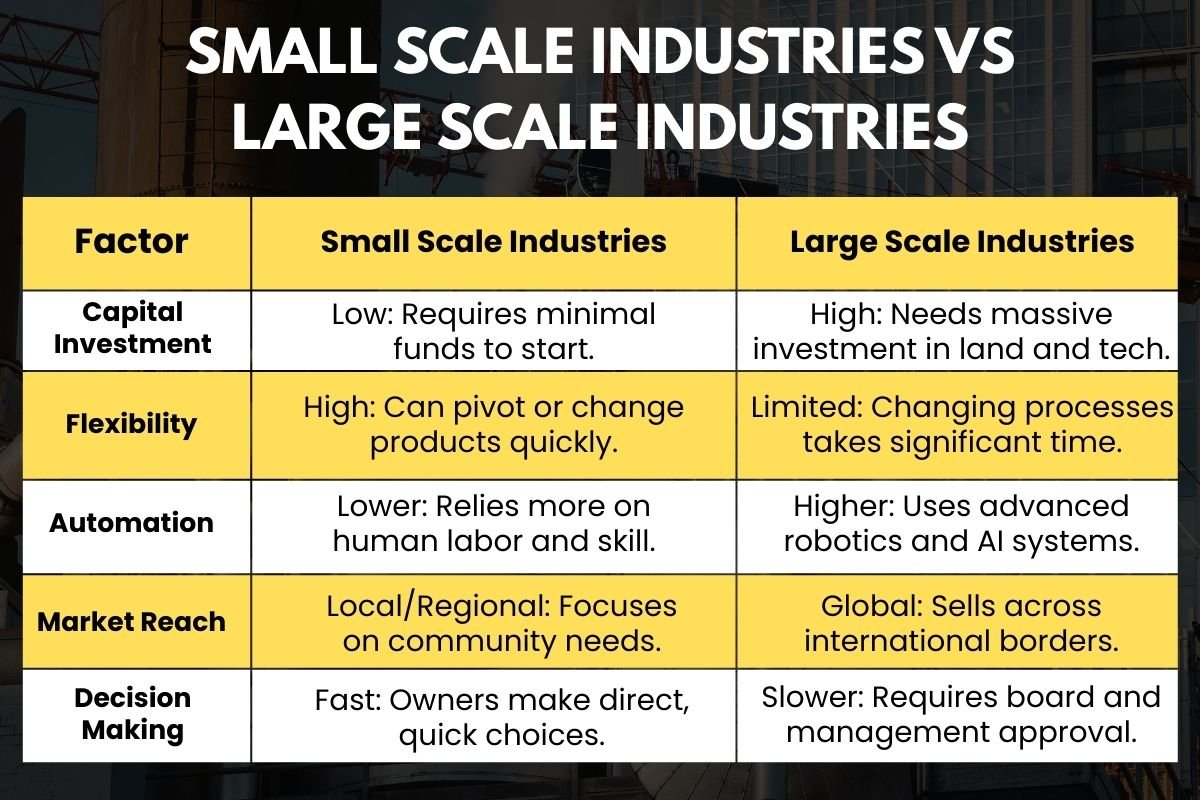
Choosing between a small or large scale model depends on the business goals and available resources. While large industries drive mass production, small industries thrive on agility and personalization.
| Factor | Small Scale Industries | Large Scale Industries |
| Capital Investment | Low: Requires minimal funds to start. | High: Needs massive investment in land and tech. |
| Flexibility | High: Can pivot or change products quickly. | Limited: Changing processes takes significant time. |
| Automation | Lower: Relies more on human labor and skill. | Higher: Uses advanced robotics and AI systems. |
| Market Reach | Local/Regional: Focuses on community needs. | Global: Sells across international borders. |
| Decision Making | Fast: Owners make direct, quick choices. | Slower: Requires board and management approval. |
The Future of Small Scale Industries:
The landscape of Small Scale Industries is undergoing a historic shift. By 2026, these businesses will no longer just be “local shops.” They will be high-tech, sustainable players on a global stage.
Key Trends Shaping the Future
- Digital Transformation & Industry 4.0: Small firms are moving from “trying AI” to embedding it into daily work. Tools like AI agents for customer service and 3D printing for custom parts allow small shops to match the speed and precision of giant factories.
- The Sustainability Transition: Sustainability is moving from a “marketing story” to an “operating system.” In 2026, SMEs are using green tech not just to save the planet, but to lower energy bills and meet the demands of eco-conscious buyers.
- Rise of the “Micro-Multinational”: Thanks to digital platforms, a one-person business can now sell to 50 countries from day one. Youth entrepreneurship is booming as Gen Z and Alpha use low-code tools to build apps and global brands with minimal costs.
The $5 Trillion Priority
For this future to work, the world must bridge the SME financing gap, which has reached over $5.7 trillion. As millions of young people enter the workforce each year, expanding access to capital is the only way to create the 400+ million jobs needed globally.
Conclusion:
Small scale Industries show that you can make a major mark on the world without having a huge footprint. Their flexibility makes them the ultimate economic survivors, even with the fact that they face actual challenges like funding gaps and technological shifts. These commercial “speedboats” are developing into high-tech, environmentally friendly leaders that propel innovation worldwide as 2026 approaches. Supporting these companies helps more than just a neighborhood store. It feeds the very engine that keeps our global economy robust and open to all.
FAQ:
1. What are some common examples of small scale industries?
Examples include food processing units, textile workshops, furniture manufacturing, digital service agencies, repair businesses, specialty retail stores, and artisan crafts. Many technology-driven micro-enterprises are also emerging as high-growth small scale businesses.
2. Are small scale businesses profitable?
Yes, many small scale businesses can achieve strong profitability when they focus on efficient operations, clear market positioning, and customer-centric strategies. Profitability often depends more on business planning and demand than on company size.
3. What role do governments play in supporting small scale industries?
Governments worldwide support these businesses through tax incentives, funding programs, export assistance, training initiatives, and simplified regulations. Such policies encourage entrepreneurship and help stabilize national economies.