
The adoption of remote training has increased by 300% since 2020. This has increased the global corporate e-learning market. And changed it to an incredible $521 billion in 2026. Businesses are shifting to virtual models to fill critical skill gaps. It is future-proofing their operations as digital transformation makes traditional classrooms obsolete. This article examines how “Virtual Corporate Training.” It is now a strategic necessity for businesses. Those who are hoping to stay competitive in an AI-driven economy, rather than a luxury.
Virtual training offers a smooth cross-border bridge for modern companies. This allows distributed workforces with round-the-clock, on-demand access. Businesses can provide employees in any time zone. With the help of consistent, high-impact learning. By using asynchronous modules and immersive technology. The secret to keeping an agile, high-performing staff that thrives in the hybrid era. It is to become an expert in these digital delivery techniques. Regardless of the size of your company.
What is Virtual Corporate Training?
It is a systematic, technologically advanced approach to professional development. Virtual corporate training uses digital platforms in place of traditional classroom settings. It allows employees to upskill from any location with an internet connection. By converting an organization’s expert knowledge into a flexible online format.
From live webinars and Virtual Instructor-Led Training (VILT). They help to create interactive e-learning modules and high-fidelity simulations. This ecosystem thrives on diversity. Organizations use an advanced tech stack to make this work:
- Learning Management Systems (LMS): To host, track, and manage course progress.
- Video Conferencing: For real-time collaboration and “face-to-face” interaction.
- Interactive Tools: Such as digital whiteboards, breakout rooms, and gamified assessments.
By integrating these tools. Virtual training transforms passive content into an engaging, interactive experience. This mirrors and often surpasses the efficacy of in-person workshops.
Importance of Virtual Corporate Training:
In an era of rapid disruption, virtual training is a strategic business imperative. It ensures talent development and peak performance across geographically distributed and hybrid teams. This helps with unified standards regardless of location.
As industries evolve, continuous skill renewal is vital for staying competitive. Digital platforms provide the unique ability to scale these learning initiatives instantly. Training thousands of employees across global time zones simultaneously. By eliminating travel and venue costs. Businesses achieve a high-impact, cost-effective solution that fosters an agile, future-ready workforce.
Key Benefits of Virtual Corporate Training:
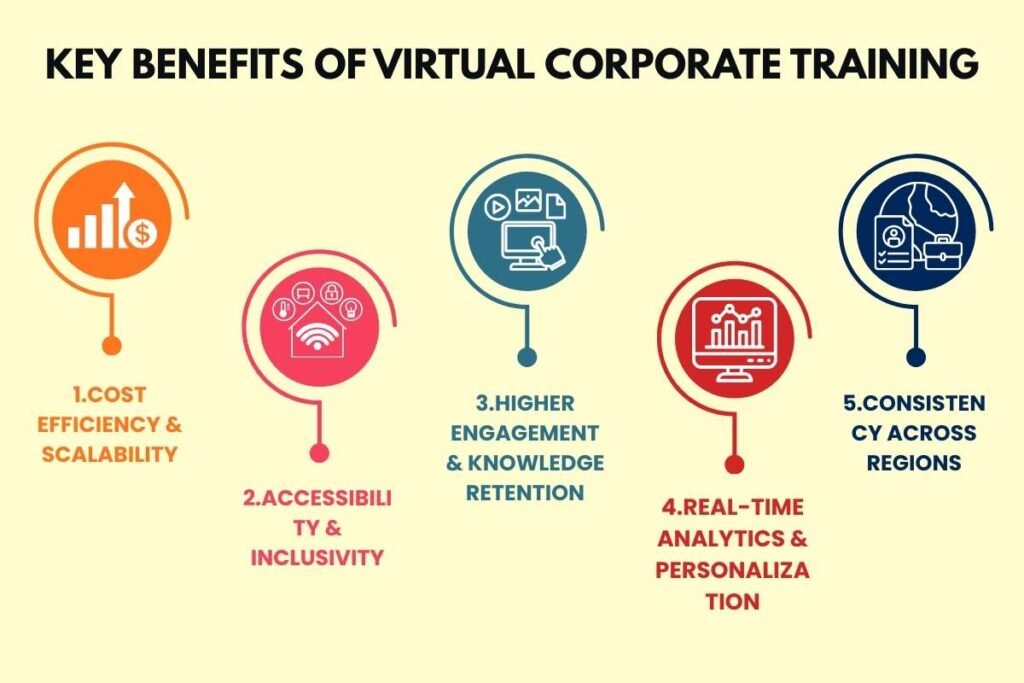
Virtual training transforms how organizations develop talent. By offering flexibility that traditional methods cannot match. Here are the primary advantages:
1. Cost Efficiency & Scalability
Virtual programs eliminate major overhead expenses, including travel, venue rentals, and physical materials. Because digital content is reusable. Companies can scale training from ten to ten thousand employees globally. Without a proportional increase in costs.
2. Accessibility & Inclusivity
By removing geographical barriers. Virtual training ensures every employee has equal access to growth opportunities. Features like closed captions, screen readers, and multi-language support. This makes learning more inclusive for diverse workforces and those with different abilities.
3. Higher Engagement & Knowledge Retention
Interactive multimedia, such as gamified leaderboards, simulations, and instant quizzes. This shifts employees from passive listeners to active participants. This “learn-by-doing” approach significantly boosts long-term knowledge retention compared to static lectures.
4. Real-Time Analytics & Personalization
Modern platforms provide deep insights into learner progress. Managers can track completion rates and assessment scores in real-time. This allows them to tailor content to a specific role. And also address individual skill gaps immediately.
5. Consistency Across Regions
Virtual training guarantees a standardized curriculum. Whether an employee is in London or Tokyo. They receive the same high-quality instruction. This ensures brand and operational alignment across the entire global organization.
Types of Virtual Corporate Training Programs:
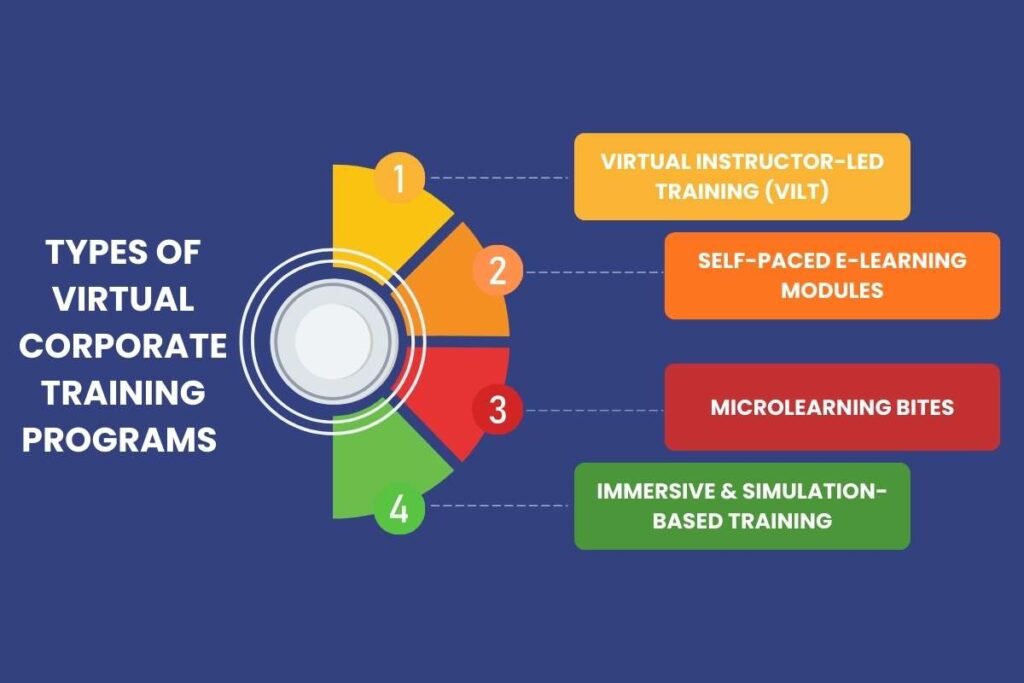
Modern virtual training is not a “one-size-fits-all” solution. To maximize impact, organizations deploy diverse formats tailored to specific learning goals:
1. Virtual Instructor-Led Training (VILT)
VILT replicates the energy of a physical classroom in a digital space. These are real-time, synchronous sessions. Where expert trainers lead live webinars, facilitate breakout room activities. They provide immediate feedback via chat and digital whiteboards.
2. Self-Paced E-Learning Modules
These asynchronous programs allow learners to progress at their own speed. Usually hosted on an LMS. These modules feature structured paths, interactive video content, and automated assessments. They provide instant feedback loops for the learner.
3. Microlearning Bites
Microlearning delivers “just-in-time” knowledge through short, 3–5 minute lessons. Examples include a quick “How-To” video, a daily quiz, or an infographic. This format fits easily into busy schedules. It significantly enhances long-term retention by focusing on one concept at a time.
4. Immersive & Simulation-Based Training
Leveraging AR and VR, these programs provide hands-on practice in a risk-free environment. This is essential for high-stakes technical skills. Such as medical procedures, electrical safety, or complex machinery operation. This is where mistakes in the real world would be costly.
Challenges of Virtual Corporate Training:
While the benefits are vast, implementing virtual training comes with unique hurdles. Addressing these proactively transforms potential roadblocks into opportunities for better engagement.
1. Engagement & Participation Barriers
“Zoom fatigue” and digital distractions are the primary enemies of online learning. Without the physical presence of a trainer, learners may multitask or lose focus.
The Solution: Including interactive polls, gamified quizzes, and breakout rooms. Every 10–15 minutes. Ensure sessions are concise and include frequent “brain breaks” to maintain mental energy.
2. Tech Limitations & Bandwidth Issues
Uneven internet speeds or complex software requirements. It can exclude employees in regions with poor infrastructure or outdated hardware.
The Solution: Prioritize platform compatibility (mobile-friendly tools). And offer low-bandwidth versions of content, such as downloadable PDFs or audio-only streams. Conduct a “tech check” session before launching major programs.
3. Cultural & Language Diversity
A program designed in one country may not resonate globally. Due to language barriers or culturally specific references that don’t translate well.
The Solution: Invest in content localization. This goes beyond literal translation. It involves using local case studies, inclusive imagery, and culturally relevant idioms. This helps to ensure the message is meaningful for every region.
Virtual Corporate Training vs. In-Person Training:
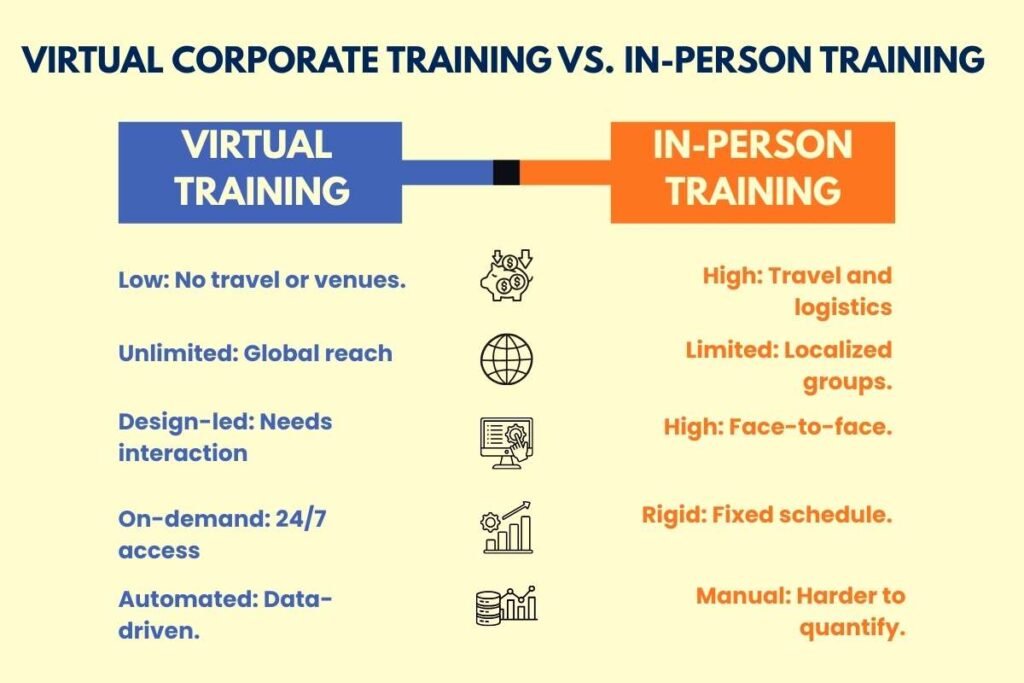
Choosing between virtual and in-person training. It depends on your specific goals, budget, and workforce distribution. While virtual learning offers unmatched reach. In-person sessions remain the gold standard for high-touch relationship building.
| Criteria | Virtual Training | In-Person Training |
| Cost | Low: No travel or venues. | High: Travel and logistics. |
| Scalability | Unlimited: Global reach. | Limited: Localized groups. |
| Engagement | Design-led: Needs interaction. | High: Face-to-face. |
| Flexibility | On-demand: 24/7 access. | Rigid: Fixed schedule. |
| Tracking | Automated: Data-driven. | Manual: Harder to quantify. |
Strategic Takeaways:
- Use Virtual Training for: Compliance, software rollouts, technical upskilling, and onboarding global teams. Where speed and cost-efficiency are paramount.
- Use In-Person Training for: It includes executive leadership retreats. Along with high-stakes hands-on safety training and intensive team-building. Where emotional intelligence and networking are the primary goals.
- The 2026 Trend: Most successful organizations now use a Hybrid Model. Delivering theory and data through virtual modules. While reserving in-person time for deep reflection and peer collaboration.
AI in Virtual Corporate Training: Leading Case Studies:

Global leaders are revolutionizing “Virtual Corporate Training.” By integrating AI to move beyond static learning toward high-impact, data-driven results.
- Walmart & IBM: Walmart used AI-powered VR to cut training time by 95%. While IBM’s Watson creates hyper-personalized paths, significantly boosts completion rates.
- Amazon & McDonald’s: Amazon leveraged AI to increase task fulfillment by 40%. McDonald’s utilized voice-activated AI to reduce time-to-hire by 65%.
- Unilever & Google: Unilever’s Unabot automates onboarding across 190 markets. Google uses predictive analytics to future-proof employee skills.
The Verdict: AI changes virtual training. Spanning from a passive requirement into a strategic engine for ROI. This helps in scaling expert knowledge with unprecedented precision.
Future Trends in Virtual Corporate Training:

According to Enterprise Wired, the shift toward “New Collar” skills. And AI-integrated workflows are redefining the training landscape in 2026. Here are the popular trends shaping global strategy:
AI-Driven Personalization: Generative AI creates dynamic learning paths in real-time. It also helps in adapting content difficulty. These are based on an employee’s specific performance data and career trajectory.
Immersive AR/VR Experiences: Adoption of the “Metaverse for Training” has surged. VR learners are completing courses 4x faster than in traditional classrooms. By practicing in risk-free, 3D environments.
Hybrid Learning Models: Forward-thinking firms are blending asynchronous digital modules. Along with high-touch, in-person workshops to maximize both scalability and human connection.
Data-Driven Optimization: Advanced analytics now track “learning velocity” and behavioral application. This allows L&D teams to prove a direct ROI on business KPIs.
Conclusion:
Spanning from a temporary solution. Virtual corporate training has developed into a vital component of organizational excellence. Businesses can create a truly agile workforce. By embracing immersive technologies and AI-driven personalization. Success depends on striking a balance. By using data-driven digital tools and maintaining the human element through hybrid approaches. Companies that prioritize ongoing, accessible, and engaging learning. They will be at the center of their respective industries as 2026 progresses.
FAQ:
1. Is virtual corporate training effective compared to traditional classroom training?
Yes. When designed properly, virtual corporate training can be as effective. It can be even more effective than in-person training. Interactive elements like live discussions, assessments, and real-time feedback. They often improve engagement, knowledge retention, and skill application.
2. What skills can be taught through virtual corporate training programs?
Virtual corporate training can cover a wide range of skills. It includes leadership development, technical, and IT skills. Along with compliance training, cybersecurity awareness, sales enablement, and customer service training.
3. How can companies keep employees engaged during virtual corporate training?
Engagement can be improved by using interactive content. Like quizzes, polls, breakout sessions, gamification, real-world case studies, and short microlearning modules. Clear objectives and frequent feedback also help maintain learner focus.