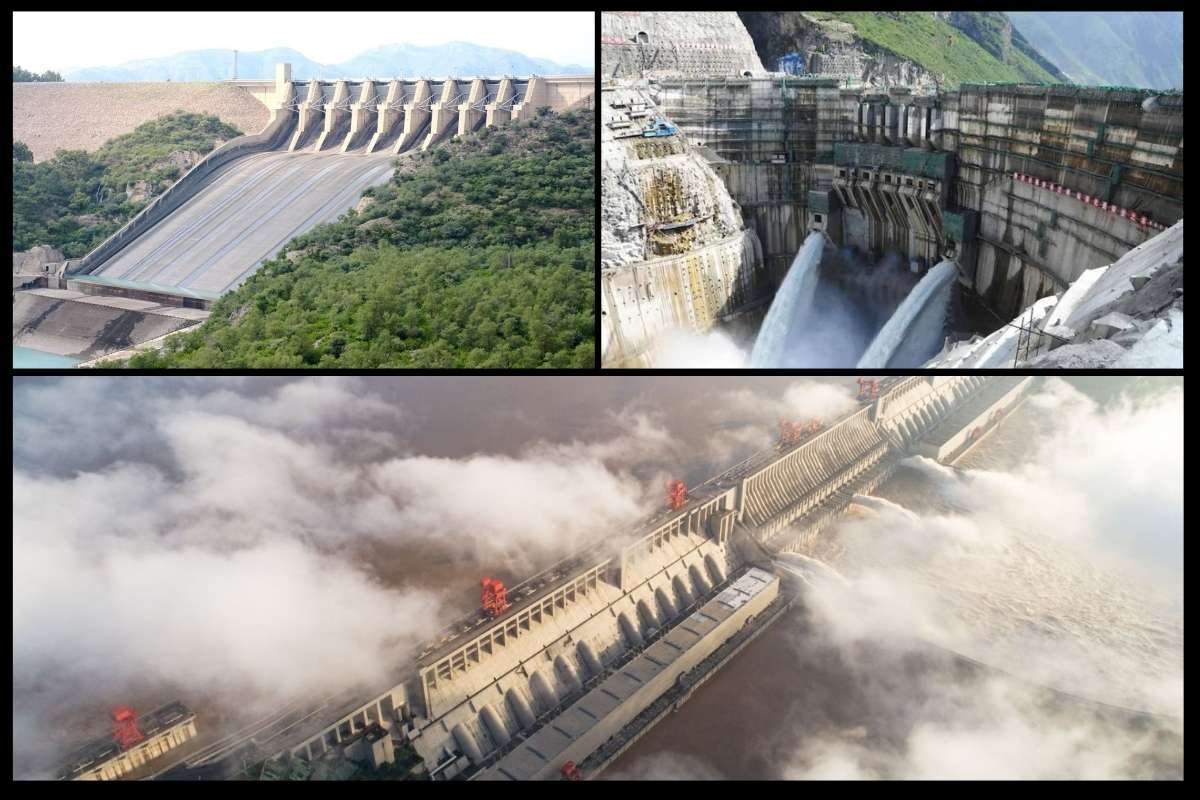
Dams have been rudimentary for civilizations to exist. From the oldest known Jawa Dam in Jordan to the Yarlung Tsangpo Mega-Dam Project, which started in June of 2025, these dams are essential for water preservation and supply. Now, one question that we all have asked at least once in our lifetime: Which is the largest dam in the world?
The answer to that question keeps changing every year. As the world’s infrastructure develops, the number of the largest dams in the world increases. But it also raises the question of what is classified as the “largest dams,” as there is no single criterion for the world’s largest dams.
We categorize dams based on three things, i.e., volume, height, and power capacity. And the answer to the “largest dams in the world” changes by these three categories.
So, here’s what we can do. Here are the 23 largest dams in the world, based on the three criteria. Let’s take a look at each of them.
Your Complete Overview of the 23 Largest Dams in the World
Here is the ultimate list of the 23 largest dams in the entire world. We have divided them into two categories. In the next couple of minutes, we will check out the largest dam by height and by size.
So, without wasting too much time, here are the 23 largest dams:
| Category | Name | Country | Year | Metric | Measurement |
|---|---|---|---|---|---|
| Largest Dams by Structure Volume | Tarbela Dam | Pakistan | 1976 | Volume (million m³) | 153 |
| Fort Peck Dam | USA | 1940 | 96 | ||
| Atatürk Dam | Turkey | 1990 | 84.5 | ||
| Houtribdijk | Netherlands | 1968 | 78 | ||
| Oahe Dam | USA | 1963 | 70.3 | ||
| Mangla Dam | Pakistan | 1967 | 65.4 | ||
| Gardiner Dam | Canada | 1967 | 65.4 | ||
| Oroville Dam | USA | 1968 | 59.6 | ||
| San Luis Dam | USA | 1967 | 59.6 | ||
| Samara Dam | Russia | 1959 | 54 | ||
| Largest Dams By Height | Jinping-I Dam | China | 2013 | Height (m) | 305 |
| Nurek Dam | Tajikistan | 1980 | 300 | ||
| Xiaowan Dam | China | 2010 | 292 | ||
| Xiluodu Dam | China | 2013 | 285.5 | ||
| Grande Dixence | Switzerland | 1960 | 285 | ||
| Inguri Dam | Georgia | 1987 | 272 | ||
| Vajont Dam | Italy | 1960 | 261.6 | ||
| Nuozhadu Dam | China | 2014 | 261.5 | ||
| Mica Dam | Canada | 1973 | 243 | ||
| Sayano-Shushenskaya Dam | Russia | 1988 | 242 | ||
| Largest Dams by Power Capacity | Three Gorges Dam | China | 2012 | Power Capacity (MW) | 22,500 |
| Baihetan Dam | China | 2021 | 16,000 | ||
| Itaipu Dam | Brazil/Paraguay | 1984 | 14,000 |
World’s Largest Dams by Structure Volume
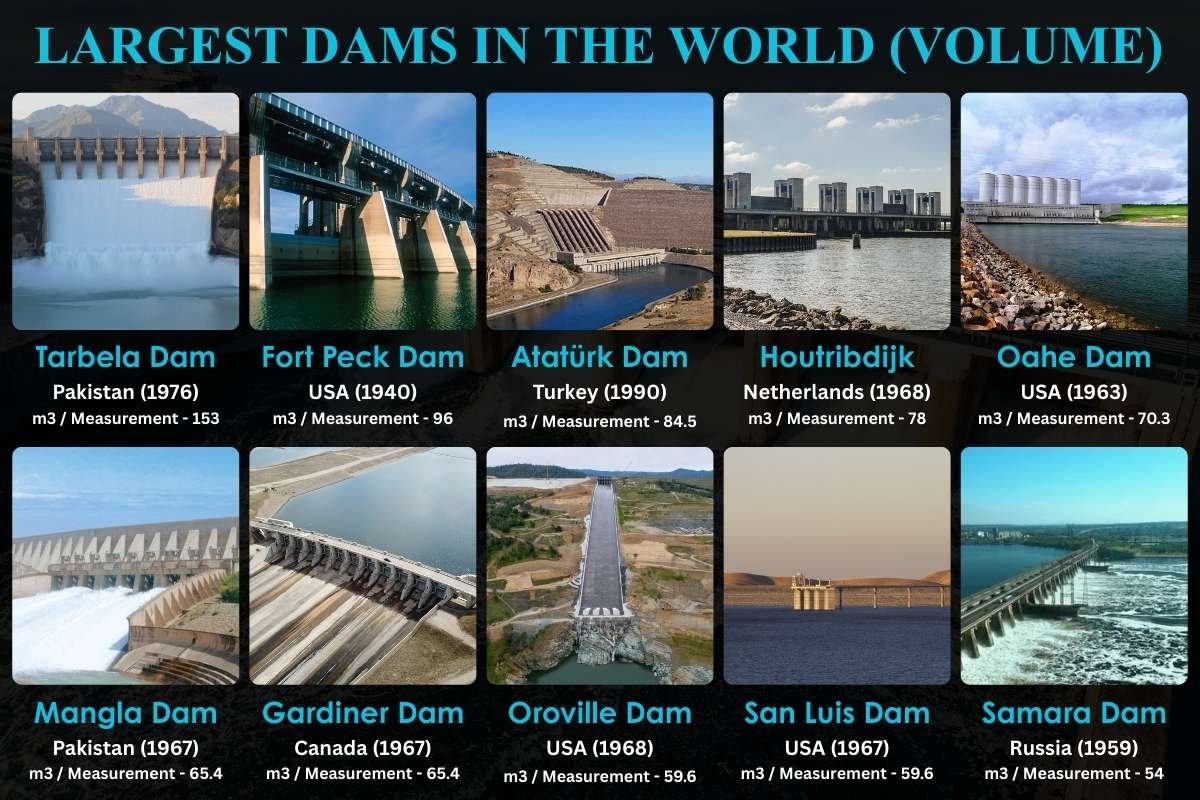
Here are 10 dams that are the largest in the world by their structural volume:
1. Tarbela Dam
- Country: Pakistan
- Volume: 153 million m³
The Tarbela Dam stands on the Indus River in Pakistan. Completed in 1976 as part of the massive Indus Basin Project. It is the largest earth-fill dam. The dam creates Tarbela Lake, a vital reservoir. This structure manages floods and provides crucial irrigation for millions of acres of farmland.
The dam’s hydropower plants generate nearly 3478 MW of electricity, feeding power directly into Pakistan’s national grid. Tarbela Dam greatly supports the daily lives and economy of the nation.
2. Fort Peck Dam
- Country: USA
- Volume: 96 million m³
The Fort Peck Dam stands on the Missouri River in Montana. Finished in 1940, this massive structure is the largest hydraulically filled earthfill dam in the United States. During the Great Depression, the project employed over 11,000 workers. The dam created Fort Peck Lake, one of the largest artificial lakes in the country.
Today, the dam controls floods and generates 185 MW of vital hydroelectric power. The U.S. Army Corps of Engineers manages the structure, which provides power and safeguards communities downriver.
3. Atatürk Dam
- Country: Turkey
- Volume: 84.5 million m³
The Atatürk Dam stands tall on the Euphrates River in southeastern Turkey. Completed in 1990, this massive rock-fill dam is central to the extensive Southeastern Anatolia Project (GAP). The power plant generates 2,400 MW of vital hydroelectricity, supplying the region’s energy needs.
More importantly, it provides irrigation for nearly 500,000 hectares of farmland through a tunnel system. This structure transforms arid land into productive agricultural areas, profoundly improving the lives of local farmers and boosting the regional economy.
4. Houtribdijk
- Country: Netherlands
- Volume: 78 million m³
The Houtribdijk is a major dam in the Netherlands, completed in 1976. This 26-kilometer structure connects the cities of Lelystad and Enkhuizen. Its primary role is to separate the Markermeer and IJsselmeer lakes. Created to reclaim land, the dam now functions as a crucial flood barrier, shielding surrounding provinces from storm surges.
It also serves as a vital roadway (N302) for travelers. Recently reinforced, the dam now uses nature-based materials to improve safety and preserve local wildlife, showing how we can build with nature.
5. Oahe Dam
- Country: USA
- Volume: 70.3 million m³
The Oahe Dam is a massive rolled-earth dam on the Missouri River in South Dakota. Finished in 1962, the dam was a key project for the U.S. Army Corps of Engineers. It creates Lake Oahe, one of the largest reservoirs in the United States. This structure serves multiple vital purposes.
It controls dangerous floods, provides irrigation water for farmers, and generates 786 MW of reliable hydroelectric power. The dam’s presence significantly manages the river’s flow and supports the economy and communities.
6. Mangla Dam
- Country: Pakistan
- Volume: 65.4 million m³
The Mangla Dam is a crucial embankment dam located on the Jhelum River in Pakistan. Completed in 1967 as part of the Indus Basin Project, it is one of the country’s most critical water structures. The dam creates a large reservoir that helps regulate water for irrigation across the Indus basin.
Its power station generates over 1,000 MW of hydroelectricity, a key source of power for Pakistan’s national grid. The dam also provides some flood control, significantly benefiting the nation’s people and farmlands.
7. Gardiner Dam
- Country: Canada
- Volume: 65.4 million m³
The Gardiner Dam is an enormous earth-fill dam on the South Saskatchewan River in Canada. Completed in 1967, it stands among the largest dams in the world of its type. The structure creates Lake Diefenbaker, a massive reservoir that supplies water to nearly half of Saskatchewan’s population.
The dam’s power plant generates 186 MW of hydroelectric power. Critically, it also provides irrigation for thousands of acres of farmland, supplies drinking water to cities, and offers crucial flood control. It is a multi-purpose lifeline for the Canadian prairies.
8. Oroville Dam
- Country: USA
- Volume: 59.6 million m³
The Oroville Dam is the tallest in the United States, standing 770 feet high on the Feather River in California. Completed in 1968, this massive earthfill structure is a crucial part of the State Water Project. It forms Lake Oroville, the second-largest reservoir in the state.
The dam serves to control floods and provides a vital water supply for millions of people. Additionally, its hydroelectric power plant generates 770 MW of electricity. In its full potential, it supports California’s energy needs.
9. San Luis Dam
- Country: USA
- Volume: 59.6 million m³
The San Luis Dam, also called B.F. Sisk Dam is a vital embankment dam in California. Completed in 1968, it is a joint project for both the federal Central Valley Project and the State Water Project. The dam forms San Luis Reservoir, the largest off-stream reservoir in the United States.
It stores critical irrigation water for over one million acres of farmland in the arid region. Additionally, the dam’s power plant uses powerful, reversible turbines to both pump water and generate 424 MW of electricity, efficiently managing the state’s precious water supply.
10. Samara Dam
- Country: Russia
- Volume: 54.6 million m³
The Samara Dam stands on the Volga River in Russia. It created the vast Kuybyshev Reservoir. Completed in 1957, this structure is part of the Zhiguli Hydroelectric Station. The dam includes a long earth-fill section and critical navigation locks. Its reservoir is the largest in Europe by surface area.
The power station generates nearly 2,500 MW of reliable hydroelectricity, supplying major cities like Samara and Kazan. Beyond power, the dam manages floods and aids river navigation, playing a crucial role in the water management and economy.

World’s Largest Dams by Height
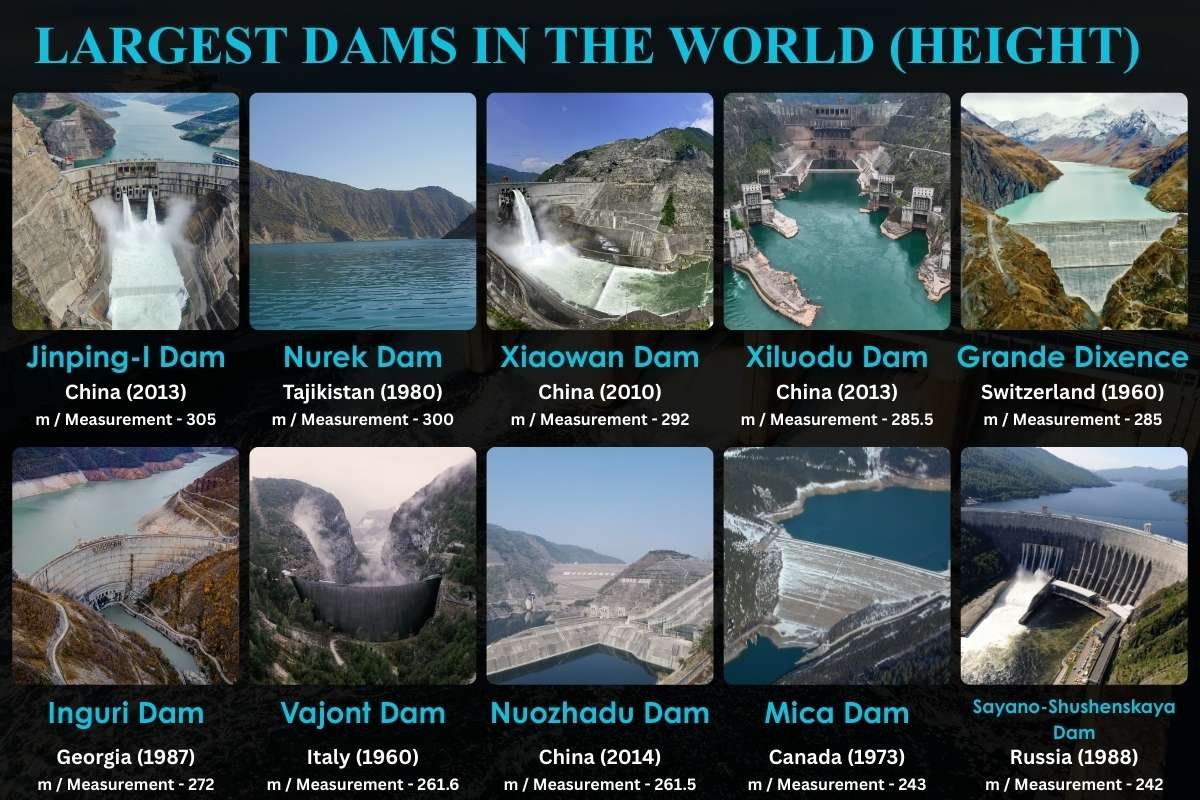
Now that we have discussed the largest dams by their structural volume, let’s take a look at dams by height.
Here’s the top 10:
11. Jinping-I Dam
- Country: China
- Height: 305 m
The Jinping-I Dam is a massive double-curvature concrete arch dam on the Yalong River in China. Completed in 2014, it stands at a remarkable 305 meters (1,000 feet), making it the tallest dam in the world. The structure’s construction overcame complex geological challenges.
Its purpose is to control river flow and generate electricity. The huge underground power station has a capacity of 3,600 MW, supplying vast amounts of clean hydroelectric power for China’s industrial growth. This dam represents a significant achievement in modern engineering.
12. Nurek Dam
- Country: Tajikistan
- Height: 285.5 m
The Nurek Dam is a massive earth-fill embankment dam on the Vakhsh River in Tajikistan. Completed in 1980, it stands at 300 meters (984 feet), making it one of the largest dams in the world by height. The dam’s primary function is hydroelectric power generation.
Its large power station has a capacity of over 3,000 MW, supplying most of Tajikistan’s electricity. Additionally, the dam’s reservoir provides crucial irrigation water for approximately 1.6 million acres of farmland, making it vital for the nation’s energy and agriculture.
13. Xiaowan Dam
- Country: China
- Height: 292 m
The Xiaowan Dam is a massive double-curvature arch dam on the Lancang (Mekong) River in China. Completed in 2010, it stands an incredible 292 meters (958 feet) tall, making it the second-highest arch dam in the world. The dam’s primary purpose is to generate clean energy.
Its powerful hydroelectric station contains six turbines with a total capacity of 4,200 MW. The structure also creates a large reservoir that helps regulate the river’s flow, providing crucial flood control for the region. This engineering marvel supports China’s energy needs. The dam also protects communities downriver.
14. Xiluodu Dam
- Country: China
- Height: 285.5 m
The Xiluodu Dam is a towering double-curvature arch dam on the Jinsha River in China. Standing 285.5 meters tall, it ranks among the world’s highest arch dams. The dam was completed in 2014 for hydroelectric power generation. Its two underground power stations hold an enormous installed capacity of nearly 14,000 MW.
The dam also plays a critical role in flood control for the Yangtze River basin, protecting downstream communities. By regulating the river’s flow, this giant dam significantly supports China’s energy and flood management needs.
15. Grande Dixence
- Country: Switzerland
- Height: 285 m
The Grande Dixence Dam stands on the Dixence River in Valais, Switzerland. Completed in 1961, this massive structure is the tallest gravity dam and 15th in the largest dams in the world, towering 285 meters high. The dam creates Lac des Dix, a reservoir that holds enough water to power much of the region. Its system channels water through 100 kilometers of tunnels to four power plants.
These plants generate over 2,000 MW of reliable hydroelectric power, supplying clean energy to hundreds of thousands of Swiss homes. The dam is essential to Switzerland’s energy security and management.
16. Inguri Dam
- Country: Georgia
- Height: 272 m
The Inguri Dam is a towering concrete arch dam located on the Enguri River in Georgia. Completed in 1987, it stands at 271.5 meters and is one of the highest arch dams. The dam diverts water through a long tunnel to an underground power station.
This station houses five turbines with a combined capacity of 1,300 MW. The dam is a national asset, supplying approximately 46% of all of Georgia’s electricity. Beyond power, it helps regional flood control and water management, making it vital for the nation’s stability.
17. Vajont Dam
- Country: Italy
- Height: 261.6 m
The Vajont Dam is a concrete double-curvature arch dam in northern Italy. Completed in 1960, it was designed for hydroelectric power and stood 262 meters high. While the dam structure itself did not fail, a catastrophic event occurred on October 9, 1963. A massive landslide from nearby Monte Toc crashed into the reservoir. The crash caused a huge wave to overtop the dam.
This wave devastated downstream communities, tragically killing around 2,000 people. The dam remains a powerful reminder of the vital need for thorough geological surveys and strict risk management in all dam construction projects.
18. Nuozhadu Dam
- Country: China
- Height: 261.5 m
The Nuozhadu Dam is a massive rock-fill embankment dam on the Lancang (Mekong) River in China. Completed in 2014, it stands at 261.5 meters high, making it one of the world’s tallest dams. This structure creates a vast reservoir, a key element of the regional water management.
Its powerful hydroelectric station has an enormous capacity of 5,850 MW, generating substantial clean energy for the nation. The dam is also crucial for flood control and improving navigation along the river, providing significant benefits for the entire region.
19. Mica Dam
- Country: Canada
- Height: 243 m
The Mica Dam is a major earthfill embankment dam on the Columbia River in British Columbia, Canada. Completed in 1973 under the Columbia River Treaty, it manages river flow between Canada and the USA. The dam created Kinbasket Lake, a massive reservoir with a huge storage capacity.
Its power station has expanded to generate approximately 2,816 MW of vital hydroelectric power. Operated by BC Hydro, the dam plays a dual role: supplying clean energy for the region and providing crucial flood control and water management for the entire Columbia River Basin.
20. Sayano-Shushenskaya Dam
- Country: Russia
- Height: 242 m
The Sayano-Shushenskaya Dam is a massive concrete arch-gravity dam on the Yenisei River in Russia. Completed in 1985, it stands 242 meters high and is designed to withstand powerful earthquakes. As one of the largest dams in the world, it is home to Russia’s largest power plant with an enormous installed capacity of 6,400 MW from 10 turbines.
This powerhouse generates over 23 terawatt-hours of electricity annually, making it a critical supplier of hydroelectric power for the national grid. Despite an accident in 2009, the dam remains a vital part of Russia’s energy infrastructure and an example of advanced engineering.
World’s Largest Dams by Power Capacity
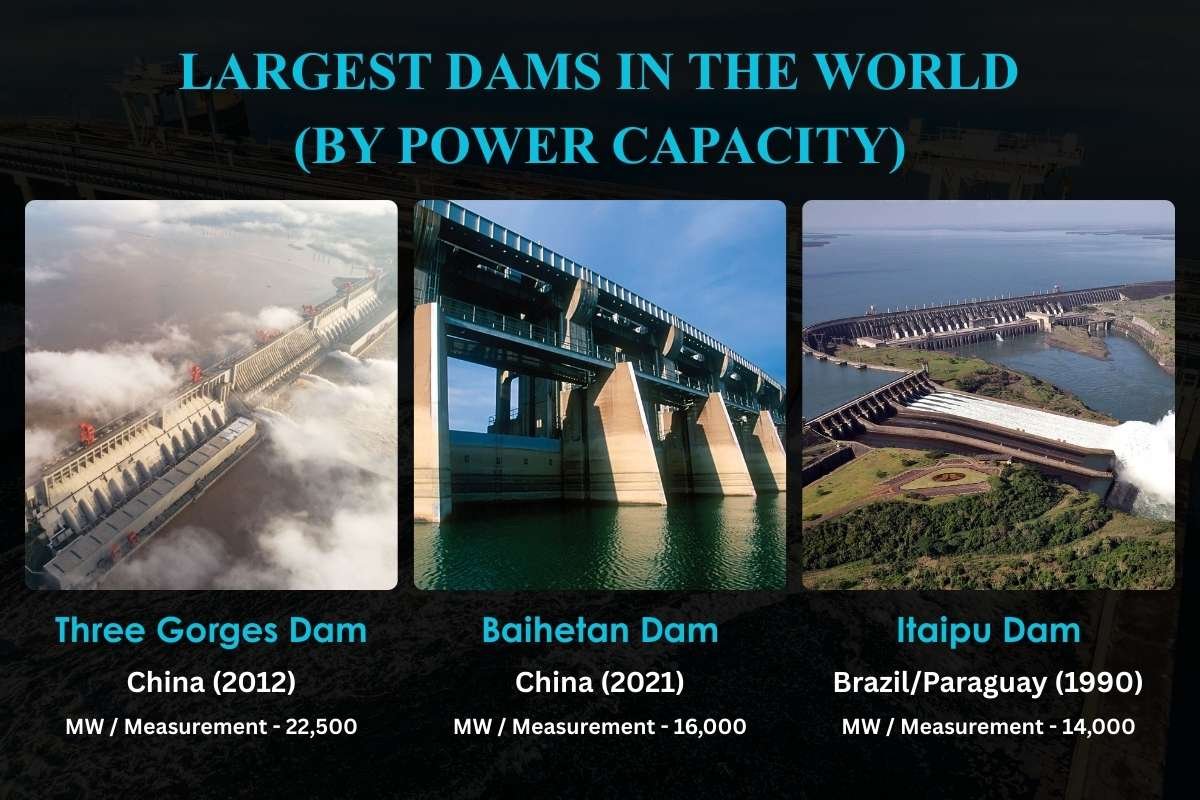
Now, let’s continue and talk about the last category, Power Capacity. The main purpose of a dam is to supply power to its region. And some dams are really good at doing so. Here are three of them:
21. Three Gorges Dam
- Country: China
- Power Capacity: 22,500 MW
When you Google the largest dams in the world by power capacity, you will find the Three Gorges Dam at the top of it. It is a massive concrete gravity dam on the Yangtze River in China. Completed in 2012, it holds the title of the world’s largest power plant. The dam’s 34 turbines generate an enormous 22,500 MW of hydroelectric power.
It creates a huge reservoir, critical for regulating river flow. The structure is essential for controlling devastating floods downstream and improving navigation for large ships. This dam profoundly impacts China’s energy supply, flood safety, and commerce.
22. Baihetan Dam
- Country: China
- Power Capacity: 16,000 MW
The Baihetan Dam is a massive double-curvature arch dam on the Jinsha River in China. Completed in 2022, it stands an impressive 289 meters tall. This structure is the second-largest power plant in the world, boasting a colossal capacity of 16,000 MW from 16 giant turbines.
It plays a critical dual role: generating substantial clean hydroelectric power and providing a huge flood control capacity for the Yangtze River basin. This engineering feat significantly boosts China’s renewable energy goals while protecting communities downstream.
23. Itaipu Dam
- Country: Brazil/Paraguay
- Power Capacity: 14,000
The Itaipu Dam stands on the Paraná River right on the border between Brazil and Paraguay. Completed in 1984, this massive hollow gravity dam is a symbol of international cooperation. It boasts a huge installed capacity of 14,000 MW, making it one of the world’s largest power plants.
The dam uses 20 turbines to generate massive amounts of reliable hydroelectricity. It significantly supplies energy to both nations and also offers crucial flood control and improved river navigation. The dam represents a major energy and engineering achievement for South America.

Upcoming Mega-Dams That Will Reshape the World’s Largest Dam Rankings
Now these were the 23 existing biggest dams, but what about the dams that are currently a work in progress?
Here are a couple of dams that will definitely impact the ranking of the largest dams in the world:
- Rogun Dam (Tajikistan): Planned to be the tallest dam in the world at 335 meters high, with an installed hydroelectric capacity equivalent to about three nuclear reactors. It will provide power to around 10 million people and significantly boost Tajikistan’s energy production. It is currently under active construction, with major milestones reached in 2025.
- Yarlung Tsangpo Hydroelectric Project (China, Tibet): Includes 5 cascade dams planned on the Yarlung Zangbo River, with a combined capacity expected around 50,000 MW, potentially the largest hydroelectric power source globally. Construction began recently and is planned for completion in the 2030s. This project aims to triple the energy output compared to the Three Gorges Dam.
- Medog Hydropower Station (China): With a planned capacity of up to 15.7 TWh annually, this project includes multiple dams and extensive diversion tunnels. Half of its hydroelectric capacity was installed by 2025, aiming to be one of the largest dams in the world in terms of energy generated.
- Wudongde Dam, Baihetan Dam, Xiluodu Dam (China): These dams are part of the Jinsha River hydroelectric complex, with generating capacities of 10,200 MW, 16,000 MW, and 13,860 MW, respectively. Some have completed phases, others remain under construction as part of a multi-phase project.
- Grand Inga Dam (Democratic Republic of the Congo): Planned to have an installed capacity of 39,000 MW, it will surpass the Three Gorges Dam. The project is still in the planning or early development phase.
Conclusion:
In the end, we have taken a deep look into the largest dams as of December 2025. We have also taken a quick look at the upcoming dams that will definitely change the list.
As more dams are being built and more advanced architectural technology is being invented, the list of the largest dams in the world will keep readjusting. Overall, these are all of the largest dams as of 2025.
But one thing is clear: the largest dams in the world show the greatness of human engineering. They also give us a glimpse of what is achievable with a bit of planning. These dams are a testament to engineering marvels. These are also a foundation of the future of energy sources.
FAQs
1. How long can a large dam safely operate?
A well-maintained, large dam is designed to function for 100 years or longer. Proper upkeep and rehabilitation are essential for extended service life.
2. Do dams contribute to climate change?
Yes, reservoirs, particularly in tropical areas, can emit methane. This greenhouse gas comes from rotting organic matter and adds to climate change.
3. Why is geological study so important for dam construction?
Accurate geological assessment prevents catastrophic failures, like the Vajont disaster. Understanding the ground is critical for long-term safety and stability.