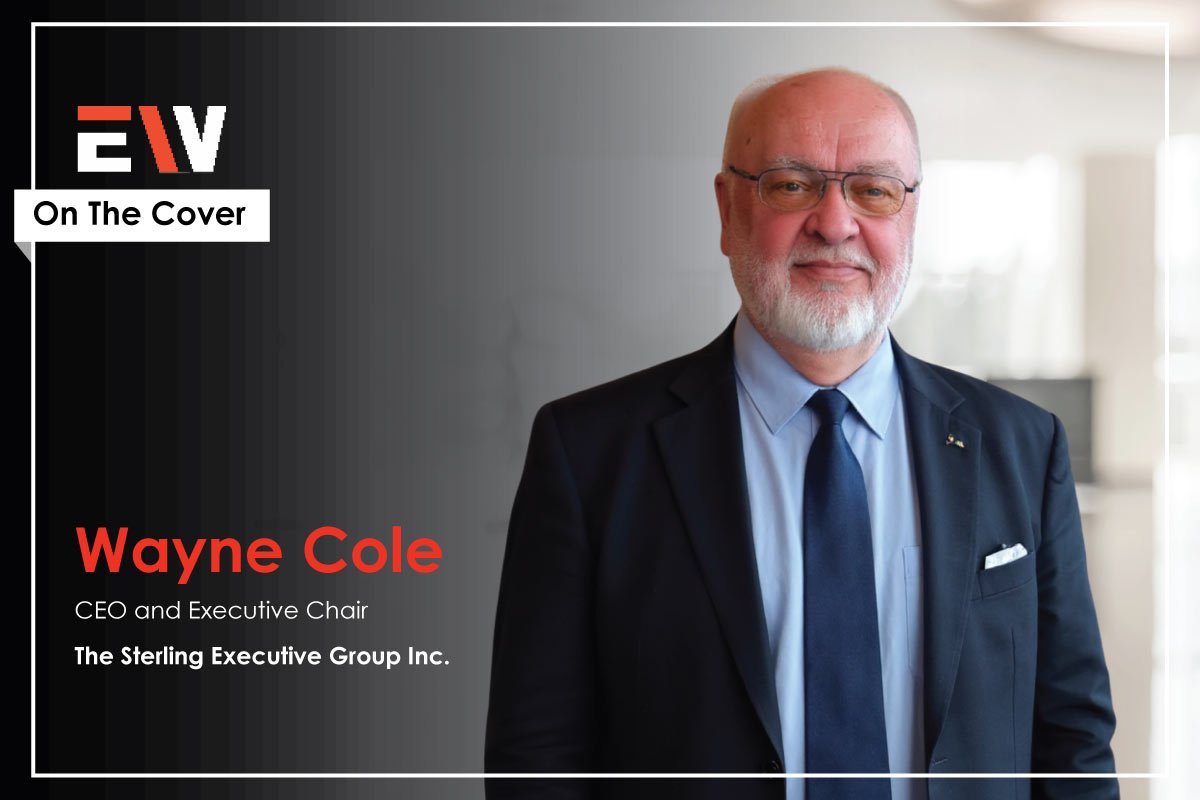
Leadership is becoming increasingly challenging to execute effectively, and yet it is also becoming easier to accomplish alone. Distributed teams, faster decision-making processes, and constant change have heightened the risks of poor judgment, slow execution, and untested assumptions. In this climate, the most successful leaders are not those who gather more ideas; they are the ones who operate with greater clarity, stronger discipline, and a more dependable system for translating insight into action.
The Sterling Executive Group was established as a countermeasure: a confidential, chair-led peer system where non-competing CEOs and C-level leaders pressure-test real decisions, commit to action, and deliver results. Wayne Cole, CEO and Executive Chair of The Sterling Executive Group Inc., exemplifies this modern approach to executive development. With decades of experience across startups, mergers and acquisitions, financial management, and growth-stage execution, Wayne Cole has helped shape a leadership model designed for today’s hybrid economy, where virtual leadership capability is no longer optional.
Why CEOs and C-Level Leaders Join Sterling
Sterling is designed for leaders who want to make better decisions in real-time and achieve stronger execution between meetings. Members join to:
- Improve decision quality and speed under pressure
- Pressure-test assumptions with non-competing peers beyond their local market
- Convert insight into action through chair-led one-on-one follow-through
- Build leadership tradecraft that works in hybrid and virtual settings
- Operate with candour and confidentiality protected by rigorous curation and standards
- Eliminate travel while increasing consistency, cadence, and accountability
What Is an Executive Peer Group—and How Sterling Works
An executive peer group is a confidential forum where non-competing CEOs and C-level leaders meet regularly – typically on a monthly basis – to address real business and leadership challenges. Unlike networking groups, which prioritize connections, or one-to-one executive coaching, which is inherently limited to a single perspective, peer groups are designed around collective experience. Members bring live operating issues to the table, peers challenge assumptions based on firsthand leadership experience, and a trained chair ensures discussions remain decision-focused and result in concrete commitments.
Sterling applies this structure with rigour. Cohorts are carefully curated, sessions follow a disciplined operating rhythm, and chair-led one-on-one conversations between meetings support the work. The result is not simply insight, but follow-through—leaders return with clearer priorities, stronger decision frameworks, and measurable progress.
Wayne Cole’s Leadership Journey: Trust, Insight, and Action

Wayne Cole’s journey with Sterling has been both enriching and deeply practical. Serving as a peer group chair for more than eight years – across both in-person and virtual formats – reinforced his belief that experiential peer learning only works when trust is designed rather than assumed. When executed well, the model creates confidentiality, candour, and practical insight: the conditions where executives can think clearly, challenge assumptions, and make confident decisions.
With Sterling, Wayne Cole set out to build a pan-Canadian, virtual-first model that preserves what makes peer learning powerful while removing barriers that limit traditional groups. Geography, travel, and inconsistent participation often dilute the value of legacy peer models. Sterling was designed to sustain depth and standards while expanding access to the right peers regardless of location.
The Sterling Advantage: A System Built for Outcomes
Sterling’s differentiators are not standalone features; each is engineered to produce a specific leadership outcome and reduce predictable failure modes in executive peer groups.
- Pan-Canadian cohorts → sharper judgment – By bringing together leaders from across Canada, Sterling creates intellectual diversity that reduces local-market bias, minimizes regional politics, and improves pattern recognition. Leaders can test whether challenges are genuinely unique or common across industries and geographies.
- Curated, non-competing peers → candour without political cost – Careful member selection protects psychological safety, confidentiality, and candour, conditions essential for honest C-level dialogue and real problem-solving.
- Chair-led operating rhythm and one-on-one translation → execution, not insight – Between meetings, chairs work directly with members to translate peer insight into leadership-team action plans, priorities, and execution frameworks. Commitments are documented and revisited, transforming conversations into tangible progress.
- Virtual-first design → consistency and accessibility – Eliminating travel removes a significant barrier to reliable attendance. Leaders engage more consistently, maintain momentum, and gain access regardless of location, thereby extending leadership development beyond major metropolitan centers.
- Cognitive session design → clarity and retention – Meetings are structured to minimize fatigue, facilitate decision-making, and enhance retention. The focus remains on clarity, rather than the volume of discussion.
- Twelve to fifteen interactive workshops annually → repeatable tradecraft – These small, virtual sessions function as a practical curriculum without the conference model—no travel, limited participants, high relevance, and immediate application.
Together, these elements form a leadership development system designed to compound capability over time rather than deliver isolated moments of inspiration.
What Membership Looks Like in Practice: From Intake to Impact
Sterling membership is designed to feel less like “joining a group” and more like installing a leadership operating system—one that improves decision quality, follow-through, and leadership-team performance over time. The model is intentionally pragmatic: it assumes you are already carrying a full load, and it respects that your most valuable development happens when you are working on real decisions, not hypothetical case studies.
Membership begins with fit and curation. Sterling treats cohort composition as a primary lever of value, not an administrative step. The intake process focuses on leadership scope, decision context, business complexity, and the kind of peer challenge that will be most useful. The objective is simple: place each leader into a non-competing cohort where candour is safe, comparisons are relevant, and the “signal-to-noise ratio” stays high.
Once inside, Sterling’s operating rhythm creates continuity—one of the most overlooked drivers of executive development. Many leaders have attended excellent events that created a moment of insight, but little sustained change. Sterling is designed to produce compounding return through repetition: leaders bring decisions, peers pressure-test assumptions, commitments are made, and the chair supports translation into execution before the next session.
What You Take Away Each Month
In most executive environments, leaders are surrounded by input but starved for high-quality challenge. Sterling provides an environment where challenge is not adversarial; it is productive. Each meeting is structured to convert complex situations into a small set of clear decisions and subsequent actions. Leaders leave with:
- A sharper definition of the real problem. – Many C-level issues present as strategic or operational but are actually leadership-system constraints: unclear decision rights, insufficient bench strength, misaligned incentives, weak cadence, or unresolved conflict. Sterling peers help identify what is truly causal versus what is merely visible.
- Better assumptions and cleaner options. – The peer cohort functions as a “decision lab.” Members test alternatives, identify blind spots, and stress-test narratives to refine their understanding of the issues. A key differentiator is that peers are not trapped in the same local market or industry mythology. They can challenge what insiders are too close to see.
- A commitment you can execute—not just a conclusion. – Sterling’s sessions are designed to end in commitments, not commentary. The output is clarity on what you will do next, what you will stop doing, what you will communicate, and what you will ask of your leadership team.
- Chair-led translation into leadership-team action. – This is where Sterling separates itself from groups that end at discussion. Between meetings, the chair works directly with you to convert peer insight into execution: clarifying priorities, tightening accountabilities, improving meeting cadence, strengthening role clarity, and building a practical plan that fits your organization’s reality.
The Chair as a Force Multiplier
Sterling chairs are not passive facilitators. They protect standards, manage airtime, keep sessions decision-focused, and prevent the group from drifting into “club dynamics.” In many peer environments, the group’s value depends on the personalities and chemistry of its members. Sterling’s model depends on design and discipline, which makes value more consistent across cohorts and over time.
The chair also provides a critical benefit that many CEOs quietly need: a trusted, experienced counterpart who helps them think through how to communicate decisions, sequence change, and manage the human side of leadership without losing momentum. In practice, this turns the peer cohort into a leadership performance system rather than a monthly discussion forum.
Why Virtual Strengthens the Model When It’s Done Properly
Virtual is not a compromise inside Sterling’s design; it is a performance decision. When travel is removed, attendance becomes reliable, and cost is reduced. When attendance becomes reliable, the group builds continuity. When continuity exists, accountability becomes real. And when accountability becomes real, leaders take action sooner.
In addition, the virtual format produces a subtle advantage: it reduces performative dynamics. Leaders can arrive focused, operate in a disciplined structure, and return to execution without losing a day to transit. For many senior executives, that is the difference between development as an aspiration and development as an operational practice.
Sterling does not claim that virtual is inherently better. It claims something narrower and more defensible: virtual leadership is a required competency in a hybrid economy, and leaders develop it most effectively through repeated, high-quality practice in an environment designed for outcomes. The longer leaders wait to build this capability, the more they will encounter friction in alignment, accountability, culture, and decision velocity.
The Workshops as a Practical Curriculum (Without the Conference Theatre)
Sterling’s 12–15 interactive workshops each year add a second layer of value: targeted leadership tradecraft that leaders can immediately apply. They are intentionally small, practical, and discussion-forward, designed to produce usable tools, not just “good content.” Members do not attend as spectators. They participate as operators, integrating ideas into decisions, cadence, and leadership-team behaviour.
Who does Sterling work best for
Sterling delivers the highest value to leaders who recognize a simple truth: the next level of performance is rarely achieved by working harder; it is achieved by improving the system through which decisions are made and executed. It is particularly effective for CEOs and C-level executives who are:
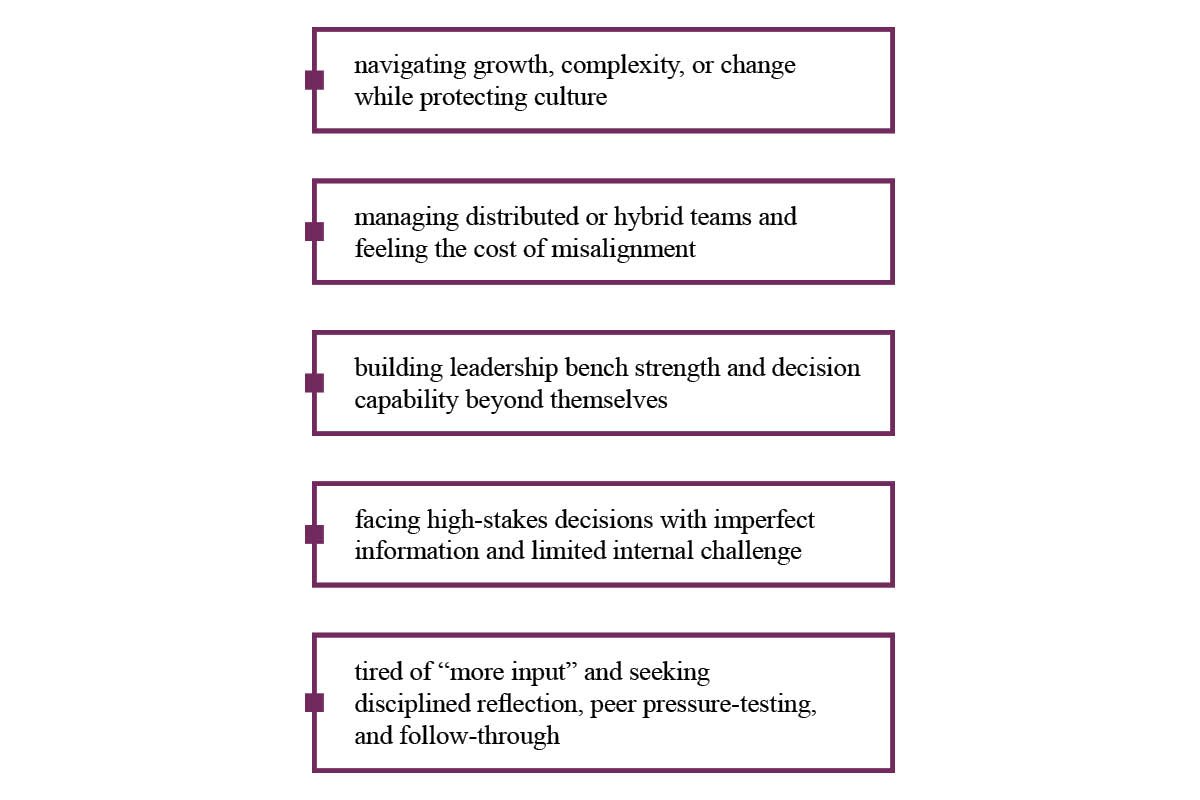
- navigating growth, complexity, or change while protecting culture
- managing distributed or hybrid teams and feeling the cost of misalignment
- building leadership bench strength and decision capability beyond themselves
- facing high-stakes decisions with imperfect information and limited internal challenge
- tired of “more input” and seeking disciplined reflection, peer pressure-testing, and follow-through
A Clear Next Step
Sterling is not for everyone, and that is by design. The best way to determine fit is through a short exploratory conversation focused on your decision context, leadership team realities, and what kind of peer environment would most effectively strengthen your execution. If you are a CEO or C-level leader seeking a confidential, high-rigour system to enhance decision quality and foster leadership capability over time, Sterling is designed for that purpose.
The Virtual Question:
What Skeptics Get Wrong—and What They’re Right About
Many senior leaders still hesitate when they hear “virtual.” Their concerns are not irrational. Poorly designed virtual meetings can be draining, impersonal, and unfocused. Sterling’s position is that virtual can be ineffective—unless it is engineered for outcomes.
“Trust isn’t created by proximity,” Wayne Cole emphasizes. “Standards, confidentiality, and cadence create it.” Sterling designs these intentionally: non-competing cohorts, enforced confidentiality, clear behavioural expectations, and disciplined facilitation.
Some leaders worry about losing hallway conversations. Sterling’s answer is direct: hallway interaction can be valuable, but it is not a system for decision support. Sterling replaces “hallway luck” with a reliable operating rhythm, documented commitments, and chair follow-through that helps leaders translate insight into execution.
Others equate in-person with seriousness. Sterling reframes seriousness as outcomes. When travel is removed, participation increases, continuity strengthens, and accountability becomes more consistent. The work becomes more reliable, not less.
When top business schools such as Harvard, Wharton, and MIT deliver flagship executive programs in blended and live-online formats, it signals a significant shift: virtual leadership is now a core competency. Sterling develops that capability through repeated peer practice and disciplined accountability; precisely the conditions leaders need to operate effectively in a hybrid world.
Modern Leadership Focused on Decisions, Leadership Systems, and Tradecraft
Today’s leaders face unprecedented cultural and operational shifts. Teams are distributed, feedback cycles are shorter, work-from-home is firmly embedded, and tolerance for ambiguity is lower. Leaders must deliver results while building sustainable cultures—including in virtual settings.
Sterling supports executives in two ways. First, pan-Canadian cohorts broaden perspective, helping leaders distinguish between local assumptions and universal leadership realities. Second, Sterling emphasizes leadership tradecraft: repeatable skills that work across various contexts, including expectation-setting, accountability without burnout, conflict resolution, decision-making, and leadership bench development. The goal is not more theory, but better decisions in real time.
Common Leadership Blind Spots—and Sterling’s Two-Layer Coaching Approach
Wayne Cole consistently sees blind spots at the C-level: activity mistaken for progress, underdeveloped leadership systems, delayed difficult conversations, and local-market tunnel vision.
Sterling addresses these through a two-layer coaching approach. Peer cohorts provide challenge, comparison, and pattern recognition. Chair-led one-on-one conversations translate insight into execution plans and operating discipline. “Blind spots surface faster when peers aren’t from your local market,” Wayne Cole notes, “and action follows because accountability is built into the rhythm.”
Turning Clarity Into Momentum
Wayne Cole’s personal philosophy is simple: “Clarity creates momentum.” He believes most executives do not need more ideas; they need a sharper thinking environment that converts complexity into clear decisions, and a disciplined cadence that turns decisions into action.
A typical example illustrates Sterling’s impact. A CEO may arrive with a sound growth strategy but stalled execution. Peers often identify the fundamental constraint: the leadership team’s capacity, role clarity, accountability, and decision-making authority. The chair then helps translate these insights into an actionable plan, clarifying responsibilities, establishing an operating rhythm, and tightening accountability.
In the next cycle, the CEO returns with renewed momentum. The business has not become easier; the leadership system has become stronger. Wayne Cole describes Sterling at its best as “peer insight, disciplined facilitation, and coached translation into execution.”
Looking Ahead: Trusted, Pan-Canadian Leadership Support in 2026 and Beyond
In 2026, Sterling Executive Group will focus on expanding access while preserving the quality that defines its programs. Priorities include growing pan-Canadian cohorts, enhancing chair capabilities, and deepening the integration of one-on-one coaching as a core value for members.
Sterling will also continue offering 12 to 15 virtual speaker workshops annually. These small, interactive sessions are designed for practical application rather than spectacle. Unlike traditional conferences, these invitation-only workshops require no travel, involve a limited number of participants, and provide highly relevant content that members can apply immediately within their respective cohorts.
For CEOs and C-level executives seeking a confidential, high-rigour environment to pressure-test decisions, strengthen leadership systems, and build tradecraft for hybrid leadership, Sterling offers a disciplined peer system free from geographic and travel constraints. In a hybrid economy, the question is no longer whether virtual leadership matters. The question is whether you are building it intentionally.
The leaders who thrive in the next decade will not be defined by how much they know, but by how well they make decisions—and how consistently their organizations execute those decisions. Sterling was built to support that work: a trusted, pan-Canadian peer environment with disciplined facilitation and chair-led translation into action. For CEOs and C-level executives seeking to refine their judgment, enhance leadership systems, and develop virtual leadership capabilities through repeated practice, the next step is a brief conversation to explore fit and cohort alignment.