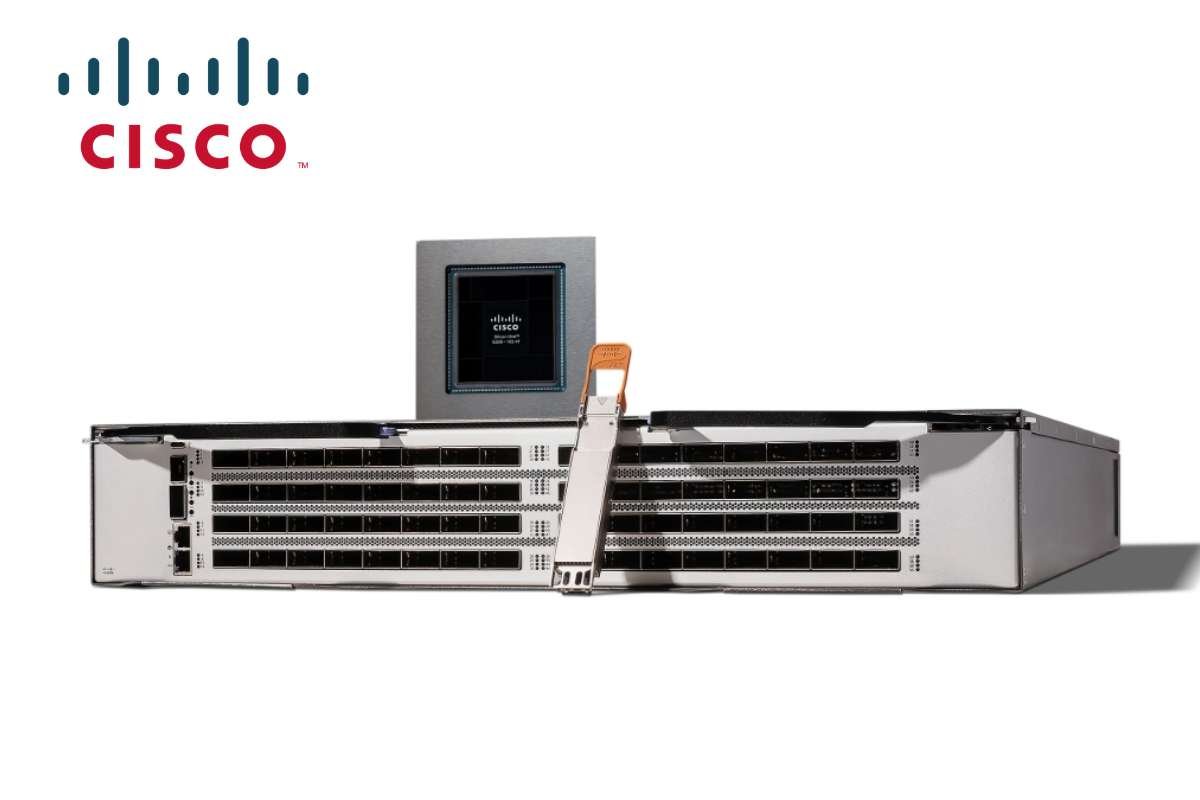
Cisco launch Silicon One G300 as it introduced its new networking chip along with updated switching and optical products, marking a significant step in its strategy to expand its presence in the AI networking market.
G300 Chip Targets High-Capacity AI Infrastructure
The G300 chip was presented at Cisco Live EMEA in Amsterdam. It delivers 102.4 terabits per second of Ethernet capacity and supports up to 512 Ethernet ports per chip. Each port can operate at 1.6 terabits per second, enabling connectivity for more graphics processing units at the network edge.
The chip debuts in Cisco N9000 and 8000 switches, which use liquid cooling to improve power efficiency. These systems are designed to support demanding AI training and inference workloads, where network speed and reliability directly affect the return on investment in graphics processing units.
Cisco states that the G300 delivers measurable performance gains. According to company leadership, the chip enables higher network utilization and faster job completion times compared to infrastructure that is not optimized for AI workloads. The company positions the chip as a foundation for linking massive AI clusters inside data centerss, highlighting the Cisco launch Silicon One G300.
The launch is part of a broader redesign of Cisco’s AI networking portfolio. The updated Nexus switch line now integrates with the Nexus Dashboard management platform. Over the past year, Cisco has also unified elements of its data center and AI networking systems and introduced Nexus One Fabric to converge key networking software platforms.
Optical Expansion And Intensifying Market Competition
Alongside the G300, Cisco announced new optical modules and expanded systems powered by Silicon One P200. These include 1.6 terabit OSFP optics and 800 gigabit Linear Pluggable Optics modules. The company says these modules aim to improve performance and reduce power consumption in modern data centers.
The new P200-powered N9000 systems and expanded operating system support on 8223 systems provide data center interconnect, spine, core, and peer routing capabilities. These systems are targeted at hyperscale cloud providers, service providers, and enterprise customers building infrastructure focused on AI.
Cisco’s strategy reflects the increasing importance of networking in AI deployments. As AI clusters grow, network throughput, congestion management, and telemetry become critical factors. Following the Cisco launch Silicon One G300 on February 10, 2026, the company’s new 102.4 Tbps silicon includes a larger, fully shared 252MB packet buffer designed to absorb traffic bursts 2.5 times better than industry alternatives and reduce slowdowns to graphics processing units. It also features hardware-based “Intelligent Collective Networking” for path-based load balancing and enhanced telemetry to support traffic management and network optimization at speeds 100,000x faster than software-based tuning.
The announcements place Cisco in direct competition with other major players in AI networking, including NVIDIA and Arista Networks. NVIDIA offers networking systems built around its own silicon and data processing units, while Arista relies heavily on Broadcom silicon in its high capacity switches. Each vendor emphasizes different strengths, such as throughput, congestion control, or integration across hardware and software.
Cisco is also building a more integrated platform approach. The company has expanded its AgenticOps management capabilities, which use a Deep Network Model to provide natural language insights into network operations. New features include automated troubleshooting, continuous optimization, improved observability, and enhanced automation tools for service provider networks.
Security remains part of the broader portfolio. Updates to Cisco AI Defense include centralized visibility for AI software assets, model testing enhancements, and tools designed to detect threats across AI-driven environments.
Following the major Cisco launch Silicon One G300 at Cisco Live 2026, the company is bridging the gap between hardware and software. For entrepreneurs and business owners investing in AI infrastructure, Cisco’s latest releases signal a push toward tighter integration of silicon, switching, optics, software, and security. As AI workloads continue to scale, the competition among networking vendors is expected to focus on performance, efficiency, and operational simplicity.