The Agile Software Development Life Cycle (ASDLC) is the blueprint. It transforms an undeveloped concept into a workable reality. Especially useful in the high-stakes world of modern software engineering. This procedure is used to follow a strict, straight line. Picture it as a huge ship that is difficult to maneuver once it leaves port. However, the industry shifted toward the Agile SDLC. A model founded on the principles. Such as continuous iteration, radical flexibility, and smooth collaboration. As the digital landscape grew more unstable.
Agile is now more than just a technical approach. It’s a global innovation language. It is utilized everywhere from Silicon Valley to Tokyo. By segmenting intricate projects into feasible “sprints.” It enables teams to instantly adjust to changing market demands and cultural norms. More than just a success story. Agile SDLC changed the way software is developed. This is the reason why your favorite apps get better every week.
What is the Agile Software Development Life Cycle?
The traditional, linear SDLC is rethought as a continuous loop of evolution. By the dynamic framework known as the Agile Software Development Life Cycle. Agile fits into the larger context as a method for handling uncertainty. Whereas traditional models frequently depend on a “big bang” release. By dividing complicated projects into manageable “sprints.” They usually last two to four weeks, and it operates as an incremental and iterative model.
Frameworks like Extreme Programming (XP), Scrum, and Kanban. They fall under the agile umbrella. And they offer the structure needed for this quick delivery. Agile perfectly satisfies modern global expectations by highlighting frequent feedback over strict documentation. This allows developers to freely innovate. And businesses receive high-value software that can quickly adapt to meet market demands. It is the best way to remain competitive in the rapidly evolving digital economy.
Origin of Agile:
The foundations of the Agile Software Development Life Cycle trace back to 2001. In Snowbird, Utah. This is where 17 software practitioners met. And they address the limitations of rigid development models. This gathering led to the creation of the Agile Manifesto. It is a short but influential document that introduced four core values. Individuals and interactions over processes and tools. Working software over comprehensive documentation. Customer collaboration over contract negotiation. And lastly, responding to change by following a plan. These principles reshaped modern software engineering. And continue to guide agile frameworks like Scrum, Kanban, and Extreme Programming worldwide.
Core Principles of Agile Software Development Life Cycle:
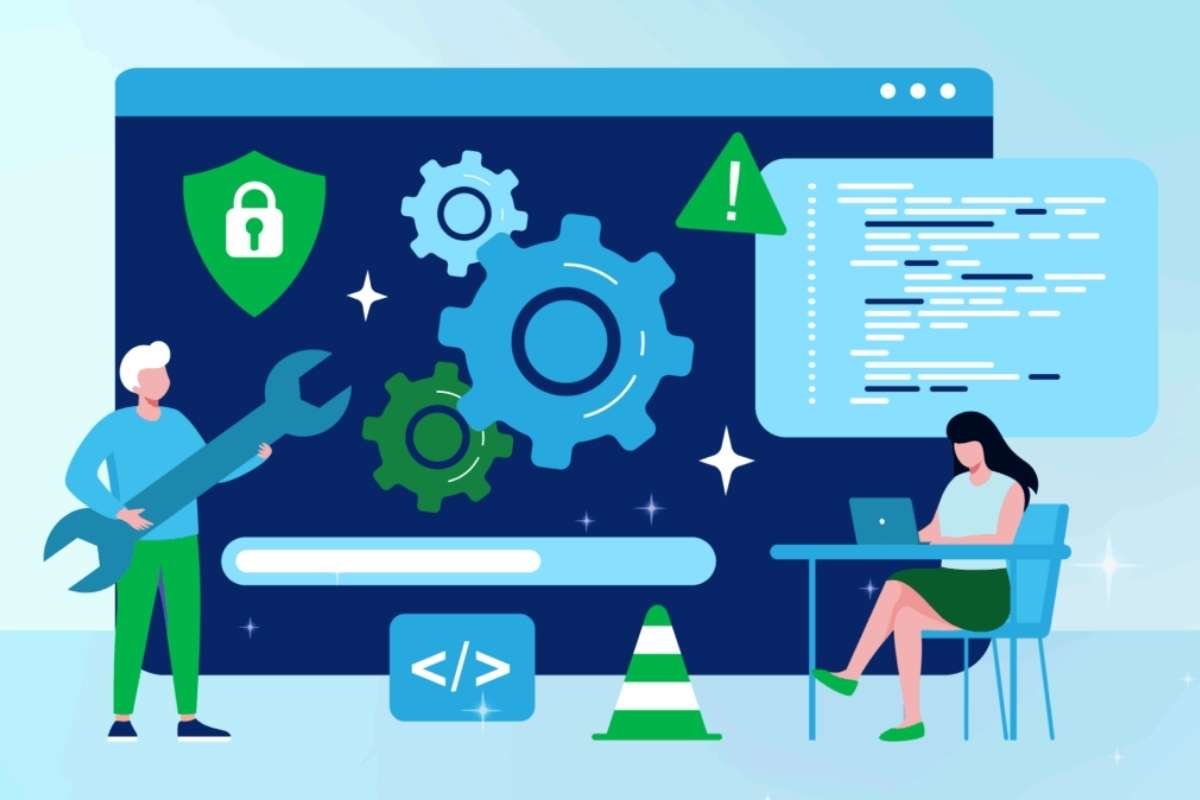
The Agile SDLC prioritizes flexibility over strict planning. Agile is based on five fundamental principles. As opposed to traditional models that reveal a finished product only at the very end:
- Iterative & Incremental Delivery: Projects are divided into short “sprints.” Instead of one massive launch. You get a series of working software versions. It ensures value is delivered early and often.
- Customer & Stakeholder Collaboration: Rather than working in a vacuum. The developers engage in constant feedback loops with users. This reduces guesswork. It also ensures the final product actually solves the user’s problems.
- Embracing Change: Agile thrives on volatility. It welcomes evolving requirements, even late in the development process. This allows teams to pivot based on new data or shifting market trends.
- Cross-Functional & Empowered Teams: Small, self-organizing teams own the entire process. It starts from planning to execution. This autonomy boosts morale. Also, ensuring that those closest to the code are making the key decisions.
- Continuous Improvement: Through “Retrospectives,” teams analyze their performance after every sprint. This commitment to “Kaizen” (continuous improvement). It ensures the process becomes leaner and more efficient over time.
Roles in Agile Software Development Life Cycle:
Agile success isn’t just about processes. It’s about a highly synchronized “human ecosystem.” Where distinct roles collaborate to drive value.
- Product Owner: The visionary who manages the product backlog. They help in ensuring the team works on the highest-priority features first.
- Scrum Master / Agile Coach: The facilitator who protects the team from distractions. They also help remove technical or “process” roadblocks. They also ensure agile principles are followed.
- Development Team: A cross-functional powerhouse of engineers, designers, and testers. They turn backlog items into functional software increments.
- Stakeholders & Users: The external compass provides the feedback. It is necessary to refine features and ensure market fit.
During a Sprint Planning session. These roles converge: the Product Owner presents the “what.” The Development Team determines the “how” (and how much they can handle). Along with the Scrum Master, ensures the plan is realistic and focused.
Advantages of Agile Software Development Life Cycle:
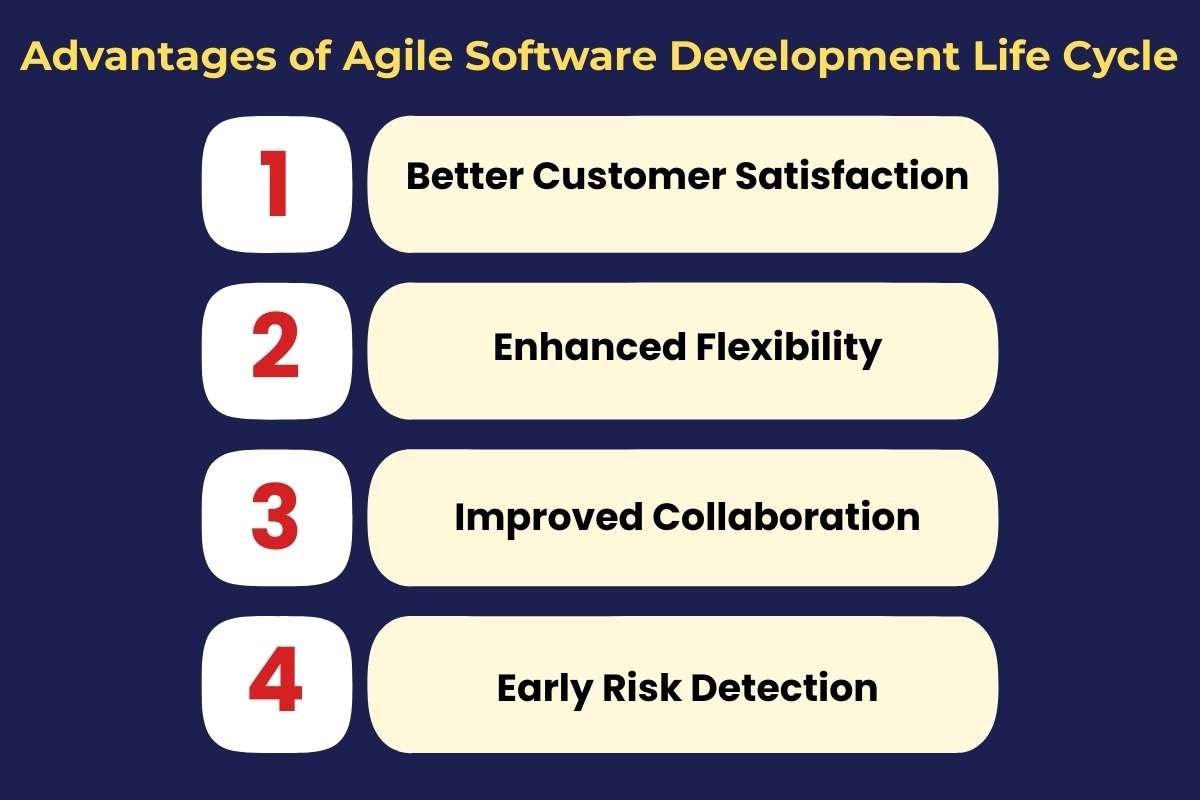
Adopting the Agile SDLC offers competitive advantages. They resonate across global markets, from startups to tech giants. Its primary strength lies in Faster Time-to-Market. By releasing functional increments early. Businesses realize value long before a project is “finished.”
- Better Customer Satisfaction: Continuous involvement ensures the final product mirrors user needs. And not just initial (and potentially outdated) specifications.
- Enhanced Flexibility: In a volatile economy, Agile treats change as a competitive advantage. Rather than a costly disruption.
- Improved Collaboration: By breaking down silos. Agile fosters a culture of shared ownership and transparent communication.
- Early Risk Detection: Because testing happens. During every sprint, rather than at the end. Technical debt and critical bugs are captured before they become expensive disasters.
Agile transforms software development from a rigid mechanical process. And turn it into a living, breathing evolution.
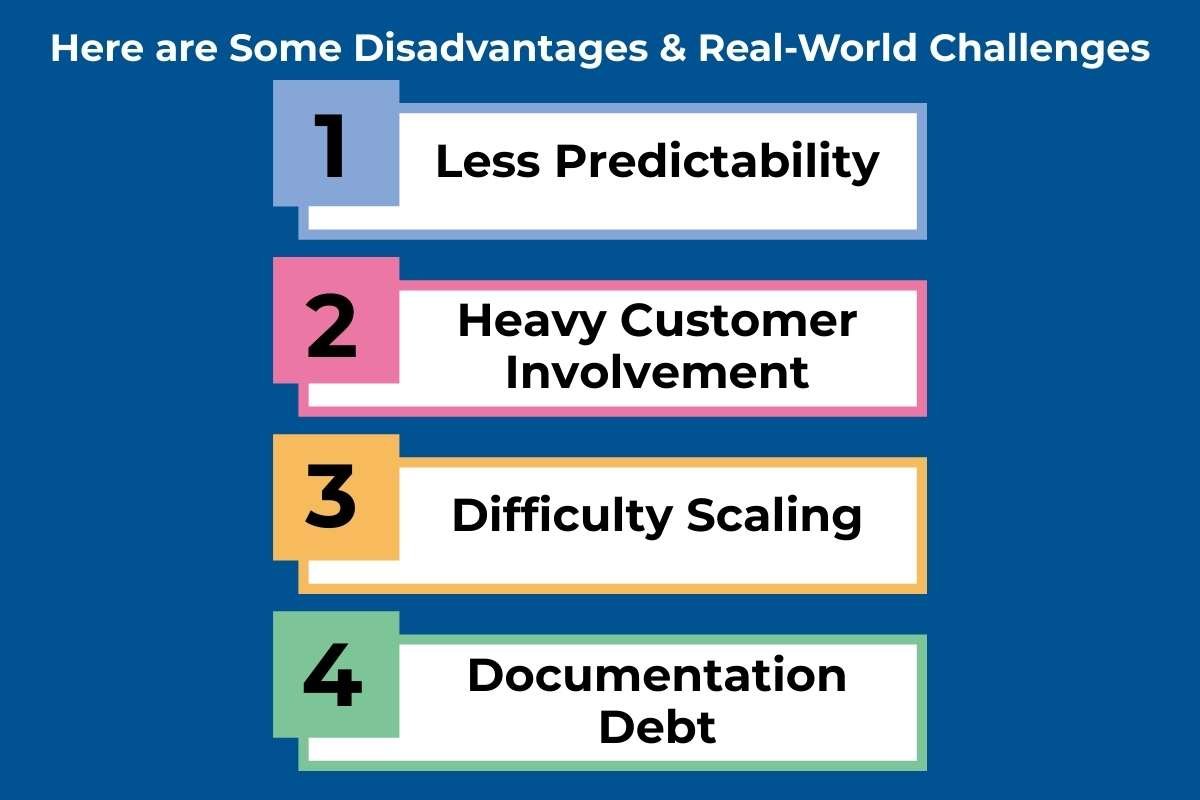
Here are Some Disadvantages & Real-World Challenges:
While Agile is powerful, it is not a universal “silver bullet.” Transitioning to an Agile SDLC requires a cultural shift. Many organizations find it difficult to navigate.
- Less Predictability: Because requirements evolve. It’s notoriously difficult to provide fixed budgets or definitive long-term timelines. Stakeholders accustomed to “fixed-price” contracts may find this ambiguity unsettling.
- Heavy Customer Involvement: Agile breathes through feedback. If your stakeholders or users aren’t available for regular demos or “Sprints.” Then the feedback loop breaks, leading to a product that misses the mark.
- Difficulty Scaling: In massive organizations with thousands of developers. They are coordinating dozens of independent Scrum teams. Without losing alignment is a monumental task. It often requires complex frameworks like SAFe or LeSS.
- Documentation Debt: Agile prioritizes “working software over comprehensive documentation.” While efficient, this can haunt a project later. Especially during maintenance, audits, or when onboarding new engineers who lack historical context.
Real-World Pitfall:
Many teams fall into “Waterscrumfall.” Where they use Sprints for development. But still requires months of rigid “upfront” planning and a separate, heavy “testing” phase at the end. This hybrid often results in the stress of Agile without any of its speed.
Agile SDLC vs. Waterfall Model:
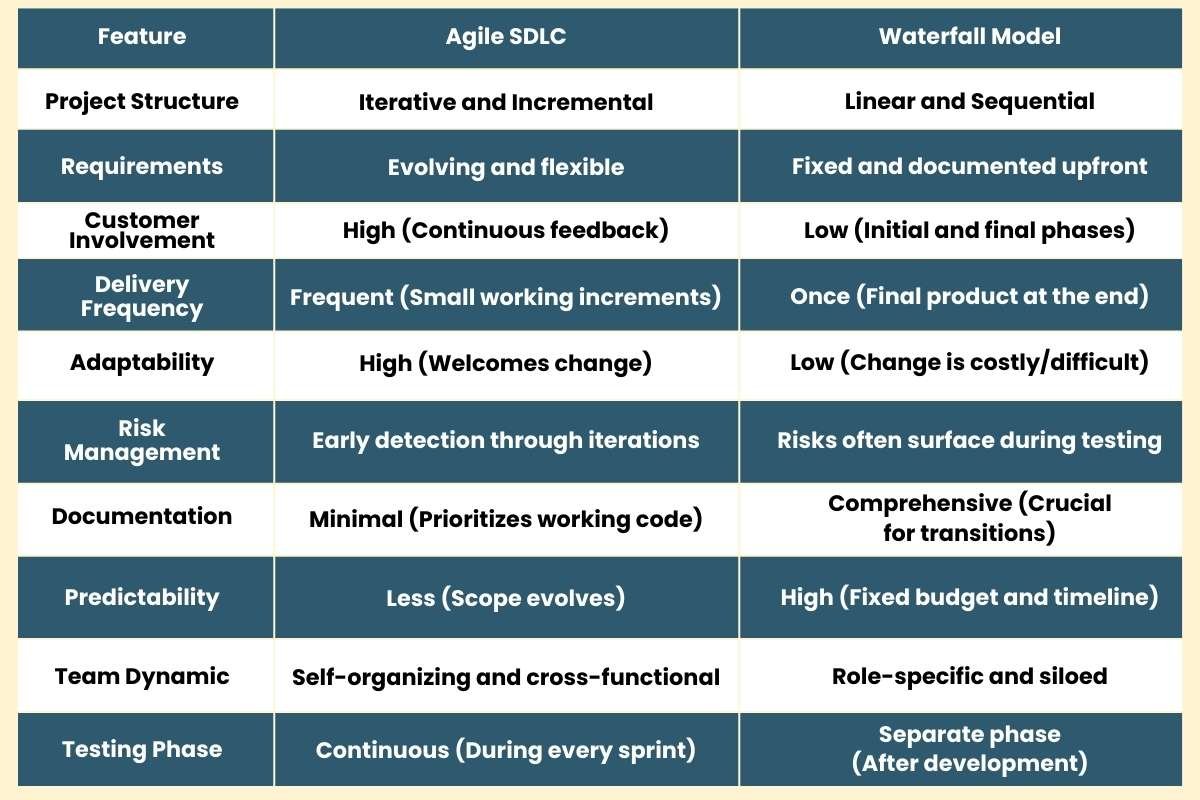
Choosing between Agile and Waterfall depends on your project’s DNA. Waterfall is a linear, “measure twice, cut once” journey. It excels when requirements are fixed. The documentation is a legal necessity, and the scope is crystal clear from day one.
In contrast, the Agile SDLC is built for the unknown. It thrives on discovery, allowing teams to build, test, and pivot in rapid cycles. While Waterfall provides a predictable roadmap. Agile acts as a high-performance GPS, recalculating the route as market conditions change.
| Feature | Agile SDLC | Waterfall Model |
| Project Structure | Iterative and Incremental | Linear and Sequential |
| Requirements | Evolving and flexible | Fixed and documented upfront |
| Customer Involvement | High (Continuous feedback) | Low (Initial and final phases) |
| Delivery Frequency | Frequent (Small working increments) | Once (Final product at the end) |
| Adaptability | High (Welcomes change) | Low (Change is costly/difficult) |
| Risk Management | Early detection through iterations | Risks often surface during testing |
| Documentation | Minimal (Prioritizes working code) | Comprehensive (Crucial for transitions) |
| Predictability | Less (Scope evolves) | High (Fixed budget and timeline) |
| Team Dynamic | Self-organizing and cross-functional | Role-specific and siloed |
| Testing Phase | Continuous (During every sprint) | Separate phase (After development) |
Real-life Case Examples:
To see the Agile Software Development Life Cycle in action. As it helps to look at companies that transitioned from rigid plans. And transform them to fluid, iterative releases. These examples highlight how Agile solves specific business problems.
1. Spotify: The “Squad” Model
They organized into Squads (small, cross-functional teams). With Tribes (groups of squads) and Guilds (communities of interest).
- The Approach: They organized into Squads (small, cross-functional teams), Tribes (groups of squads), and Guilds (communities of interest).
- Agile Benefit: This allowed them to test new features, like “Discover Weekly.” It focused on small groups of users. It helps gather data and iterate quickly without affecting the entire platform.
2. Cisco: Subscription Billing Platform
Cisco traditionally used Waterfall for its massive infrastructure projects. However, when building their Next-Generation Billing Platform. They switched to the Scaled Agile Framework (SAFe).
- The Approach: They moved from long, multi-month release cycles to bi-weekly “sprints.”
- Agile Benefit: Cisco reported a 40% reduction in critical defects. It is a significant increase in employee satisfaction. Because teams felt more empowered and less overwhelmed by “big bang” deadlines.
Conclusion:
Writing code is only one aspect of the Agile Software Development Life Cycle. It is a clever method for groups to collaborate and remain adaptable. Businesses can create better tools more quickly. If you are taking small steps and paying attention to users. The benefits are worth the effort, even though mastery requires practice. You get more contented teams and products that people genuinely enjoy using. Agile makes it easy to navigate the unknown, whether you’re creating a massive system or a tiny app.
FAQ:
1. What is the Agile Software Development Life Cycle in simple terms?
The Agile Software Development Life Cycle is an iterative and incremental approach. To build software where projects are divided into small, manageable units called sprints. Instead of delivering the entire product at once. Teams release working features in cycles, gather feedback, and continuously improve. This approach prioritizes adaptability, collaboration, and faster value delivery over rigid planning.
2. Does Agile Software Development Life Cycle reduce project risk?
Yes. Agile delivers working software in short cycles. Along with teams, identify bugs, usability issues, and technical limitations early. This reduces the likelihood of large-scale failure. In comparison to models where testing happens only at the end.
3. Is documentation ignored in Agile?
No. Agile values “working software over comprehensive documentation,” but it does not eliminate documentation. It focuses on just enough documentation to maintain clarity without slowing down development. This balance ensures speed without sacrificing long-term maintainability.