
Enterprise technology refers to large-scale systems and platforms that help organizations manage operations, data, and workflows across departments. This article explains its key components and shows how they work together. It also covers why enterprise technology matters and the emerging trends shaping its future.
The deal should have been simple. The numbers were ready, the client was interested, and the team had done the work. But somewhere between departments, things slowed down. One team waited for confirmation, another worked with outdated data. What should have moved forward easily turned into a series of follow-ups and fixes. Moments like this reveal how disconnected systems can hold everything back.
Enterprise technology refers to the systems, tools, and platforms that large organizations use to run their operations. These technologies help teams manage data and support daily work across departments. They allow businesses to handle large-scale tasks with speed and control, while keeping information accurate and easy to access.
In the end, it brings structure and alignment across the business, so information flows clearly, and decisions happen without unnecessary friction.
What are the key components of enterprise technology?
It works as a connected system. It is a combination of layers that support how a business runs every day. These layers include hardware, software, and infrastructure. Each has a clear role, but their real value shows when they work together.
1. Hardware
Hardware forms the physical base of enterprise technology. It includes servers, storage devices, employee systems, and networking equipment. These components handle data processing and keep operations running in the background.
For Example: a large e-commerce company depends on powerful servers to manage thousands of orders at the same time. Employees use laptops or desktops to access systems and complete tasks. Even basic network devices help maintain stable communication across teams.
Many organizations now rely on cloud providers instead of maintaining physical systems on-site. This allows them to scale resources based on demand. If traffic increases, they can expand capacity without installing new machines. Even with this shift, hardware remains essential. If this layer slows down, everything built on top of it feels the impact.
2. Software
Software gives hardware its purpose. This is where most business activity happens. Enterprise software includes tools that help manage operations, customer relationships, and internal workflows.
For Example: A retail company like a fashion brand uses enterprise software to track inventory in real time across all its stores and warehouses. When a customer buys a product in one city, the system updates stock levels instantly across every location. At the same time, the sales team can view customer purchase history and send targeted offers based on past behavior, all within the same connected system.
Enterprise software connects different parts of the organization. Teams can access shared data instead of working in isolation. This improves coordination and reduces confusion. It also helps leaders make decisions based on real-time information.
Unlike basic applications, enterprise software is built for scale. It supports multiple users, integrates with other systems, and handles large volumes of data. As the business grows, the software grows with it.
3. Infrastructure
Infrastructure brings everything together. It ensures that hardware and software work as one system. Without it, even the best tools would struggle to function properly.
For Example: a global consulting firm with teams in Mumbai, London, and New York relies on cloud infrastructure to access the same project files in real time. When a consultant updates a client report in one location, the changes appear instantly for the rest of the team.
At the same time, secure networks ensure that only authorized employees can access this data, even when they are working remotely.
Cloud infrastructure allows people to work from anywhere while maintaining performance. It also supports data backup and recovery, which protects the business from unexpected failures.
Security is a key part of infrastructure. It manages access and protects sensitive data from threats. This is critical because enterprise systems often handle important business and customer information.
When these three components work together, they create a system that is stable, flexible, and ready to scale.
Hardware provides the power.
Software delivers the functionality.
Infrastructure keeps everything connected.
Understanding this relationship helps businesses build technology that supports both current needs and future growth.
Why does enterprise technology matter?

It matters because modern organizations run on interconnected systems, distributed teams, and constant data exchange. Without a unified structure, work becomes fragmented, decisions slow down, and growth introduces operational chaos instead of control and clarity.
1. Operational efficiency
Enterprise technology improves efficiency by removing manual dependencies across workflows. Tasks move through predefined systems where steps are automated or standardized, which reduces repetitive effort and minimizes delays caused by human coordination.
It also reduces task switching between disconnected tools, allowing employees to complete work in fewer cycles with fewer interruptions. Over time, this creates a smoother operational rhythm where output increases without proportional increases in effort.
2. System integration
It integrates separate tools and platforms into a single operational ecosystem. Instead of data being stored and processed in isolated systems, enterprise architecture enables continuous flow across departments.
This reduces duplication of work, prevents mismatched records, and removes the need for repeated data entry across multiple systems. Integration also ensures that updates in one part of the system are reflected everywhere else, which improves consistency and reduces operational friction during cross-functional work.
3. Data accuracy and reliability
Enterprise systems improve data quality by centralizing storage and standardizing how information is captured and processed. This reduces the risk of conflicting records created by manual inputs or disconnected applications.
With structured data pipelines, errors are identified earlier, and inconsistencies are minimized before they spread across systems. As a result, organizations operate with a more reliable information base, which strengthens confidence in reporting and analysis across all levels of decision-making.
4. Faster execution cycles
Execution becomes faster because enterprise systems remove unnecessary dependencies between tasks. Instead of waiting for approvals, updates, or manual transfers across tools, processes move automatically through connected workflows.
This reduces idle time between stages of work and eliminates delays caused by missing or misaligned information. The result is a continuous execution flow where teams spend more time producing outcomes and less time resolving operational blockers.
5. Scalable infrastructure
Enterprise technology supports growth by design, allowing systems to handle increased users, data volume, and operational complexity without requiring structural redesign. As demand increases, additional capacity can be added within the same framework without breaking existing workflows.
This prevents bottlenecks that typically arise when systems are stretched beyond their limits. It also allows organizations to expand into new markets or functions without rebuilding their core technology stack.
6. Decision clarity
Decision-making improves because enterprise systems consolidate data from multiple functions into a unified view. This reduces reliance on fragmented reports or delayed information streams. Leaders can evaluate performance using consistent and current data, which reduces uncertainty and improves strategic accuracy. With fewer inconsistencies in inputs, decisions become faster and more aligned with actual operational conditions rather than assumptions or partial visibility.
7. Process discipline
Enterprise systems enforce structured workflows that guide how tasks are executed across teams.
This reduces reliance on individual interpretation or informal processes that can vary from person to person.
By standardizing execution paths, organizations maintain consistency in output quality and reduce errors caused by deviation from established procedures. This also makes operations easier to audit, measure, and improve over time since processes remain predictable and traceable.
8. Cross-functional alignment
Teams become more aligned because they operate within shared systems and data environments. Information does not remain locked within departments, which reduces delays caused by miscommunication or missing context.
When all functions access the same operational data, coordination becomes more direct and less dependent on manual updates. This improves synchronization between teams such as operations, sales, and finance, ensuring they move in the same direction with fewer conflicts.
9. Cost control over time
Although enterprise systems require upfront investment, they reduce long-term operational costs by eliminating inefficiencies. Automation reduces labor-intensive tasks, integration reduces duplication, and structured workflows reduce rework.
Over time, this leads to more predictable resource usage and lower waste across operations. The financial benefit comes not from cutting capability, but from improving how efficiently existing resources are used.
10. Operational stability
Enterprise technology creates a controlled environment where systems define how work flows rather than ad hoc processes. This reduces unpredictability caused by inconsistent execution or disconnected tools.
Even under increased load or complexity, structured systems maintain stability by distributing tasks across scalable infrastructure. This ensures that performance remains consistent, and operational breakdowns are minimized even as organizational demands grow.
What are the challenges in enterprise technology?
This technology brings scale and control, but implementing and managing it is not simple. Most challenges come from cost, complexity, people, and system alignment. These issues often overlap and affect each other if not handled carefully.
1. High implementation and maintenance cost
Enterprise systems require significant upfront investment in software, hardware, integration, and long-term support. Costs also continue after deployment due to upgrades, licenses, and maintenance.
Tips to improve:
- Prioritize systems based on business impact instead of adopting everything at once
- Use cloud-based solutions to reduce infrastructure costs
- Plan phased rollouts instead of full-scale deployment
- Track ROI at each implementation stage
2. Integration with legacy systems
Many organizations already use older systems that are not designed to work with modern platforms. Connecting new technology with legacy infrastructure often creates compatibility issues and slows down implementation.
Tips to improve:
- Use middleware or API based integration layers
- Gradually replace outdated systems instead of full replacement
- Map existing workflows before integration planning
- Standardize data formats across systems
3. Data security and compliance risks
Enterprise systems handle large volumes of sensitive data. This makes them a target for breaches and creates pressure to comply with regulations and internal policies.
Tips to improve:
- Implement role-based access control for all systems
- Regularly update security protocols and patches
- Conduct periodic security audits
- Encrypt sensitive data both in storage and in transfer
4. User adoption and training gaps
Even well-designed systems fail if employees do not use them properly. Lack of training or resistance to change often leads to underutilization of tools.
Tips to improve:
- Provide structured onboarding programs for new systems
- Offer continuous training instead of one-time sessions
- Create role-specific learning paths
- Collect user feedback and improve usability
5. System complexity and management overhead
As enterprise systems grow, they become complex to manage. Multiple tools, layers, and integrations can make troubleshooting and maintenance difficult.
Tips to improve:
- Consolidate tools where possible to reduce fragmentation
- Maintain clear documentation of system architecture
- Assign dedicated system owners for each platform
- Monitor system performance regularly to detect issues early
6. Scalability planning challenges
Even though enterprise systems are designed to scale, poor planning can lead to bottlenecks when demand increases rapidly.
Tips to improve:
- Design systems with future growth in mind, not just current needs
- Use a scalable cloud infrastructure with elastic resources
- Test system load capacity before scaling operations
- Avoid tightly coupled system dependencies
How is enterprise technology implemented across industries?
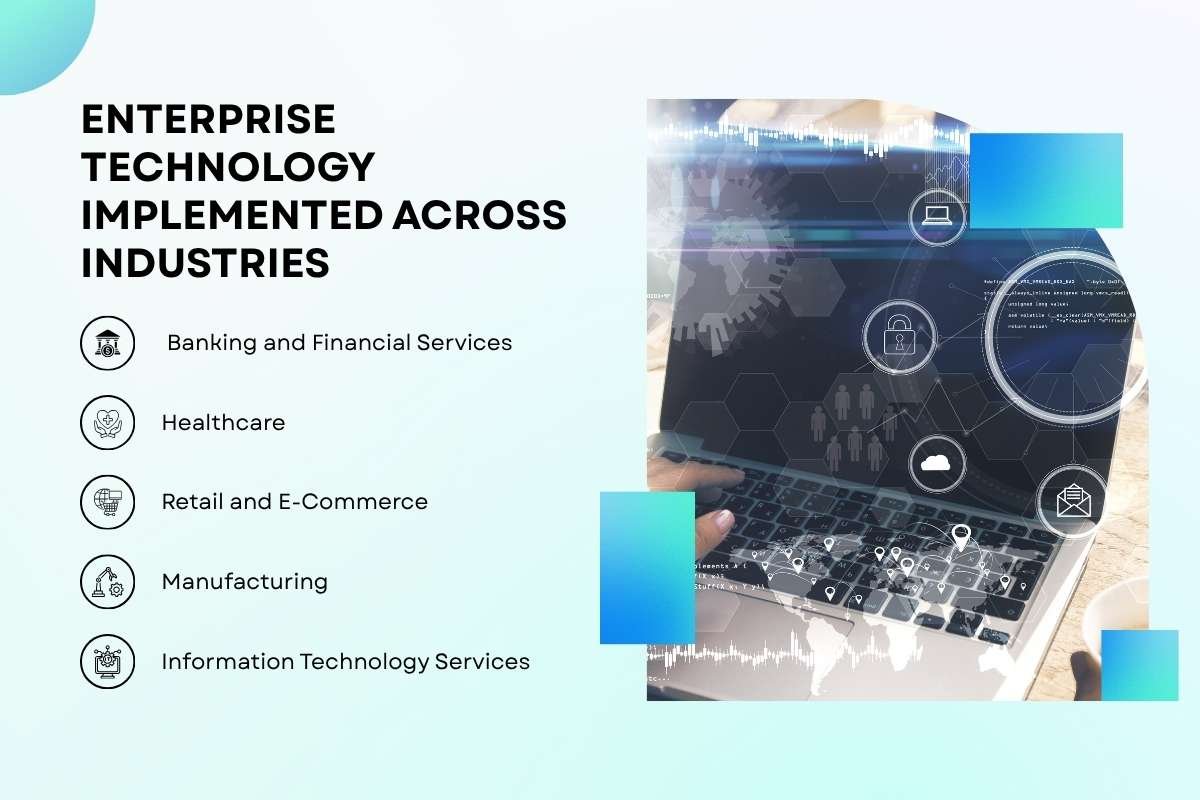
1. Banking and financial services
Enterprise technology is deeply integrated into banking systems to manage transactions, customer accounts, lending processes, and fraud detection. Core banking platforms process large volumes of financial data in real time while ensuring accuracy and regulatory compliance. Risk management systems analyze customer behavior and credit profiles to support faster and more reliable financial decisions.
Drawbacks:
The main drawback in this industry is system complexity and security exposure. Because banking platforms are highly interconnected, even small technical failures can disrupt services at scale. At the same time, centralized financial data becomes a high-value target for cyberattacks, increasing pressure on constant monitoring and security upgrades.
2. Healthcare
In healthcare, enterprise technology is used to manage electronic health records, hospital operations, and clinical coordination between departments. Patient data is stored in centralized systems that allow doctors, laboratories, and pharmacies to access consistent and updated information. This improves diagnosis speed, reduces duplication of tests, and supports better coordination across medical teams.
Drawbacks:
The key drawback in healthcare is integration and usability. Many hospitals still rely on older systems that are difficult to connect with modern platforms. At the same time, complex interfaces can slow down adoption among medical staff, especially when training is limited or time-constrained.
Also read: Wearable Health Monitors: Revolutionizing Personal Healthcare
3. Retail and E-Commerce
Retail and e-commerce companies use enterprise systems for inventory management, supply chain tracking, and customer behavior analysis. These platforms provide real time visibility into stock levels across multiple locations and help businesses adjust supply based on demand patterns. Customer data integration also supports targeted marketing and personalized recommendations.
Drawbacks:
A major drawback in this industry is dependency on data accuracy. If inventory or customer data is not updated correctly, it can lead to stock mismatches, delayed deliveries, or poor customer experience. High system dependency also means that any downtime directly affects sales operations.
4. Manufacturing
Manufacturing industries use enterprise technology to monitor production lines, manage supply chains, and track equipment performance. Sensors and connected systems provide real-time data on machine efficiency, helping detect faults early and reduce production downtime. Enterprise planning systems also coordinate procurement, production schedules, and distribution in a unified workflow.
Drawbacks:
The drawback here is the high implementation cost and operational disruption during transition. Installing connected systems and integrating legacy machinery requires significant investment. Production may also slow down during system upgrades or restructuring phases.
5. Information technology services
IT service companies use enterprise platforms for project management, cloud operations, software deployment, and client delivery tracking. These systems enable collaboration across distributed teams and help manage complex workflows across multiple projects. Automation tools also support testing, deployment, and system monitoring at scale.
Drawbacks:
The main drawback in this industry is system overload and tool fragmentation. As teams adopt multiple platforms for different functions, managing and integrating them becomes difficult. This can lead to inefficiencies and reduced visibility across projects if systems are not properly aligned.
How to build an enterprise technology strategy?
A strong strategy starts with understanding how technology supports real work inside an organization.
Step 1: Assess current operations
Step 2: Define clear business objectives
Step 3: Select core enterprise systems
Step 4: Build integration across departments
Step 5: Implement in controlled phases
Step 6: Train teams for ado ption
Step 7: Monitor and optimize continuously
Take the example of a magazine company. In a magazine company, operations span content creation, editing, publishing, advertising, and subscriber management. These functions often run in separate systems, which creates delays and inconsistencies. A structured strategy connects them into one coordinated workflow and improves overall efficiency.
Step 1: Assess current operations
The first step is to study how the magazine company currently functions. This includes editorial planning, writing workflows, editing cycles, ad sales processes, and distribution channels. Many teams rely on disconnected tools for drafting, approvals, and publishing, which creates delays and duplication of effort. Mapping these workflows helps identify gaps where technology can reduce manual work and improve coordination across departments.
Step 2: Define clear business objectives
Once current operations are understood, the next step is to define what the company wants to achieve. For a magazine business, this could include faster publishing cycles, improved collaboration between teams, better ad revenue tracking, and stronger subscriber engagement. These goals must guide technology decisions so that every system directly supports a measurable business outcome instead of adding unnecessary complexity.
Step 3: Select core enterprise systems
After defining goals, the company must choose the right systems to support them. A content management system becomes central for publishing workflows, while customer relationship management tools help manage subscribers and engagement. Advertising platforms support campaign tracking and revenue management. Each system must be evaluated based on scalability, integration ability, and ease of use across editorial, marketing, and sales teams.
Step 4: Build integration across departments
In most magazine companies, departments operate independently, which leads to data silos. Integration ensures that information flows across systems without manual transfers. For example, subscriber data can connect with content performance metrics to understand reader preferences. This creates a unified environment where editorial, marketing, and sales teams work with the same information instead of fragmented data sources.
Step 5: Implement in controlled phases
Enterprise technology should be introduced gradually rather than all at once. The magazine company can begin with core publishing systems, then move to subscriber management, and later integrate advertising platforms. A phased rollout reduces disruption and gives teams time to adjust. Each stage should be tested before moving forward to ensure stability and avoid operational breakdowns.
Step 6: Train teams for adoption
Technology only works when people use it effectively. Editorial teams, designers, and sales staff must be trained on how to use new systems in their daily tasks. Training should focus on real workflows such as publishing articles, managing subscriptions, and tracking campaigns. Continuous support helps reduce resistance and ensures consistent usage across departments.
Step 7: Monitor and optimize continuously
After implementation, the strategy must be continuously reviewed. The magazine company should track system performance, workflow efficiency, and user feedback. If delays or gaps appear, systems should be adjusted to improve performance. Over time, the technology stack should scale with growing readership, increased content output, and expanding revenue channels.
A well-structured strategy helps a magazine company operate as a connected system instead of isolated teams. It improves coordination, reduces delays, and supports sustainable growth through better use of technology.
Enterprise technology trends in 2026

A key trend is the shift toward AI-embedded enterprise systems.
The agentic AI market is poised to reach $45 billion by 2030.
Instead of using AI as a separate tool, companies are integrating it directly into ERP, CRM, and analytics platforms. This enables more automated workflows where systems can analyze data and trigger actions with minimal manual input.
Security and governance are becoming central to enterprise planning. As systems become more connected, AI companies are focusing on data control, model transparency, and compliance in regulated environments.
At the same time, businesses are placing a stronger emphasis on measurable ROI, ensuring that investments directly contribute to operational and financial outcomes.
Conclusion
Most operational delays do not come from a lack of effort. They come from gaps between systems that were never designed to work together. Over time, those small gaps add up and start affecting how quickly a business can move and decide.
Enterprise technology helps close those gaps by creating a connected environment where data, teams, and processes stay aligned. When that alignment is in place, work feels less fragmented, decisions become clearer, and the business is able to scale without losing control over how it operates.
FAQs
1. What does enterprise technology mean?
It refers to large-scale digital systems that help organizations manage operations, data, and communication more efficiently.
2. Why do businesses need integrated systems?
They help reduce errors, improve coordination between teams, and make decision-making faster and more accurate.
3. What are common types of these systems?
They include tools for resource planning, customer management, cloud computing, and data analytics.