Shifting buyer expectations mean traditional cold outreach no longer delivers reliable conversion rates. Implementing tailored B2B marketing strategies allows companies to connect with decision-makers through educational resources, active online communities, and direct personalized messaging.
These strategies include tracking clear buyer intent signals and focusing on first-party data, so marketing teams spot active deals earlier in the purchasing process. Delivering relevant answers to real buyer questions helps brands build authority and win long-term contracts.
12 B2B marketing strategies to build a stronger market position
B2B marketing requires more than reaching potential buyers through a single channel. Marketing teams need to build trust, communicate clear value, understand buyer behavior, and connect their campaigns with measurable business results.
The following B2B marketing strategies cover key areas such as omnichannel engagement, thought leadership, AI, personalization, partnerships, visual content, testing, and data privacy.
1. Integrated omnichannel approach
Successful B2B marketing strategies encompass a cohesive omnichannel approach. Seamless integration across various channels – website, email, social media, and offline interactions – ensures consistent messaging and a unified brand experience.
Best For: Businesses managing multiple customer touchpoints and long B2B buying journeys.
2. Emphasis on relationship building

B2B transactions often revolve around relationships. Cultivating long-term relationships through personalized interactions, exceptional customer service, and understanding client pain points is crucial in fostering loyalty and repeat business.
Best For: Companies selling high-value products or services with long-term client relationships.
3. Thought leadership and authority
Establishing thought leadership positions a company as an industry authority. Participating in industry events, speaking engagements, and contributing to reputable publications solidifies credibility and attracts potential clients.
Best For: B2B brands that want to build industry credibility and influence purchasing decisions.
4. Measuring success and ROI
Measuring the effectiveness of B2B marketing strategies involves tracking metrics aligned with specific goals. Key performance indicators (KPIs) such as lead generation, conversion rates, customer acquisition costs, and customer lifetime value help assess ROI and campaign success.
Best For: Marketing teams that need to connect campaigns with revenue and business outcomes.
5. The role of AI and personalization

Artificial intelligence (AI) plays a significant role in enhancing B2B marketing strategies. AI-driven analytics, predictive modeling, and personalized marketing automation enable more targeted and effective campaigns, optimizing results.
Best For: Companies handling large audiences that need scalable personalization and faster marketing decisions.
6. Sustainable and ethical marketing
In the contemporary landscape, ethical marketing practices and sustainability are gaining prominence. B2B companies are increasingly emphasizing corporate social responsibility (CSR) and aligning with sustainable initiatives, resonating with socially conscious clients.
7. Ecosystem collaboration
Collaboration within the B2B ecosystem fosters mutually beneficial relationships. Partnering with complementary businesses or industry influencers can expand reach, enhance credibility, and offer clients a comprehensive solution set.
Best For: Companies looking to expand their reach through strategic partners, industry experts, and complementary businesses.
8. Value proposition clarity
Communicating a clear and compelling value proposition is essential. Articulating how a product or service solves client challenges or adds value to their business distinguishes a company from competitors.
Best For: Businesses competing in crowded markets where buyers need a clear reason to choose them.
9. Thoughtful use of video and visual content

Video content continues to dominate in B2B marketing strategies. Incorporating videos, infographics, and visually appealing content into marketing strategies enhances engagement and effectively communicates complex information.
Best For: Companies selling complex products or services that benefit from demonstrations and visual explanations.
10. Influencer marketing in B2B
Utilizing industry influencers or thought leaders can amplify brand reach and credibility. Partnering with respected figures in the industry helps build trust and credibility among potential clients.
Best For: Brands seeking trusted industry voices to reach specialized audiences and strengthen credibility.
11. Experimentation and A/B testing
Experimenting with different strategies and conducting A/B tests allows marketers to optimize campaigns. Testing variables like messaging, visuals, and call-to-action buttons helps identify what resonates best with the audience.
Best For: Marketing teams with enough campaign activity to test messaging, creative, audiences, and conversion paths.
12. Compliance and data privacy

With increased scrutiny on data privacy, compliance with regulations like GDPR and CCPA is crucial. Implementing robust data protection measures and ensuring transparent data handling builds trust with clients.
Best For: B2B companies handling customer data across multiple markets, platforms, and marketing channels.
How AI is transforming B2B marketing in 2026
AI is changing how B2B marketers research audiences, create content, personalize campaigns, and measure results. Instead of relying only on broad customer segments, businesses can use AI to identify patterns in customer behavior and predict which prospects are more likely to convert.
AI tools can also help marketers create personalized emails, recommend content, score leads, analyze customer conversations, and automate routine tasks. AI search is also changing how buyers find information, making it important for brands to create clear, useful content that can appear in AI-generated answers.
B2B marketing KPIs that businesses should track
B2B marketing teams need to track metrics that connect marketing activity with actual business results. The right KPIs depend on the campaign goal, but a few metrics are useful across most B2B programs.
- Marketing Qualified Leads (MQLs): Measures prospects that meet defined marketing criteria.
- Conversion Rate: Shows how many prospects take the desired action.
- Customer Acquisition Cost (CAC): Measures the cost of gaining a new customer.
- Pipeline Contribution: Shows how much sales pipeline marketing helps generate.
- Customer Lifetime Value (CLV): Estimates the total value generated by a customer.
- Return on Marketing Investment (ROMI): Compares marketing costs with the revenue or value generated.
- Customer Retention Rate: Shows how effectively the business keeps existing customers.
Common B2B marketing mistakes to avoid
B2B marketing can lose effectiveness when businesses focus too much on generating leads and not enough on the quality of the buying experience. One common mistake is creating content that talks extensively about the company without addressing the buyer’s actual problems.
Other mistakes include targeting overly broad audiences, using the same message across every account, relying on vanity metrics, ignoring existing customers, and failing to align marketing with sales. Businesses should also avoid adding AI tools without clear goals, human review, or data governance.
How to build a B2B marketing strategy step-by-step
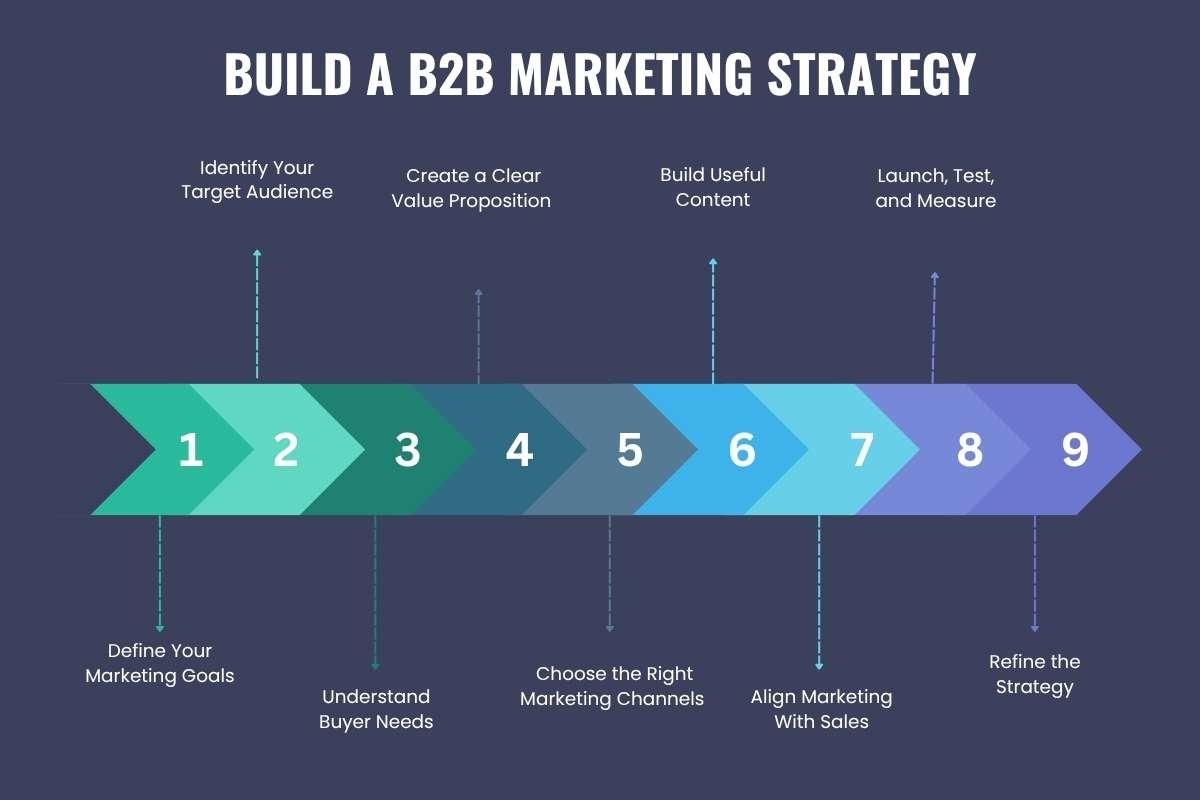
A strong B2B marketing strategy starts with a clear understanding of who you want to reach, what they need, and how your business can help. The process also requires clear goals, the right channels, useful content, and regular performance checks.
Step 1: Define your marketing goals
Set specific goals that connect marketing activity with business outcomes. These may include generating qualified leads, increasing pipeline contribution, improving conversion rates, or reducing customer acquisition costs.
Step 2: Identify your target audience
Define the companies and decision-makers you want to reach. Consider factors such as industry, company size, job role, business needs, and buying behavior. A clear audience makes it easier to create relevant messaging.
Step 3: Understand buyer needs
Research the problems, questions, and priorities that influence your target buyers. Use customer feedback, sales conversations, website behavior, and market research to understand what buyers need before they make a purchase.
Step 4: Create a clear value proposition
Explain what your business offers and why it matters to the target customer. Focus on the specific problem you solve, the value you provide, and the reason a buyer should consider your solution.
Step 5: Choose the right marketing channels
Select channels based on where your target audience researches and makes business decisions. Search, email, professional social networks, industry events, content marketing, and targeted advertising can all support B2B campaigns when used for the right audience.
Step 6: Build useful content
Create content that answers buyer questions and supports different stages of the purchasing process. Guides, case studies, reports, videos, webinars, and comparison content can help prospects evaluate their options and understand your expertise.
Step 7: Align marketing with sales
Marketing and sales should share clear definitions of qualified leads, buyer stages, and campaign goals. Regular communication also helps marketing teams understand which leads convert and which messages perform well with prospects.
Step 8: Launch, test, and measure
Track the KPIs that match your goals after launching campaigns. Test different messages, content formats, audiences, and calls to action, then use the results to improve future campaigns.
Step 9: Refine the strategy
B2B marketing requires ongoing adjustment as buyer behavior, campaign results, and business priorities change. Review performance regularly and invest more in the channels and messages that produce meaningful business results.
Conclusion
A successful approach to B2B marketing strategies requires clear alignment between sales targets, buyer research, and ongoing campaign execution. Evaluating core channels like account-based marketing, search optimization, and targeted lead nurturing gives teams a clear view of where growth occurs. Consistently refining messaging based on actual buyer behavior helps companies build sustainable pipelines, lower acquisition costs, and win long-term commercial accounts.
FAQs
1. What are B2B marketing strategies?
They are structured plans designed to promote products or services directly to other commercial organizations and business decision-makers.
2. How do B2B marketing strategies differ from consumer marketing?
B2B strategies focus on longer purchasing cycles, rational decision-making, and larger multi-person buying committees rather than impulse individual sales.
3. Which channels work best for B2B marketing?
Commonly used channels include search optimization, industry content, email nurturing, targeted digital advertising, and professional social networks like LinkedIn.
4. How do companies measure B2B marketing success?
Teams track key operational numbers such as pipeline generation velocity, customer acquisition cost, conversion rates, and total lifetime revenue per account.
5. How often should a company update its B2B marketing plan?
Most organizations review tactical performance monthly and adjust overarching strategy on a quarterly or annual schedule to adapt to changing market conditions.